Compare leading music video directors and creative approaches, from cinematic storytelling and fashion led pop to performance, documentary intimacy, surreal world building, and large scale productions.
The best music video director isn’t necessarily the most famous name on a festival shortlist. The right choice depends on the artist’s sound, audience, visual ambition, budget, schedule, and delivery needs. A performance-led pop single needs a different operator from an intimate alternative track, a fashion campaign, or a cinematic project built around locations and atmosphere.
That makes this a fit-based comparison, not a universal ranking. The list brings together international directors with distinct creative languages, alongside Image Studio’s Rome-and-Milan production model. Each profile considers signature style, standout work, production scale, platform deliverables, and practical suitability, so artists and labels can move from admiration to a workable hiring decision.
The market itself is broader than award coverage suggests. A 2025 independent wrap report covering 1,101 music videos identified 929 director credits, including 111 artists directing themselves, while only 114 non-self-directing people directed more than one video. Roughly 90% of credited directors made one video that year, which is a useful reminder that the best director for your release may be a specialist whose fit is stronger than their public profile. The 2025 Music Video Wrap Report captures that fragmented working reality.
1. Image Studio for Cinematic Music Video Production
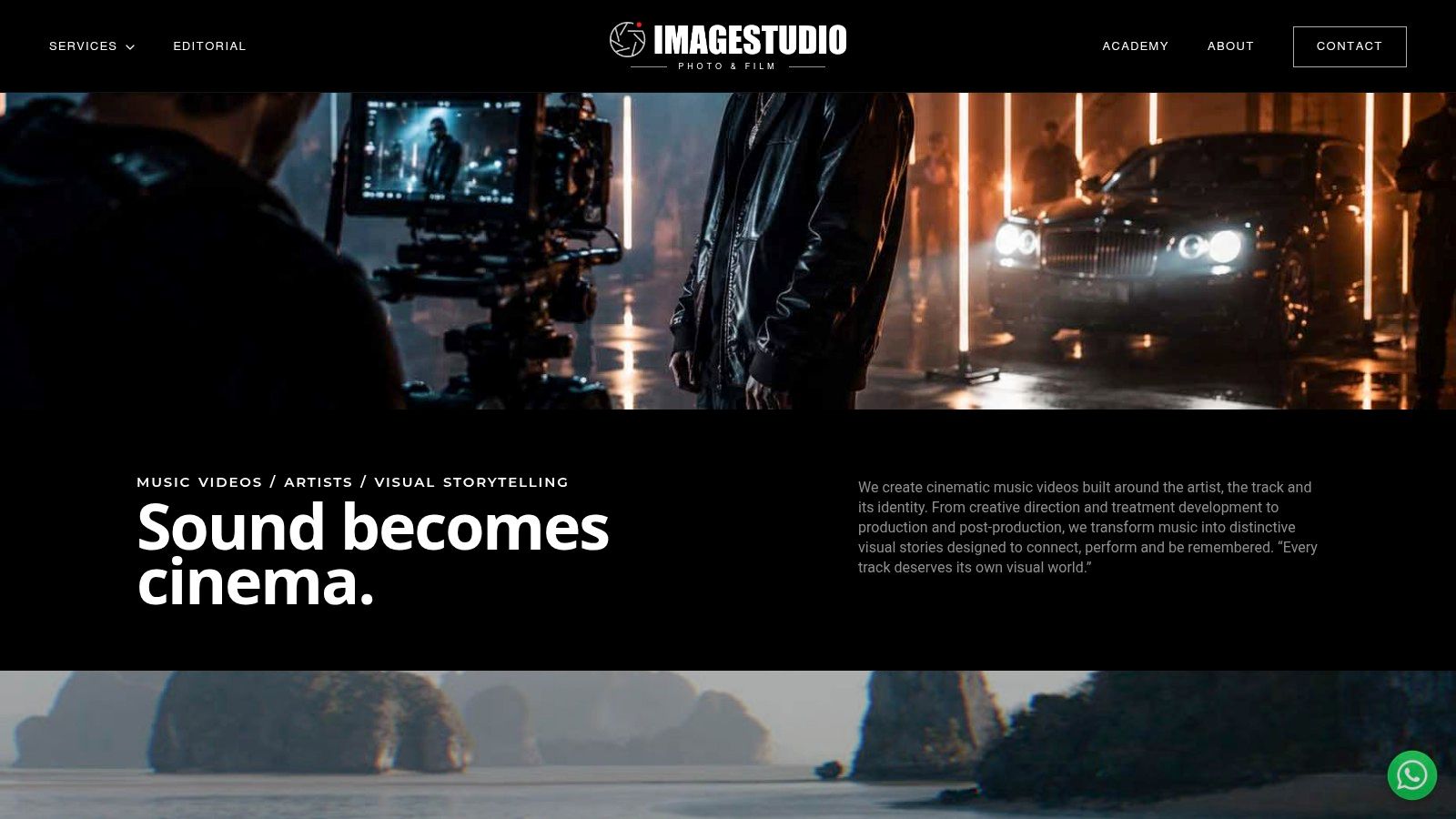
Image Studio suits artists and labels that need a cinematic short film and a platform-ready campaign asset from the same production. Its music video direction and production service covers creative direction, treatment development, pre-production, directing, cinematography, editing, color grading, sound design, and final delivery through one coordinated team.
The studio’s approach is fashion-forward, editorial, and narrative-driven. It fits songs that require atmosphere, character, location, and performance to operate as one visual system. A brief built around a single performance may need less infrastructure, while a concept with locations, designed sets, or multiple edits benefits from production and post-production being planned together.
Image Studio operates from Rome and Milan, coordinating Italian shoots, destination productions, and international work through its network of directors, cinematographers, editors, and creative collaborators. Its published materials cite 14+ years, 250+ projects, and content exceeding 150 million views across platforms. Those figures come from the studio’s own information, so they should be read as portfolio context rather than independent performance validation. The practical value lies in connecting treatment development, crew planning, location logistics, finishing, and delivery.
Best fit and trade-offs
Choose Image Studio for narrative, atmosphere-first, performance-led, fashion, or location-driven projects. The same visual system can support social edits, stills, and other campaign assets.
Production rule: A cinematic concept earns its budget only when the treatment, shoot plan, post workflow, and final deliverables serve the same audience objective.
The trade-off is a higher production commitment and a more defined creative language. Professional music video budgets commonly range from $500 to $5,000 for micro projects, $5,000 to $25,000 for independent productions, $25,000 to $150,000 for label-tier work, and above $150,000 for major campaigns, according to this production-market breakdown. Image Studio is better suited to briefs requiring production design, controlled cinematography, finishing, and logistical coordination than to deliberately lo-fi clips made for speed alone.
For teams comparing music video production companies, ask whether the project needs a director only or a production partner responsible for the treatment, shoot, post-production, and final master. That distinction should guide the shortlist before creative preferences do.
2. Director X for Mainstream Performance and Pop Impact
Director X, the professional name of Julien Christian Lutz, is a strong match for artists who need mainstream visibility, bold art direction, and tightly controlled performance. His work on Drake’s “Hotline Bling” and collaborations involving Rihanna demonstrate a pop-facing vocabulary built around memorable movement, color, framing, and cultural recognition. The result is designed to be understood quickly, but it isn’t visually anonymous.
His most useful skill is the ability to make talent look central while managing complex choreography and large-scale production. That matters for artists whose songs depend on performance energy, dance, celebrity presence, or a visual moment that can travel beyond the full-length video. His experience across music videos, commercials, film, and television also makes him suitable for a broader campaign where the main video needs to connect with brand films, teasers, or other promotional formats.
Where the choice works
Director X is particularly effective when the artist wants:
Performance authority: Precise blocking and choreography can keep a demanding routine legible on screen.
Pop-forward art direction: Color, set design, and graphic compositions give the release an immediate visual identity.
Campaign continuity: Cross-format experience can help align the music video with commercial or screen work.
Stakeholder confidence: A recognizable credit history helps labels, brands, and management teams assess fit before committing.
The main limitation is that this is a premium, highly stylized choice. Lead times and availability can be challenging, particularly when long-form projects occupy the director’s schedule. The visual language may also feel too polished for an artist whose appeal depends on rawness, understatement, or deliberately imperfect documentation.
A useful storytelling approach for music videos should clarify whether the artist needs a performance vehicle or a narrative with independent dramatic weight. Director X is strongest when the performance itself is the event and every visual decision amplifies that event.
Visit Director X Films to review the director’s current portfolio and inquiry route.
3. Tanu Muiño for Fashion-Led Global Pop
Tanu Muiño suits artists who want a high-energy pop film with fashion authority, kinetic camera movement, and replayable visual details. Her work associated with Harry Styles, Lil Nas X, Dua Lipa, and Doja Cat shows how editorial styling, choreography, color, and set design can operate as one pop grammar rather than separate departments.
The appeal isn’t just surface polish. Muiño’s strongest work gives performance a physical structure, then layers in styling and art direction that reward repeat viewing. That combination is useful for global pop releases, fashion partnerships, and songs that need a visual hook capable of moving through music platforms, social feeds, press coverage, and branded environments.
The production advantage
Muiño is a good choice when the creative team has a clear appetite for:
Fashion integration: Wardrobe, beauty, set, and camera can share one editorial point of view.
Sharp performance: Choreography and camera movement can make the artist’s physical presence carry the film.
Multi-market execution: Established production rosters across the United States, United Kingdom, and Europe support international briefs.
Cultural scale: High-visibility releases can give the video a place in a wider pop conversation.
This approach can escalate quickly. Elaborate styling changes, custom sets, choreography, crowd scenes, and effects each add time, crew requirements, and post-production complexity. The director is therefore less suitable for artists seeking a restrained, lo-fi narrative or a quick visual companion that leaves most of the budget in the music release itself.
Muiño’s work is a strong reference for artists who want the video to feel like a complete fashion and performance object, not merely a recorded song with attractive images. The hiring conversation should test whether the concept can survive production constraints without losing its central hook.
Review the current portfolio through UnderWonder before approaching representatives.
4. Hannah Lux Davis for Artist Branding and Multi-Format Pop
Hannah Lux Davis is a practical choice for artists who need glossy pop direction tied closely to identity, beauty, fashion, and campaign consistency. Her work with major female artists has established a visual approach that keeps the performer highly legible, often through controlled lighting, direct-to-camera moments, polished styling, and narrative beats that reinforce the artist’s public image.
That artist-first discipline is valuable when a label isn’t commissioning an isolated video. Davis also works across commercials and tour visuals, so the production can be planned as a wider system. A single shoot might need to generate the main video, short-form cuts, vertical material, tour screens, promotional moments, and stills, each with different pacing and framing requirements.
What to confirm before hiring
The strongest fit is a pop release where the artist’s face, styling, and brand language must remain clear across every version. Ask early about:
Master-video intent: Is the full piece built around a narrative, a performance, or a sequence of artist-branding moments?
Short-form extraction: Which shots and beats can become effective social edits without feeling like leftovers?
Tour integration: Can the visual grammar translate to wide screens, interstitials, and live-show content?
Approval structure: Who signs off on beauty, wardrobe, choreography, edit, color, and final delivery?
The trade-off is equally clear. A pop-gloss aesthetic won’t suit every genre, especially music built around abrasion, documentary intimacy, or underground texture. High-demand tentpole periods can also affect scheduling and rates, so a label should confirm availability before developing a treatment around the director’s name.
For artists prioritizing consistent presentation over visual risk, Davis may be a better match than a more experimental auteur. The finished video should make the artist’s identity stronger, not bury it under production design.
Explore the director’s work and contact details at Hannah Lux Davis.
5. Nabil for Documentary Intimacy and Emotional Restraint
Nabil Elderkin, known professionally as Nabil, is the right fit when a song needs mood, emotional proximity, and a photographic eye rather than constant spectacle. His work moves across avant-pop, hip-hop, and alternative music, with a visual sensibility grounded in composition, atmosphere, and human presence. The images can feel carefully made without becoming over-designed.
That restraint is a production strength. A director who understands documentary observation can give an artist room to inhabit a scene instead of forcing every moment into choreography or overt symbolism. Nabil’s experience with long-form and documentary projects also supports treatments with a stronger narrative spine, particularly when the video needs to connect with album artwork, editorial photography, or a wider artist profile.
Why the tonal range matters
Nabil can move from intimate portraits to larger-scale imagery while preserving a coherent emotional temperature. That flexibility makes him useful for artists who want an artful film with cultural edge, but don’t want a maximalist pop surface.
The best briefs for this approach define what the camera should notice. A song about absence, memory, identity, or place may benefit more from controlled blocking and observational detail than from expensive spectacle. Minimalist production doesn’t mean careless production. Locations, light, lens choice, casting, wardrobe, and edit rhythm still need deliberate coordination.
The limitation is that artists seeking instant visual impact through neon color, large choreography, or aggressive cutting may find the approach too measured. Availability can also be affected by long-form commitments. A treatment should therefore explain the emotional behavior of the film, not just collect moody references.
Nabil’s official portfolio is the place to judge the complete tonal range. Don’t select this style from one still. Watch how the director sustains feeling across the whole duration.
6. Anton Tammi for Surreal World-Building
Anton Tammi is a compelling choice for artists who want a recognizable visual universe, especially one built from neon-noir atmosphere, unusual motifs, and nonlinear storytelling. His work around The Weeknd’s After Hours cycle, including “Blinding Lights,” shows how several videos can reinforce a shared world instead of behaving like disconnected promotional clips.
That continuity is useful for an artist planning a release with multiple assets. A director-photographer can help align motion, stills, campaign imagery, and luxury or automotive partnerships, giving the audience repeated visual signals across formats. Night exteriors, controlled color, lensing, and movement can become part of the artist’s identity rather than a one-off treatment effect.
Strong concept, demanding execution
Tammi works best when the artist accepts that the video may operate through dream logic rather than literal explanation. The audience might remember a color, vehicle, gesture, or recurring location before they can summarize the plot. That ambiguity can create stronger world-building, but it requires confidence from the artist, label, and brand partners.
International scheduling across Europe and the United States can add logistical complexity. Night work, exterior choreography, specialty vehicles, weather-sensitive locations, stunts, and effects all require careful pre-production. A concept that looks simple in a treatment can become expensive once safety, permits, transport, lighting, and post-production enter the plan.
The director’s fashion and commercial experience is an advantage when an artist wants the music video to sit naturally beside luxury campaign imagery. It becomes a limitation when the brief needs a straightforward performance film with minimal visual interpretation.
See the current body of work at Anton Tammi. The right question isn’t whether the look is striking. It’s whether the artist has enough musical and visual material to support an entire world.
7. Jonas Åkerlund for Provocative Spectacle and Veteran Scale
Jonas Åkerlund fits artists and brands seeking provocative imagery, aggressive editorial rhythm, and high-production spectacle. His work with Madonna, including “Ray of Light,” and with Lady Gaga on “Paparazzi” and “Telephone,” reflects a director comfortable with bold concepts, heightened performance, confrontation, and visual worlds designed to generate discussion.
The broader production value comes from experience across music videos, concert films, series, features, and brand work. If the release may extend into tour capture, a concert film, or documentary material, that cross-medium background can help the team plan beyond the first upload. Effects-heavy concepts also benefit from a director who understands how to coordinate performance, practical production, editorial pace, and finishing.
When intensity helps or hurts
Åkerlund is a strong choice for artists who want the video to feel dangerous, theatrical, or deliberately confrontational. The approach can support a major release that needs a clear visual statement rather than a safe collection of attractive shots.
It isn’t automatically suitable for conservative brands or artists whose audience expects softness, realism, or understatement. Provocation must serve the song and the artist’s positioning, not replace a weak concept. Premium rates and senior availability constraints also make early conversations essential, particularly when the production requires complex locations, effects, or multiple capture formats.
A practical guide to directing a music video should begin with the song’s emotional contract with its audience. If the track promises danger, excess, or transformation, Åkerlund’s intensity may be the right amplification. If it promises intimacy, the same instincts could overwhelm the material.
Review the director’s current work at Jonas Åkerlund and ask representatives to distinguish the creative fee from production, post, travel, and additional campaign deliverables.
Top 7 Music Video Directors Comparison
Director / Service
Implementation complexity
Resource requirements
Expected outcomes
Ideal use cases
Key advantages
Music Video Director & Cinematic Music Video Production
High, full end-to-end production and coordination
Premium budgets; studio and location logistics (Rome/Milan); on-set and post teams
Cinematic, narrative-driven music videos; social- and broadcast-ready deliverables
Artists/labels wanting narrative, fashion-forward cinematic films and multiplatform assets
Full-service coordination; fashion/editorial aesthetic; proven track record and logistical flexibility
Director X (Julien Christian Lutz)
High, large crews and complex sets
High budgets; A-list talent scheduling; experienced production leadership
High, effects-heavy, fast-paced editorial and complex shoots
Veteran crews; advanced VFX/post; premium budgets
Provocative, conversation-driving videos and long-form content
Boundary-pushing artists, concert films and high-impact brand work
Legacy expertise; proven ability to execute complex, high-profile concepts
Turn a Creative Preference Into a Production Decision
Choosing the best music video director starts with the song, not the shortlist. Define the track’s emotional center, the artist’s role on camera, the audience you need to reach, and the visual behavior the video should create. A performance single might need choreography and instant readability. An alternative track may need observation, silence, texture, and time. A fashion-led release may need a director who can make styling, movement, set, and camera feel like one system.
Reduce the field to two or three compatible directors. Study complete treatments, finished videos, interview material, and relevant campaign work rather than selecting from isolated frames. Ask whether each director’s best-known work reflects what your song needs, or represents a look you admire.
Budget should be discussed before the treatment becomes expensive to defend. Production tiers commonly separate micro projects at $500 to $5,000, independent work at $5,000 to $25,000, label-tier productions at $25,000 to $150,000, and major campaigns above $150,000, according to this music video budget overview. Those ranges describe different capabilities, not just different levels of polish. Production design, choreography, VFX, large casts, multi-day shoots, travel, and finishing each change what the director can responsibly promise.
Request a delivery plan that names the master video, color grade, sound mix, captions, vertical edits, square or social crops, teasers, stills, and platform specifications. Music video demand is concentrated in the United States, India, Brazil, Germany, and Japan, which represented the top five country shares of views in 2023. The United States accounted for 32%, India 18%, Brazil 11%, Germany 7%, and Japan 5%, while the reported average music-video engagement rate was 4.2%, compared with 2.1% for other social content. The market overview supports a practical conclusion: the director and post team should design for mobile-first viewing, strong openings, visual novelty, and rewatchable performance moments.
Before signing, confirm crew, locations, permits, insurance, travel, post-production ownership, approvals, music and image rights, schedule, cancellation terms, and international logistics. Award history can help, but it isn’t the entire definition of quality. MTV’s Best Direction category has existed since 1984, and its records list Taylor Swift as the all-time leader with 4 wins, while David Fincher has 3. The Grammy music-video category was also first awarded in 1984, was originally called Best Short Form Music Video, and was shortened to Best Music Video in 2013. Those records show how directing gained institutional recognition, but a trophy doesn’t tell you whether a director can solve your locations, budget, performance style, or delivery requirements. See the MTV category history and Grammy category history for that context.
The UK Music Video Awards offer a useful working test. Their Best Director criteria focus on originality of concept, technical expertise and execution, and effectiveness in showcasing or promoting the music, while judging an exceptional body of work over the previous twelve months rather than one isolated clip. The category guidance is a strong framework for reviewing portfolios.
Representation also deserves attention. Female directors accounted for 19% of music video directors in 2023, up from 13% in 2020, according to this industry overview. A serious shortlist should consider creative fit and working quality without treating familiar names as the only credible options.
Image Studio is especially relevant for teams seeking coordinated cinematic direction and production from Rome and Milan across Italy or worldwide. Its end-to-end model can connect treatment development, cinematography, locations, post-production, color, sound, and social-ready delivery, which is often more useful than hiring a celebrated director without a production structure capable of executing the idea.
Visit Image Studio to discuss a cinematic music video built around your sound, visual identity, budget, and delivery plan. The Rome-and-Milan studio offers end-to-end direction and production, editorial cinematography, post-production, and platform-ready assets for artists, labels, and international campaigns.