Castle Wedding Photography in Italy: Beyond the Backdrop
October 20, 2026
Two Italian castles. Two very different wedding stories. Through original photographs from Castello di Rossino and Castello di Ristonchi, Image Studio explores how historic architecture, changing light and human connection shape memorable wedding photography.
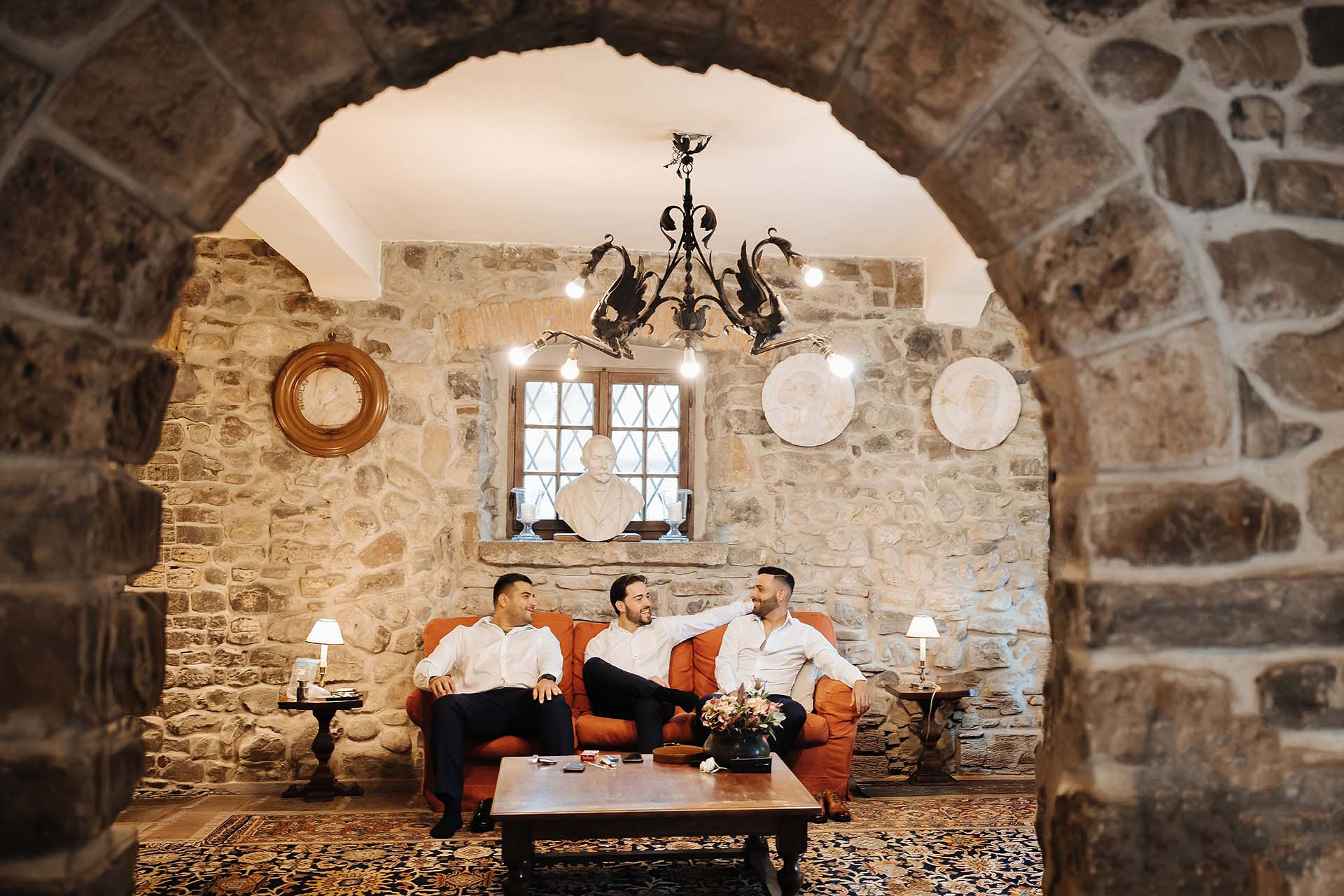
At Castello di Rossino, a stone arch frames three men sharing a quiet moment on a rust-coloured sofa. In another photograph from the same wedding, the bride and groom exchange rings against the texture of an old stone wall. Later, they walk back through the ceremony aisle smiling, surrounded by guests, flowers and movement.
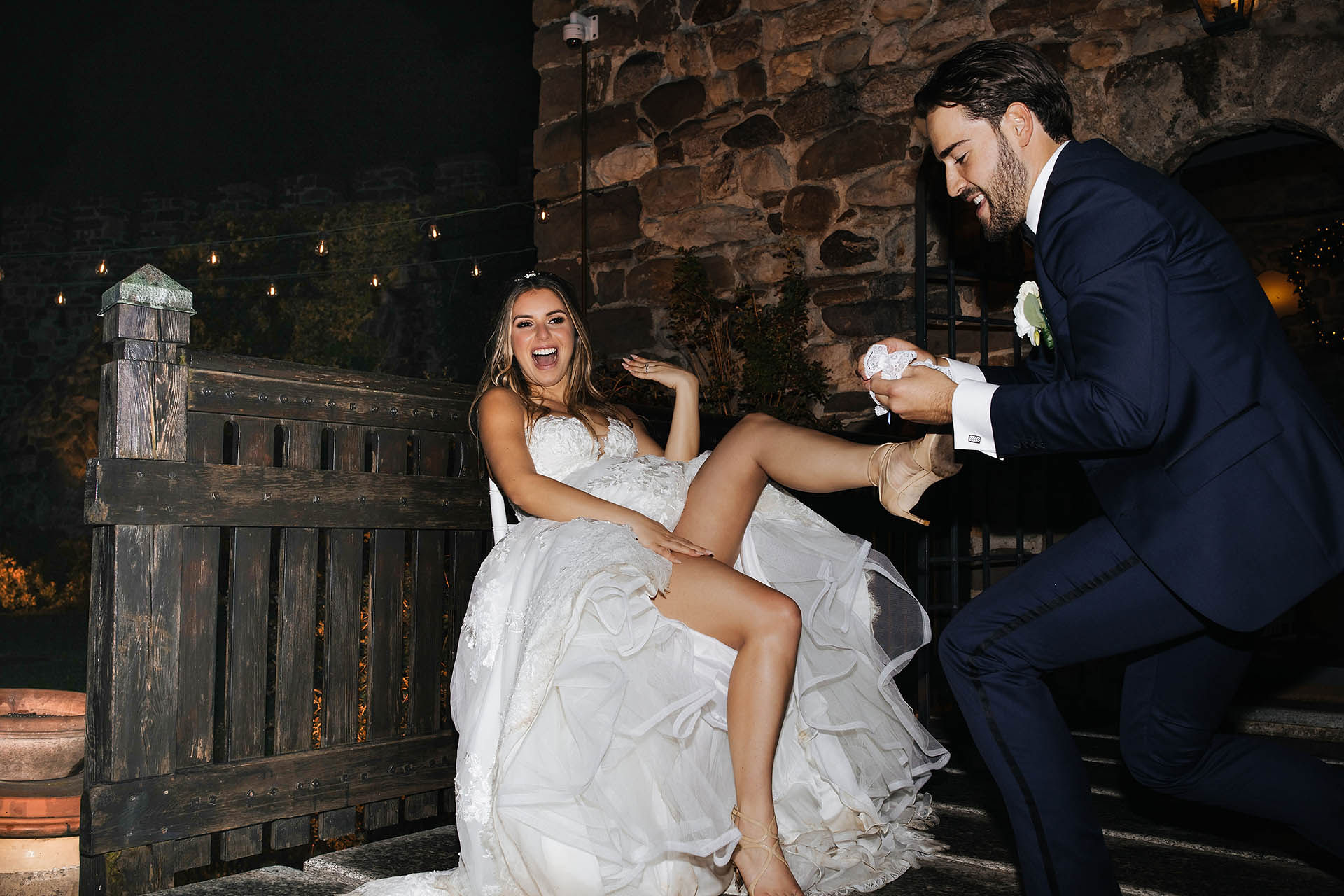
By the evening, the atmosphere has changed entirely. The formal portraits have given way to celebration, and there is a photograph of the bride laughing while the groom helps with her shoe.
These images belong to one wedding, but they reveal several different qualities of the same place. The historic interior provides character and depth. The ceremony brings the architecture into the story. As the celebration continues, the people become more important than the setting around them.
This is what makes photographing a wedding in an Italian castle so interesting. The architecture is already remarkable, but the photographs become meaningful when the people inside it are allowed to be themselves.
Italy has no shortage of castles, historic estates and fortified residences that offer extraordinary settings for a wedding. Yet their photographic possibilities are not interchangeable. Some are defined by enclosed courtyards, thick stone walls and dramatic interiors. Others open toward gardens, olive groves and vast countryside views. Each demands a different relationship between the couple, the light and the surrounding space.
To explore that difference, we return to two weddings from the Image Studio portfolio: Valentina and Vincent at Castello di Rossino, near Lecco in the Lake Como region, and Lauren and Travis at Castello di Ristonchi in Tuscany.
Both celebrations took place in historic settings. What makes the photographs interesting is how differently those settings appear once the day begins to unfold.
Two Italian Castles, Two Different Visual Stories
At Castello di Rossino, the architecture has a strong physical presence. The stone is close to the people. Interior arches create frames within the photograph, while textured walls and intimate courtyards bring a sense of enclosure.
One image from Valentina and Vincent’s preparations shows the groom and two companions sitting together in a room framed by a substantial stone arch. The composition allows the architecture to establish the location without making the three men feel insignificant. Their relaxed interaction gives the setting life; the room does not need to be empty to be photographed beautifully.
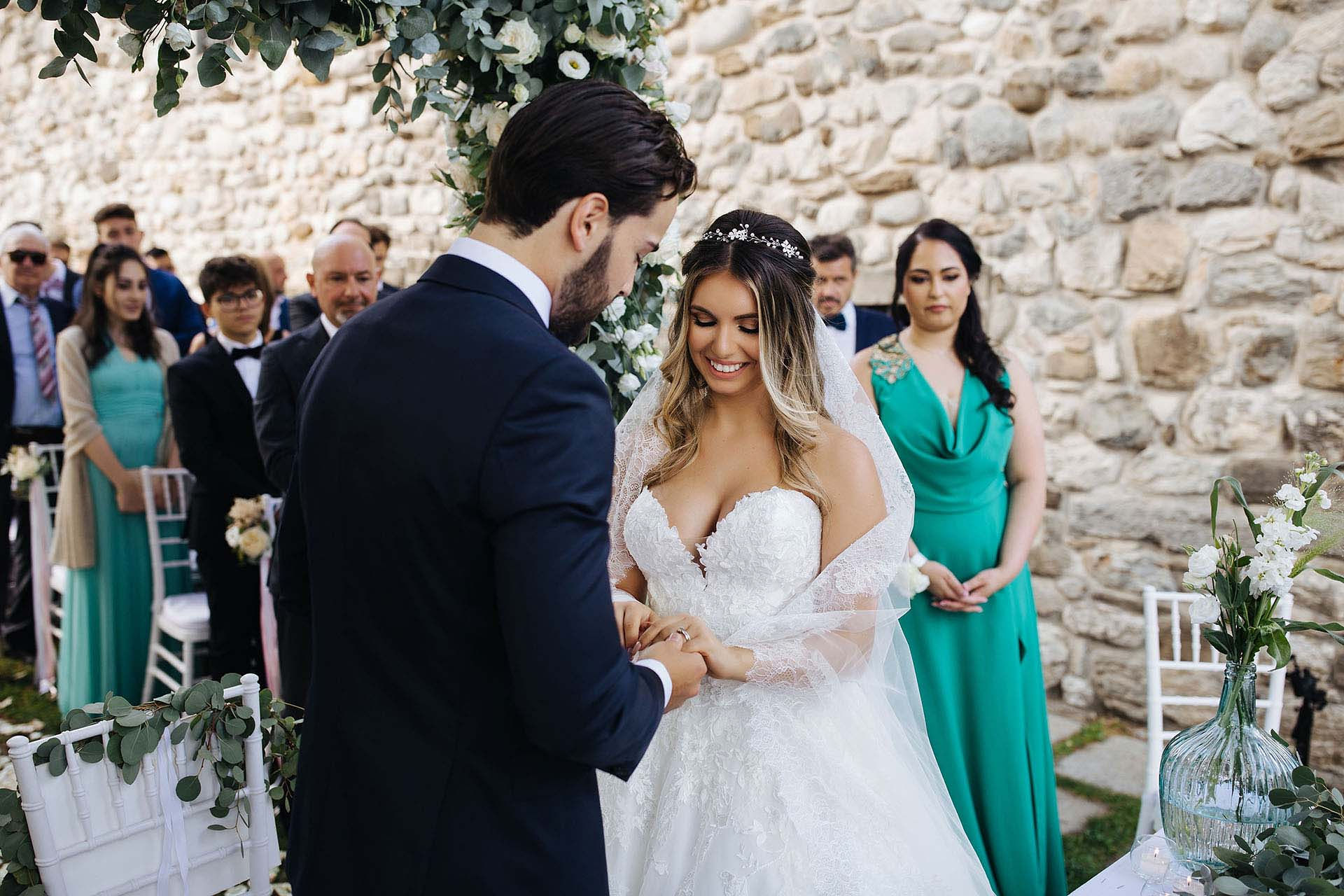
Other photographs move much closer. During the ceremony, the exchange of rings is recorded against an old stone wall, with family and guests visible behind the couple. The material character of the castle remains present, but it no longer dominates the composition.
Then the wedding shifts outward. The couple walks back along the ceremony aisle, surrounded by movement and smiling guests. Later, they share a quiet moment at a table, with drinks and flowers in the foreground. By night, the photographs become energetic and informal.
The changing proximity is important. We move from a room containing people, to people standing within architecture, to gestures and expressions that would remain meaningful in almost any location.
Castello di Ristonchi creates a different photographic experience. In Lauren and Travis’s wedding gallery, the estate opens toward the Tuscan landscape. Trees, grass, distant hills and the sky become part of the ceremony.
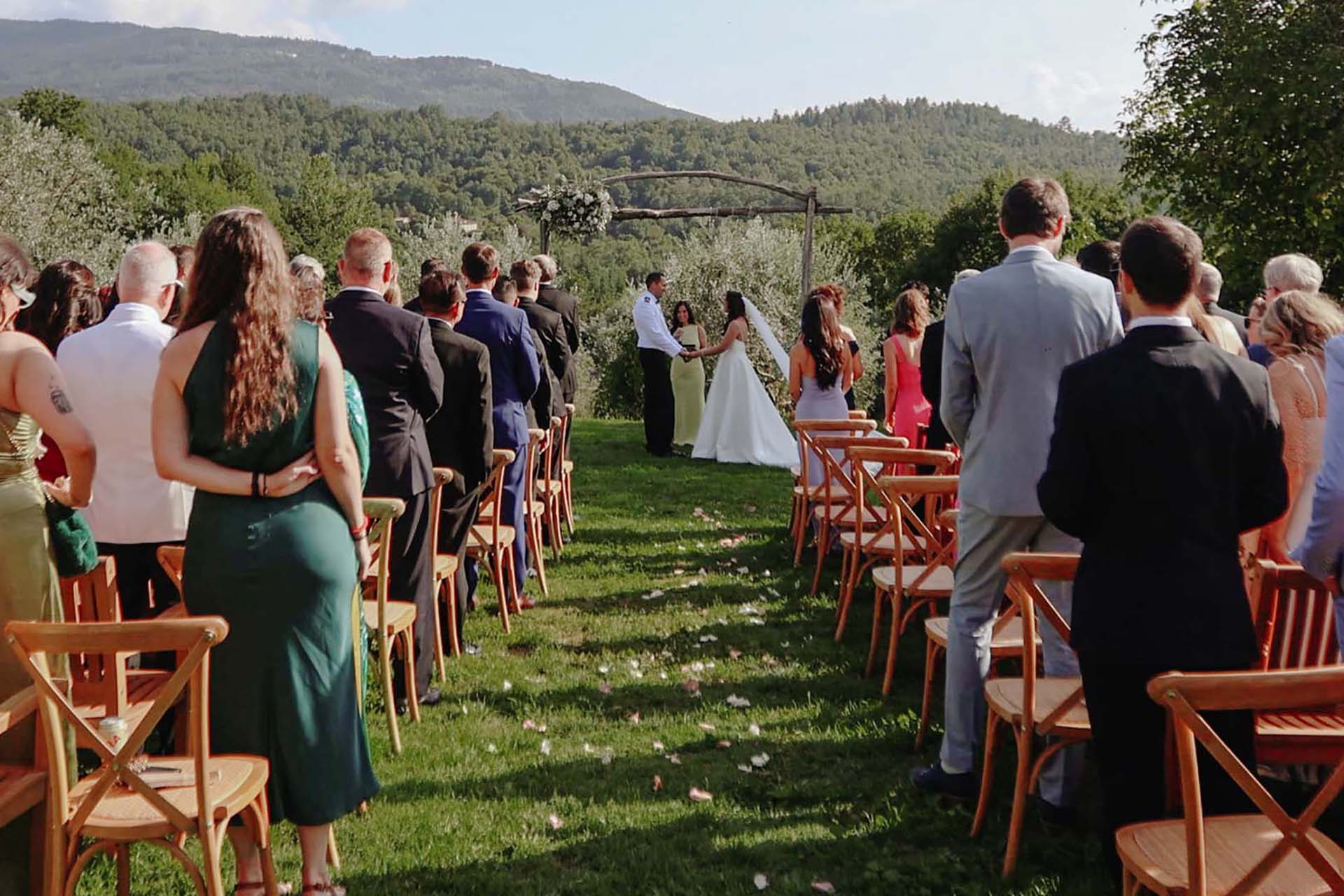
A wide photograph shows guests standing on either side of a grass aisle, with the couple exchanging vows beneath a simple wooden structure. The surrounding hills are clearly visible, but the image still belongs to the people gathered there.
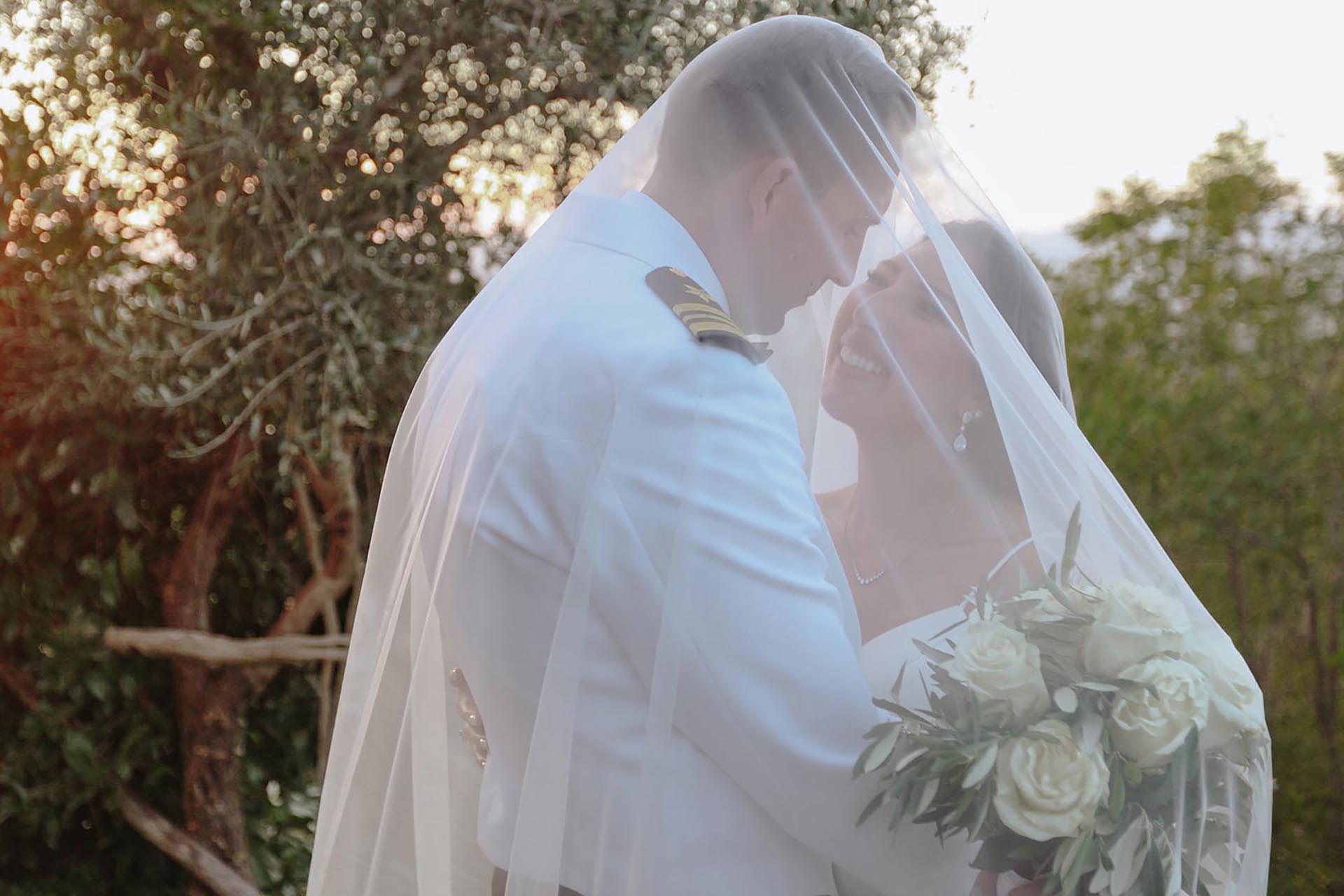
Closer portraits introduce a very different visual relationship. Lauren’s white gown, Travis’s formal white uniform and the dark greenery create strong contrasts. In one particularly intimate photograph, the couple stands close together beneath the bridal veil, which lifts across the frame and softens the sunlight.
At the reception, the atmosphere changes again. The celebration moves beneath a pale sail tent, where warm light, guests seated around tables and the movement of the couple create another chapter of the visual story.
Lauren and Travis exchanging vows at an outdoor ceremony overlooking the Tuscan countryside at Castello di Ristonchi
The distinction between these weddings is not a question of which castle is more beautiful. It is how each setting changes the relationship between architecture, landscape and the people being photographed.
The Architecture Should Have a Purpose in the Photograph
Historic buildings create an almost irresistible temptation to photograph everything.
A dramatic arch, an elaborate staircase, an ancient doorway or a terrace overlooking the landscape may already look like a finished composition. The danger is that the couple becomes another decorative element within it.
Wide architectural portraits are valuable. They establish the setting and can become some of the most visually striking images in a wedding gallery. But if every portrait depends on showing the grandeur of the venue, the people can begin to disappear.
The strongest collections work at different distances.
A wide photograph reveals the relationship between the couple and the castle. A medium composition allows clothing, gestures and architectural details to share attention. A close portrait removes most of the surroundings and concentrates on expression, touch or movement.
These photographs serve different purposes. One preserves the experience of being in an extraordinary place. Another preserves what happened between two people while they were there.
The Rossino ceremony photographs illustrate this balance particularly well. In the close photograph of the ring exchange, the couple’s hands become the centre of attention. The stone wall and the guests behind them provide context without competing with the gesture.
At Ristonchi, the wide ceremony photograph makes a different choice. The guests, landscape and ceremony arrangement are essential to understanding the scene. Cropping tightly would produce a more intimate image, but it would remove much of the atmosphere that makes this particular celebration distinctive.
A thoughtful photographer needs both instincts: knowing when to include the surroundings and knowing when to leave them out.
When the castle’s colour becomes part of the image
Historic stone has its own visual character. Some surfaces are pale and reflective; others are dark, warm or heavily textured. Their appearance changes with the direction of the light and the colour of the surrounding environment.
This affects how wedding clothing is photographed.
At Ristonchi, Travis’s bright formal uniform and Lauren’s wedding gown sit against darker greenery and warm stone. Their clothing naturally attracts attention because it differs so clearly from the setting. The photographer must preserve detail in the light fabric while allowing the background to retain its character.
At Rossino, darker formalwear creates a different contrast against pale stone and greenery. In the interior photographs, warm surfaces and window light establish an atmosphere that would feel quite different if every shadow were removed.
These aren’t simply technical problems to correct afterward. They are part of the visual identity of the location.
Photographing an Italian castle well means respecting its material character rather than forcing every room and courtyard into the same lighting treatment.
A Ceremony Needs More Than One Perspective
Wedding ceremonies offer some of the most important photographs of the entire day, yet they provide relatively little opportunity for intervention.
A photographer cannot ask a couple to exchange rings again because the composition wasn’t ideal. A processional cannot be paused while someone changes position. Once the ceremony begins, anticipating events matters more than directing them.
Castle venues add another dimension. Historic walls, narrow passages, ceremony arches and outdoor gardens can restrict movement or influence where the photographer can work.
At Rossino, the close photograph of Valentina and Vincent exchanging rings places their hands and expressions at the centre of the frame. The old wall gives the image a clear sense of place, while the people watching behind the couple remain visible.
Another photograph from the same ceremony shows them walking back together through an aisle scattered with petals. This image is much more dynamic. The guests on both sides become part of the composition, the floral arch remains behind the couple and the movement gives the photograph a different emotional quality.
These images preserve different things. One concentrates on a private gesture witnessed publicly. The other shows the shared celebration immediately afterward.
At Ristonchi, a wide ceremony photograph includes the couple, guests, seating arrangement, trees and distant hills. It records the entire environment in which the vows took place.
Together, the examples demonstrate why it would be limiting to photograph every ceremony from one distance.
A complete wedding story benefits from establishing photographs, carefully observed moments and the reactions of the people present. When permitted, a second photographer can contribute complementary perspectives, particularly during entrances and other moments that occur only once.
But a second photographer is not a substitute for preparation. The photography team must understand the ceremony layout, access restrictions and which positions will interfere least with the experience.
The ceremony belongs to the couple and their guests. Photography should preserve its significance without turning it into a production.
Valentina and Vincent exchanging wedding rings against the historic stone walls of Castello di Rossino
Beautiful Portraits Without Turning the Wedding Into a Photoshoot
One of the principal attractions of an Italian castle wedding is the possibility of making portraits that feel connected to the history and atmosphere of the venue.
There may be courtyards, gardens, doorways, staircases and views that appear to offer an unlimited number of photographic possibilities.
But unlimited locations do not mean unlimited time.
Couples are also hosting a wedding. They have guests to spend time with, conversations to enjoy and a celebration happening around them. A photographer who continually moves the couple from one attractive corner to another may produce variety, but at the expense of the experience.
This is where careful selection becomes important.
Rather than attempting to photograph every part of the property, we favour identifying a small number of visually distinct settings. One might provide a strong architectural composition. Another could offer softer light and greater intimacy. A third may be useful later in the day if the atmosphere changes.
The difference between photographs should come from meaningful changes in light, perspective and interaction, not simply from having a different wall behind the couple.
Lauren and Travis’s portraits at Ristonchi demonstrate the possibilities of working within a relatively consistent environment.
In one frame, they are standing together beneath a simple wooden ceremony structure with the Tuscan landscape behind them. In another, the veil moves across the foreground, creating a far more intimate composition. Other portraits concentrate on their expressions and the relationship between their clothing and the surrounding greenery.
These photographs are visually different without requiring the couple to appear in an endless sequence of unrelated settings.
Intimate wedding portrait of Lauren and Travis beneath a translucent bridal veil at Castello di Ristonchi in Tuscany
The same principle applies at Rossino, where architectural portraits, ceremony photographs and quiet interactions create variety through composition and observation.
The value of giving a portrait session an ending
An effective portrait session needs a clear purpose and a natural conclusion.
If the photographer has already created the essential architectural portrait, a close image of the couple and a few relaxed photographs in softer light, continuing simply because more locations are available may not add much value.
The couple should be able to return to their celebration while the experience still feels enjoyable.
That requires some preparation. The photographer needs to understand which spaces are accessible, how far apart they are and whether they will be available at the relevant time. A location that looks beautiful in a venue brochure may be inconvenient once guests and suppliers are moving through the property.
It also requires sensitivity to the people being photographed.
Some couples enjoy deliberate editorial direction. Others prefer to move naturally, with only small adjustments to positioning and light. The strongest approach is not the one that imposes the photographer’s favourite poses on everyone. It is the one that produces refined images while allowing the couple’s personalities to remain visible.
A castle can provide the setting for a remarkable portrait. The relationship between the people in that portrait is what makes it worth keeping.
What Happens When the Castle Changes After Dark?
A wedding venue can look like a different place once the sun disappears.
Stone walls lose some of their daytime detail. Interior lighting begins to define the rooms, outdoor spaces become more intimate and guests are less concerned with the formal structure of the celebration.
Photography must change with it.
The broad, landscape-led approach that works beautifully at an outdoor ceremony may no longer be appropriate. A photographer needs to respond to available light, movement and the changing pace of the event. Additional lighting may be useful, but it should support the scene rather than erase its atmosphere.
The evening photographs from Valentina and Vincent’s wedding at Rossino make this transition especially clear.
There is a romantic portrait in which the couple stands close together against a dark background, their expressions and the light falling across them becoming the principal subjects.
Other photographs are much less formal.
One shows Valentina laughing while Vincent helps with her shoe. Another captures him dancing, surrounded by guests. The castle walls are still there, but they are no longer the centre of attention.
Bride Valentina laughing as Vincent helps with her shoe during their evening wedding celebration at Castello di Rossino
That change feels appropriate.
By this stage, the couple has already experienced the ceremony and the formal portraits. The photographs now reveal the more spontaneous side of the celebration.
At Ristonchi, the reception beneath the sail tent creates a contrasting atmosphere. Guests gather around long tables, the couple moves through the central space and the pale canopy defines the scene.
Rather than asking the evening photographs to reproduce the aesthetic of the ceremony, the different light and arrangement become part of the story.
A complete wedding gallery should be allowed to change character.
The couple who appears calm and composed in an architectural portrait can also be the couple who laughs uncontrollably with friends later that night.
Both versions are real. Both deserve to be remembered.
What to Discuss With Your Photographer Before a Castle Wedding
Historic venues create wonderful photographic opportunities, but they also reward thoughtful preparation. The most useful questions aren’t about how many picturesque locations the property has. They’re about how the wedding will actually move through them.
What to consider
The question worth resolving
Ceremony setting
Where can the photographer work without interfering with the ceremony, and what restrictions apply?
Portrait locations
Which two or three settings offer genuinely different photographs without taking the couple too far from guests?
Natural light
How does the light fall on the ceremony space and chosen portrait locations at the actual event times?
Historic interiors
Which rooms are available, and are there restrictions on access, lighting equipment or movement?
Family photographs
Is there an accessible location with enough space and consistent light for the essential groups?
Evening coverage
How will the photographer handle the reception once daylight has disappeared?
Weather alternatives
Is there an attractive indoor or covered option that can realistically accommodate photographs without disrupting the event?
These questions are particularly relevant to destination weddings, where couples may be planning from abroad and might have seen the venue only during one visit.
A photographer does not need to promise that every photograph will take place in the most recognisable part of the castle. More useful is an explanation of how the venue’s spaces, light and logistics can support the celebration.
It is also worth discussing your priorities before the final schedule is agreed. If spending time with guests matters more than an extensive portrait session, say so. If you love architectural photography and want a small, deliberate editorial session, that can be planned too.
What matters is making the decision intentionally.
What the Best Castle Wedding Galleries Have in Common
The most persuasive wedding portfolios are not necessarily the ones with the greatest number of spectacular locations.
Look at an entire wedding, rather than only the photographs selected for the homepage.
A strong gallery should show the venue, but also the people inhabiting it. It should move convincingly between preparations, ceremony, portraits, reception and the evening. When the light changes, the photographs should remain considered, even if the visual atmosphere becomes completely different.
This is also where authenticity becomes visible.
At Rossino, the image of Vincent preparing in the stone-walled room and the photographs of the couple celebrating late into the evening belong to the same story, despite their contrasting moods.
At Ristonchi, the wide ceremony scene overlooking Tuscany, the intimate portraits beneath the veil and the reception beneath the tent reveal different aspects of the same celebration.
The castle is the setting that connects those moments. It is not the only reason they matter.
For couples choosing an Italian castle, that distinction is worth considering. You may fall in love with the building first, but the photographs you return to years later will likely include much more than architecture.
They will contain familiar expressions, small gestures and people whose presence gave the celebration meaning.
At Image Studio, our approach to wedding photography in Italy is shaped by this relationship between considered composition and documentary observation. We want the setting to retain its character without asking the couple to perform for it.
That is the difference between making attractive photographs at a castle and creating a wedding story that genuinely belongs there.
Planning a Castle Wedding in Italy?
If you’re considering a historic castle in Tuscany, the Lake Como region or elsewhere in Italy, we’d love to understand the celebration you’re imagining.
Share your wedding date, venue, ceremony setting and the moments you care about most. We can discuss how editorial portraits, documentary coverage and, where appropriate, cinematic film might work together within your schedule.
What makes castle wedding photography different from photography at a modern venue?
Historic castles often have distinctive stone interiors, courtyards, narrow passages and architectural details that influence composition and natural light. A photographer needs to balance those features with the people and events being documented, rather than using the castle as the background for every photograph.
How much time should we allow for wedding portraits at an Italian castle?
There is no universal duration. The time required depends on the distance between portrait locations, how much direction the couple enjoys and when those spaces are available. A small selection of distinctive settings is often more useful than attempting to photograph every part of the property.
Are dark castle interiors difficult to photograph?
They can be. Small windows, dark stone and mixed artificial lighting may create challenging conditions. Review complete galleries showing both natural-light interiors and evening receptions, and ask how your photographer approaches additional lighting where it is necessary and permitted.
Do we need two photographers for a castle wedding?
Not automatically. Two photographers may be valuable when preparations happen simultaneously in separate areas or when complementary ceremony perspectives are important. A smaller wedding with a straightforward schedule may be covered effectively by one experienced photographer.
Can we have natural wedding photographs and editorial castle portraits?
Yes. These approaches complement each other. Carefully composed portraits can preserve the architectural character of the venue, while documentary photographs capture interactions, reactions and the changing atmosphere of the celebration.
What should we check with a castle venue before booking photography?
Confirm access to the spaces you want photographed, ceremony restrictions, suitable interior and exterior portrait locations, guest accessibility and bad-weather alternatives. Your photographer and planner should also understand when those spaces are available during the wedding.