Explore commercial photography examples across luxury, fashion, beauty, products, hospitality, food, and lifestyle, with practical insights into lighting, composition, creative direction, CGI, and production.
The best commercial images don’t merely show what a brand sells. They make a viewer feel the temperature of a place, the texture of a material, the energy of a person, or the promise of a particular life. That’s why commercial photography examples are most useful when they’re studied as complete visual systems, not isolated hero shots.
The gallery below uses four practical lenses: visual direction, lighting, composition, and production. Together, they reveal why a luxury hotel image feels cinematic, why a beauty portrait needs controlled polish, why a product campaign may depend on CGI, and why a food shoot can turn color and texture into appetite. The same decisions can be adapted for luxury, fashion, hospitality, editorial, social, and paid digital campaigns without relying on dated or year-specific trends.
Commercial photography has also matured into a substantial global procurement category. One recent estimate values the market at $6.0 billion in 2026, with a projected 4.7% CAGR through 2030, while another estimates approximately $5.6 billion in 2025. That market context helps explain why brands now commission imagery as carefully as any other major marketing asset. For technical planning, compare these creative choices with recommendations for cameras for product photography.
Table of Contents
Image Studio
Direction that holds across formats
Tim Tadder
Build the action around the promise
RANKIN
Direct the face, then protect its texture
STAUDINGER+FRANKE
The Voorhes
Paloma Rincón
A practical color-led approach
Erik Almås
Making a location carry emotion
7 Commercial Photography Examples Compared
Turn Visual References Into a Production Brief
1. Image Studio
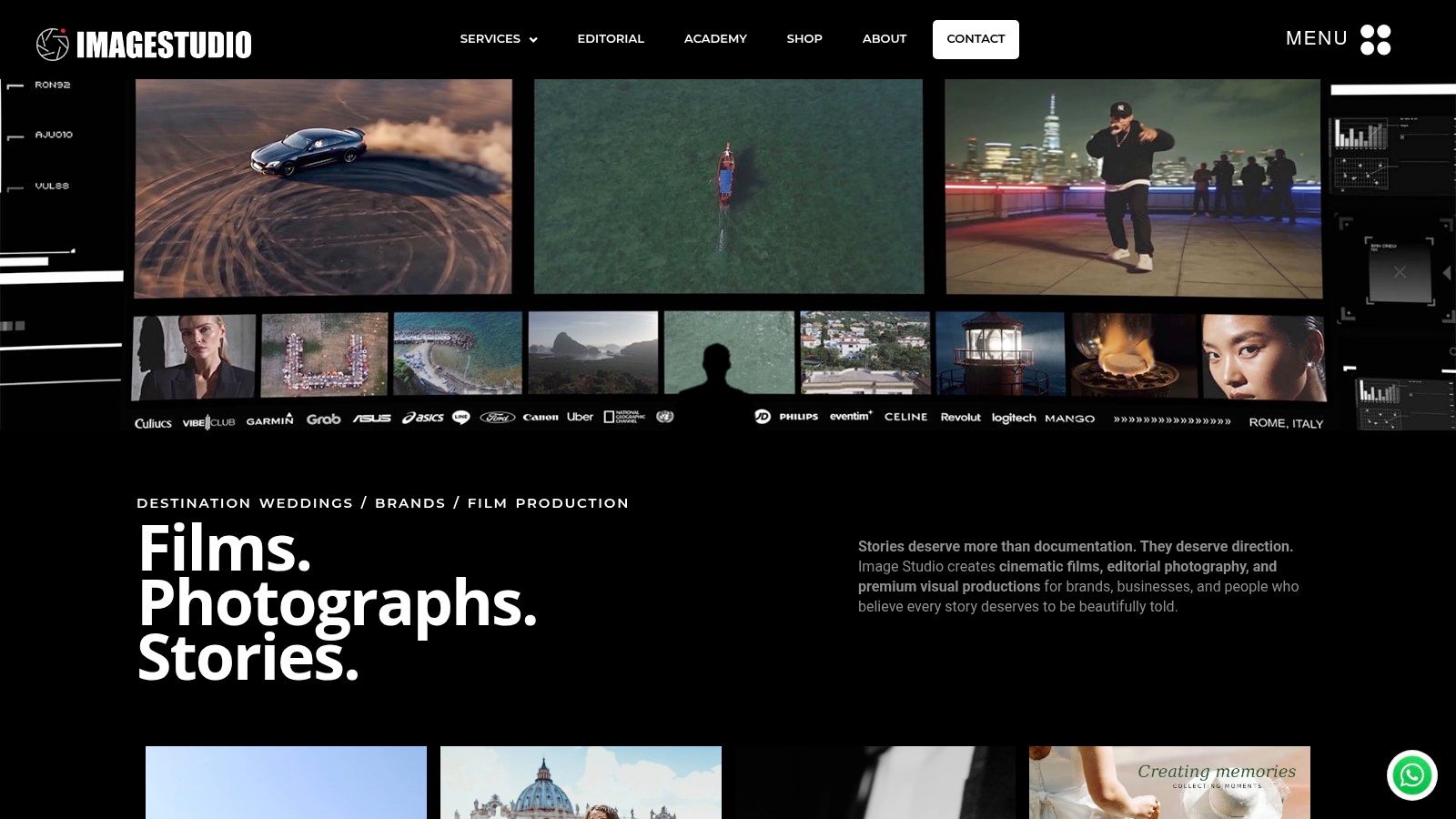
A bride crosses a sunlit Italian courtyard, her veil lifting in the wind before the frame settles on weathered stone, flowers, and distant water. Elsewhere, a fashion subject holds still against a shadowed architectural wall, carrying the quiet precision of an editorial spread while the accompanying film keeps moving. Image Studio builds both moments from one idea: photography and film share one visual language.
Based in Rome and Milan, the studio brings directors, cinematographers, photographers, editors, and creative collaborators into one production team. Its work spans luxury brands, artists, destination weddings, hospitality, and digital campaigns. The Image Studio’s commercial portfolio presents 14+ years of experience, 250+ productions, and content exceeding 150 million views across platforms, alongside a clear focus on atmosphere, narrative continuity, and polished delivery.
Direction that holds across formats
The direction starts with the setting. Window light, late-day sun, practical lamps, and controlled fill preserve the character of a location, while editorial posing gives subjects purpose instead of leaving them looking arranged. Wide environmental frames establish place, intimate portraits carry the human story, and close details provide cut points for websites, social posts, decks, and film edits.
That rhythm is useful for a campaign brief. Choose a small set of repeatable visual rules, such as warm natural light, restrained movement, and architectural compositions, then apply them to stills and motion. Set styling should follow the same logic. For a ceremony or hospitality shoot, event florals for photoshoots can connect the flowers in the scene with the wider visual identity.
The production model covers concept development, location cinematography, commercial photography, music videos, short-form content, AI-enhanced workflows, editing, color, sound, and platform-specific delivery. A luxury hotel, destination wedding, or fashion brand can therefore capture stills and motion within the same creative production, rather than rebuilding the visual direction for each format.
Practical rule: If a campaign needs photography, film, and social assets to feel related, approve the visual language before approving individual shots.
Location planning adds another layer. Established crews and destination experience support productions across Lake Como, the Amalfi Coast, Tuscany, Venice, and other locations, while bespoke proposals allow the scope to match the brief. Pricing is not published, so smaller teams should request a consultation early, particularly for destination work where availability may be limited.
Commercial Photography Examples PortfolioBest for: Luxury, hospitality, destination weddings, editorial campaigns, music, and brands that need one coordinated team across photo and film.
Pros
Unified visual language: Cinematic direction stays consistent across stills, films, reels, and digital assets.
End-to-end production: Concept, shooting, post-production, sound, color, and delivery follow one connected workflow.
Destination expertise: Local crews and established logistics support productions across Italy and internationally.
Scalable creative teams: The studio can handle intimate editorial shoots and larger commercial productions.
Cons
No public pricing: Bespoke proposals may exceed smaller production budgets.
Advance planning required: Destination and commercial bookings may need early coordination.
2. Tim Tadder
A runner hangs above the ground, fabric cuts across the frame, and a product catches a hard strip of light. Tim Tadder’s sports imagery makes speed visible, often through a blend of in-camera action, compositing, motion, and CGI. The finished photograph feels like one instant, although its construction may involve several carefully controlled elements.
His portfolio organizes campaigns and projects into visual systems rather than isolated images. Work associated with Nike, Peloton, Hyperice, Amazon Business, and Bridgestone Olympics shows how an advertising photographer and director can build a consistent world around performance, technology, and lifestyle.
Build the action around the promise
Start with the physical behavior the brand needs to communicate. A runner beside a product suggests very little if the campaign is about acceleration. A fitness subject needs a gesture that conveys effort, while a technology image may require exact body positioning so the product appears integrated with the action. High-speed shutter settings, controlled strobes, and clear separation from the background keep the subject legible inside a deliberately kinetic frame.
The composition carries equal weight. Diagonal limbs, flying fabric, suspended objects, and cropped perspectives create the sensation that the subject has entered at speed. Direct the movement toward the product or the intended focal point, then check whether the lighting remains believable after compositing or CGI. The original light direction, shadow behavior, and edge definition must support the final construction.
One frame can serve as the campaign’s visual test: if the action disappeared, would the product idea still be clear?
That question makes Tadder’s motion and stills portfolio a useful reference for teams planning a connected campaign rather than a single poster. The approach fits sportswear, connected fitness, automotive, technology, and other performance-led briefs. It suits a quiet hospitality concept or intimate editorial portrait less readily, where restraint and stillness carry more meaning.
Production budgets are typically premium, rates are handled by inquiry, and a United States base may add travel complexity for European shoots. Brands comparing stills with moving-image work can study the broader film production approach to see how a hero photograph might extend into short-form edits and platform-specific motion.
Best for: Sports, fitness, technology, action, and campaigns that need high-energy stills with a credible motion extension.
Pros
Big-brand campaign experience: The work demonstrates repeatable production for sports and technology clients.
Still and motion integration: Teams can assess how one campaign adapts across formats.
Advanced image construction: Action photography, compositing, and CGI support ambitious concepts.
Cons
Premium production expectations: Smaller brands may need a narrower scope.
Travel considerations: International production can add logistical requirements.
3. RANKIN
A RANKIN beauty portrait can hold attention through a single raised eyebrow, a precise crop, and skin that still looks like skin. Light defines the cheekbone without flattening it. Makeup, fabric, and attitude share the frame, giving the image a polished finish while preserving the subject’s personality.
The London-based studio is a useful reference for beauty, fashion, entertainment, advertising, portraits, and moving image. Its advertising gallery and wider portfolio show how a distinct visual identity can adapt across launches, editorial commissions, and high-visibility brand campaigns.
Direct the face, then protect its texture
A beauty setup begins with the desired emotional temperature. A broad soft source creates gradual transitions across the face, while flags and negative fill retain shape around the jaw, cheeks, and hair. Retouching should reinforce that structure, leaving enough surface detail for the image to feel human rather than uniformly artificial.
Small adjustments carry much of the direction. A turned chin can make a subject feel reserved; a direct eye line can create authority. Hand placement and expression shift the frame just as quickly. For campaigns requiring several moods, the photographer needs to guide those changes while keeping every image inside the same brand world.
RANKIN’s framing also turns one setup into a wider asset set. A tight crop creates intensity for a hero placement. A three-quarter view shows styling and product interaction. A full-length frame gives clothing room to move. Planning those variations together can produce material for campaign banners, press materials, social placements, and editorial coverage without making each image feel unrelated.
Motion changes the problem. Cream, gloss, and fragrance need to remain legible as a subject moves, while the light must flatter a face through changing expressions. That combination makes the studio a useful benchmark for complex launches. Bespoke pricing and international logistics can, however, expand the required scope.
For a campaign with a quieter, more literary mood, editorial photography direction can help retain narrative atmosphere while keeping fashion polish.
Best for: Beauty, fashion, entertainment, cosmetics, fragrance, and premium portrait-led advertising.
A brand team assessing the work should look for three practical strengths:
Strong beauty benchmark: Controlled lighting, styling, and retouching work together without erasing character.
Launch-ready production: The approach supports campaigns that need consistency across a tightly managed release.
Moving-image capability: Beauty concepts can continue into films and social content.
The main constraints are equally clear:
Bespoke commercial pricing: The production model is better suited to established brand budgets.
UK-centered operations: International shoots require additional planning.
4. STAUDINGER+FRANKE
A bottle stands against a controlled field, its edge sharply defined and its reflection placed with purpose. The shadow has weight, the surface responds to one consistent light source, and nothing distracts from the object. STAUDINGER+FRANKE works in this exacting space, combining photography, CGI, compositing, and post-production as one coordinated pipeline.
The Vienna-based studio focuses on luxury products, technical objects, packaging, and global brand systems. Its portfolio, production capabilities, and displayed awards point to a process built for consistency. One product may need several colors, angles, environments, and media placements, with its proportions and material behavior preserved in every version.
A useful brief starts with the product’s intended presence. Should it feel weightless, grounded, clinical, tactile, or desirable? That decision guides the lighting. Hard sources can define edges and cast graphic shadows, while broad sources describe reflective surfaces with greater restraint.
The frame should then serve the campaign. Negative space leaves room for copy, centered arrangements give packaging authority, and controlled perspective prevents distortion. CGI helps create environments that would be expensive, difficult, or impossible to build repeatedly on set.
The result is technical work that rarely calls attention to its labor. A watch, bottle, appliance, or cosmetic package appears exactly as the brand requires, because capture and finishing have been planned together from the start.
Production insight: The more surfaces, variants, and final placements a campaign contains, the earlier photography and post-production should be planned together.
This approach suits products that must remain accurate across a large brand system. It is less appropriate for documentary location work or loose lifestyle storytelling, where spontaneous interactions and changing conditions carry the image. Premium pricing is also a likely consideration when CGI and advanced post-production occupy a major part of the brief.
Best for: Luxury products, packaging, cosmetics, technology, automotive details, and technically demanding global campaigns.
Rather than separating advantages from limitations into a standard checklist, assess the production through three questions:
Can the pipeline stay consistent? Coordinated photography, CGI, and post-production support product families and multiple variants.
Can the team meet technical demands? Production information and displayed awards give agencies material for capability checks.
Does the brief need documentary freedom? If the answer is yes, this studio’s controlled process may be a poor fit. Advanced compositing and CGI can also expand production complexity.
For a brand campaign, the practical choice is clear. Use this model when accuracy, repeatability, and refined product presentation matter more than unplanned location moments.
5. The Voorhes
A cable curves across the frame like a drawn line. A package sits among sculptural props, while blocks of color turn a functional object into a visual character. The Voorhes builds commercial still life from ideas, materials, and set design, giving ordinary products a clear point of view.
The Austin-based photographer and stylist duo connects editorial covers, brand assignments, conceptual product images, and short-form content. Their method places the product inside a constructed situation, rather than presenting it alone against white. That decision gives the image a setting, scale, and implied story before the viewer reads the label.
A desk accessory can become part of a miniature architectural scene. A package can interact with food, paper, fabric, or molded forms. Each prop establishes scale, mood, contrast, or direction for the eye. The set carries meaning, so the supporting objects need the same attention as the hero product.
Lighting determines how that set reads. Clean, graphic illumination keeps the arrangement crisp and lets color or silhouette lead. More directional light creates shadows that turn everyday materials into shapes. Composition then controls the hierarchy: one form dominates, smaller elements point toward the product, and repeated lines create a route across the frame.
The approach suits consumer packaged goods, technology peripherals, lifestyle objects, and social assets designed to stop a scroll. Bold shapes and strong contrast also survive vertical crops, where a wide arrangement must remain legible inside a narrow frame.
Photo and film can share the same constructed world. A clip might show a prop entering the set, a product rotating, or a material changing form, while the still preserves the final graphic arrangement. The result is a compact content system, with one art direction supporting both a hero image and short-form motion.
For a brand team, the practical test is simple: does the product need a memorable visual premise, or only a clean demonstration? The Voorhes is a stronger fit when props can explain attitude, use, or category through composition.
Best for: Packaging, consumer goods, tech accessories, editorial-commercial hybrids, and concept-led digital campaigns.
Production watchouts: A boutique team may be less suited to several large productions at once. The set-built method is also a narrower choice for expansive hospitality assignments or documentary work. When the brief calls for a designed object, graphic frame, and adaptable social crops, its controlled visual language offers a clear campaign direction.
6. Paloma Rincón
A glass catches a saturated reflection. Powder, liquid, fruit, and molded surfaces collide in a frame built for the first glance. Paloma Rincón treats color, texture, and material behavior as active storytelling tools, giving food, beverage, technology, and lifestyle products an energetic, tactile presence.
Working between Madrid and Mexico City, Rincón moves across still life, direction, food, beverage, editorial-commercial work, and motion. Her projects show how one visual idea can extend from a controlled hero image into short-form content while preserving the campaign’s central gesture.
A practical color-led approach
A strong palette can separate a product from its category, create appetite, establish emotional temperature, and give a campaign a recognizable signature. Saturated backgrounds, reflective surfaces, sculptural forms, and arranged ingredients make the product feel almost physical through the screen.
The production begins with a color relationship rather than a collection of props. Choose one dominant hue or pairing, then select surfaces and materials that reinforce the product’s personality. A sparkling drink may call for wet glass, translucent ice, and sharp highlights. A natural food product may work better with rough stone, paper, or irregular ingredients that suggest freshness and touch.
Lighting must preserve those decisions. Hard highlights can erase detail in glossy packaging, while flat illumination drains materials of energy. Controlled reflections, directional accents, and carefully chosen surfaces keep the frame vivid without letting every element compete for attention.
The method also suits campaigns that need original, contextual imagery instead of generic stock. 34.3% of marketers rate original graphics as top performers, while 39.05% rate stock photos as poor performers, according to visual-content trend data. For a brand team, the useful lesson is practical: build a visual premise with enough authorship to remain recognizable across stills, crops, and motion.
Highly stylized color still needs to fit the identity system. A conservative brand may require a restrained palette or a modular version of the concept. The brief should also settle availability, travel, and pricing before the set is designed.
Best for: Food, beverage, consumer goods, lifestyle, technology, and brands seeking distinctive color-led campaigns.
Production strengths
Memorable visual language: Color, texture, and materials create quick recognition.
Commercial range: The approach adapts to beverages, food, technology, and editorial work.
Motion-ready direction: A hero still can extend into short-form social content.
Production watchouts
Strong stylistic signature: The palette may need adjustment for conservative brand guidelines.
Brief-dependent availability: International production requires careful coordination.
7. Erik Almås
A road narrows toward a distant horizon, a hotel walkway opens into pale light, and one person makes the destination feel vast. Erik Almås builds wide cinematic scenes with lifestyle direction, turning travel, hospitality, transportation, and luxury into lived experiences rather than isolated product categories.
Based in San Francisco, the photographer and director presents his work through campaigns, case studies, still overviews, motion, CGI, and composites. This format lets clients judge the finished frame alongside the narrative and production scale behind it. A destination brief may need a person, vehicle, property, and natural setting to feel connected. Almås shows how those elements can belong to one visual story.
Making a location carry emotion
The setting determines more than the background. It shapes light, palette, pace, and the campaign’s emotional promise. A wide frame can suggest escape and grandeur; a closer lifestyle image places the viewer inside the experience. Alternating those scales gives a campaign room to move from a destination’s geography to the details that make it feel inhabitable.
Golden light can make a resort feel restorative, provided the timing supports both the schedule and the story. Overcast conditions create a quieter, more refined mood. Artificial light can preserve faces, interiors, or product details while keeping the scene’s natural character intact.
A road, room, or vehicle also brings production constraints. Weather, access, travel, transport, permits, crew, and continuity shape the final images. CGI and compositing can support logistics-heavy briefs, but the photographic base still needs careful planning. The technical solution should recede behind the sense of place.
Location rule: Choose the emotional promise before choosing the viewpoint. A striking location can still fail if it does not express what the brand wants the audience to feel.
Almås is a useful reference for destination hotels, travel brands, transportation, outdoor luxury, and campaigns built around scale. The approach is less suited to fast studio product work, and premium pricing is handled through inquiry.
Best for: Hospitality, travel, transportation, outdoor luxury, resorts, and destination-led brand storytelling.
Production profile:
Narrative location direction: Environments and people work together to communicate an experience.
Campaign visibility: Case studies and process information clarify how large productions are assembled.
Complex logistics capability: CGI, composites, and international production support ambitious briefs.
Planning requirement: Global locations demand careful budgeting, scheduling, and coordination.
Style limitation: Location-led storytelling may not suit compact studio product campaigns.
7 Commercial Photography Examples Compared
Studio / Creator
Implementation complexity
Resource requirements
Expected outcomes
Ideal use cases
Key advantages
Image Studio
High, end-to-end productions with location logistics
Full production team, local crews, travel, bespoke budget
Cinematic, unified photo+film campaigns optimized for platforms
Cinematic landscapes with narrative case studies and compositing skills
Turn Visual References Into a Production Brief
The right reference depends on the emotion a brand needs to create. Hospitality and destination campaigns benefit from cinematic location direction, where architecture, and human behavior make a place feel desirable. Fashion and beauty require controlled polish, with lighting and direction precise enough to protect skin, styling, and product detail while leaving room for personality.
Product campaigns need a different discipline. Precision capture and CGI work best when packaging, surfaces, variants, and final placements demand consistency. A technically strong image isn’t automatically cold. With careful material choices, shadow design, and negative space, it can feel luxurious, tactile, or desirable.
Set-built still life suits brands that need a sharper conceptual voice. The Voorhes demonstrates how props, shape, and scale can turn a familiar product into an idea. For food and lifestyle brands, Paloma Rincón’s use of bold color systems shows how texture and saturation can make a campaign recognizable before the viewer reads the label. These approaches also support custom imagery at a time when marketers report stronger results from original visual work than from generic stock alternatives, as documented in visual-content research.
Production planning should include motion from the beginning. Video campaigns generated 60% higher engagement than text-only campaigns, while social video posts received 48% more views than image-only posts, according to the same visual-content source. Those figures don’t mean every brand needs a large film. They do show why a stills-only brief can leave useful campaign opportunities unexplored.
Before contacting a photographer or studio, define:
Intended emotion: Decide whether the audience should feel escape, desire, energy, trust, appetite, intimacy, or authority.
Hero composition: Identify the frame that must carry the campaign and where copy or interface elements will sit.
Lighting logic: Specify whether the light should feel natural, sculpted, glossy, graphic, soft, or cinematic.
Set or location needs: List architecture, props, food styling, models, surfaces, permits, and access requirements.
Motion extensions: Plan reels, short films, product movement, behind-the-scenes material, or animated crops alongside stills.
Post-production scope: Clarify retouching, compositing, CGI, color grading, sound, and AI-assisted workflows.
Final formats: Account for website banners, paid social, vertical stories, editorial layouts, print, presentations, and platform-specific exports.
Commercial licensing needs the same care as creative direction. Photographers usually retain copyright while clients receive a license covering agreed uses, and the license should define duration, exclusivity, modification rights, and sub-licensing according to this usage-rights guide. A fuller license normally identifies the parties, start date, territory, media, duration, and exclusivity, with permitted placements ranging from websites and social media to magazines and billboards, as explained in this client licensing guide.
Commercial use means promoting a business, product, or service, so it differs from editorial permission in commercial licensing practice. If recognizable people appear, confirm model releases as part of production. A model release gives permission for a subject’s likeness to be used and licensed, and commercial advertising normally requires that permission as outlined in this legal guide.
Image Studio is a relevant option when a campaign needs one coordinated team to carry an editorial visual language across photography, film, social assets, and post-production. Its Rome and Milan bases, destination logistics, and combined experience in commercial campaigns, hospitality, luxury, weddings, music, and digital content make it especially useful for brands that want the reference image and the final production to belong to the same world.
Image Studio combines commercial photography, film production, cinematic video, editorial direction, short-form social content, and post-production for brands, artists, hospitality teams, and destination clients. Visit the studio to discuss a campaign that needs polished stills, motion assets, and one consistent visual language from concept through delivery.