
Music does more than accompany images. It can shape emotion, attention, time and memory. Explore the science and creative craft behind sound in visual storytelling.
← Back to Editorial
← Back to Editorial
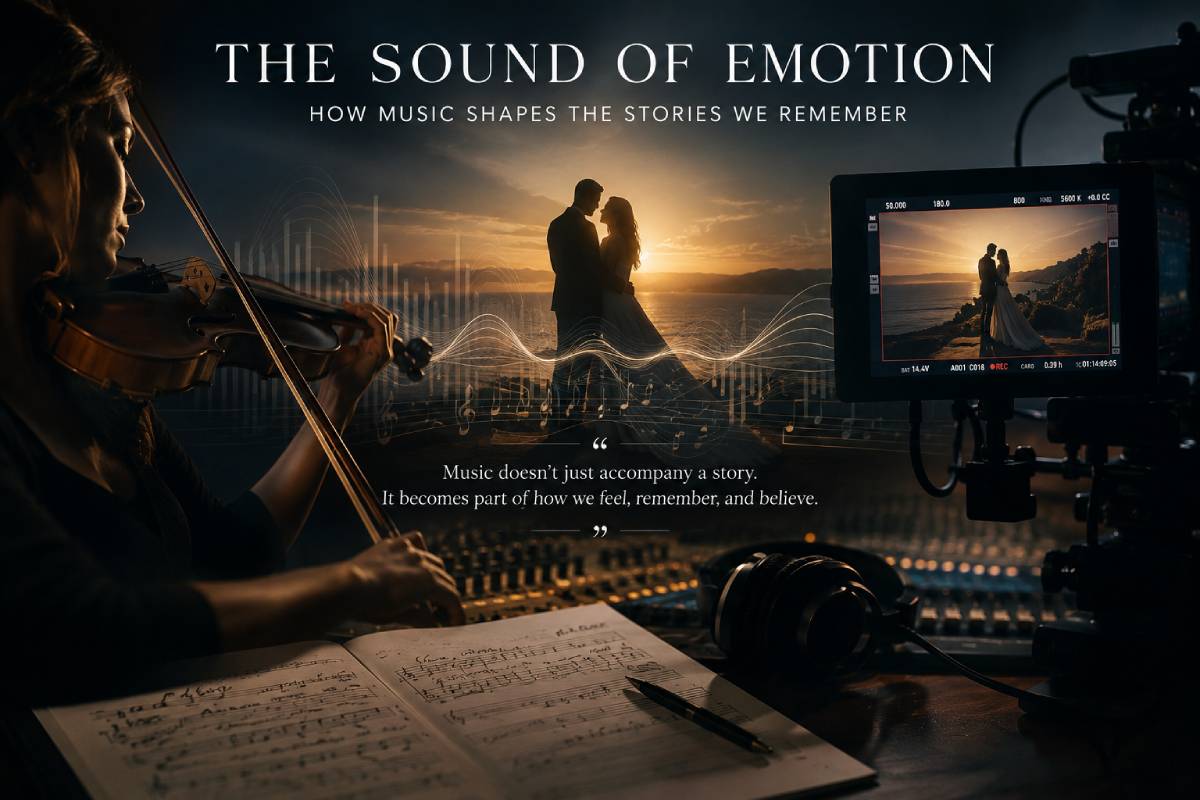
The Sound of Emotion: How Music Shapes the Stories We Remember
August 30, 2026
IMAGE STUDIO · MUSIC
Why music can alter memory, emotion, pace and meaning – and why the right soundtrack should belong to the story rather than to the trend cycle.
|
CENTRAL IDEA |
1. Before We Remember the Image, We May Remember the Sound
A melody can return without warning. Within seconds, a room, a person, a season or a version of ourselves can arrive with it. The image may be incomplete. The chronology may be uncertain. Yet the emotional temperature feels strangely intact.
That experience helps explain why music occupies such a powerful position in visual storytelling. In film, weddings, branded stories and music videos, a soundtrack is not merely something placed beneath pictures after the edit is finished. It can influence how an audience reads a face, how long a pause feels, whether a landscape seems intimate or threatening, and whether a sequence feels like memory, anticipation or release.
For Image Studio, the useful question is therefore not, “Which song makes this beautiful?” It is: “What should this story feel like, and what role should music play in creating that feeling?”
|
KEY INSIGHT |
2. Music and Emotion in Storytelling: The Short Answer
Music can shape storytelling through several mechanisms at once: it carries emotional information, establishes rhythm, influences attention, creates expectation, connects scenes, interacts with memory and gives abstract images a point of view. It can also work against the image deliberately, creating tension between what we see and what we feel.
This is why the same visual sequence can become romantic, melancholic, uneasy, triumphant or detached when its soundtrack changes. Research on film soundtracks has repeatedly found that music can influence viewers’ emotional response, interpretation and even what they notice or later remember.
|
Story element |
What music can change |
|
Emotion |
The affective tone through which a scene is experienced |
|
Attention |
Which visual details feel salient or significant |
|
Time |
Whether a sequence feels suspended, urgent, expansive or compressed |
|
Expectation |
What viewers anticipate before the image confirms it |
|
Character |
How a face, gesture or relationship is interpreted |
|
Memory |
How strongly a scene becomes associated with personal or autobiographical recall |
|
Continuity |
How separate images or locations feel like one coherent story |
3. By the Numbers: What Research Tells Us About Music and Memory
The relationship between music, emotion and memory is not merely poetic language. Experimental and neuroimaging research provides useful context — although these studies should not be read as formulas for predicting how any individual audience will respond.
|
30% |
49% vs 33% |
233 |
40 studies / 1,888 people |
|
Song cues evoking autobiographical memory (2007) |
Songs vs spoken lyrics (2025, N=84) |
Adults in a 2025 memory study |
Studies / participants in neuroimaging meta-analysis |
The 2007 study by Janata, Tomic and Rakowski found that, on average, 30% of song presentations evoked autobiographical memories, with strong emotion and nostalgia frequently present. A 2025 experiment found songs more likely than spoken versions of the same lyrics to evoke autobiographical memories – 49% versus 33% – while a separate 2025 study of 233 adults examined how musical features related to the emotional and phenomenological qualities of recalled memories.
At the neural level, a meta-analysis of 40 studies involving 1,888 participants found music-induced emotion associated with activity across a distributed network including the amygdala, insula, striatum, thalamus, hippocampus and anterior cingulate cortex. The useful conclusion is not that one brain region “creates” musical emotion, but that emotional music engages systems involved in auditory processing, emotion, motivation and memory together.
|
GOOD TO KNOW |
4. Why Music Can Unlock Autobiographical Memory
A familiar song often carries more than melody. It may contain the place where we first heard it, the people who were present, the age we were, the way a particular period of life felt and the social rituals that surrounded it. Music can function as a compact retrieval cue for an entire context.
Research comparing familiar and unfamiliar musical cues suggests that familiarity can increase memory accessibility and retrieval speed. Other work has found music-evoked autobiographical memories to be unusually vivid compared with memories cued by famous faces.
Familiarity is powerful – but it is not automatically better
A well-known song arrives with existing associations. That can be useful when those associations belong to the couple, artist or brand. It can also become a problem when the audience’s prior relationship with the song overwhelms the new story.
|
THE DETAIL |
5. Music Changes What We See
The eye does not process the image in isolation. Sound can change the emotional frame through which visual information is interpreted.
In two studies on soundtrack influence, melancholic and anxious scores changed how participants interpreted the same unfamiliar film scene — including empathy toward the character, impressions of personality, plot anticipation and perception of the environment. Eye-tracking and pupillometry in the second study also suggested that the anxious score altered vigilance and attention to minor visual details.
Another experiment with 60 participants found that music produced quicker first fixations on film objects and supplied emotional information that changed sentiment toward the story. The effect was not unlimited, but it demonstrates something filmmakers understand intuitively: music can alter both feeling and attention.
|
KEY INSIGHT |
6. Image + Music Creates a Third Meaning
An image has meaning. A piece of music has meaning. When they are combined, the result is not simply the sum of the two. The relationship can create a third interpretation that neither element carried alone.
|
Same visual material |
Possible musical treatment |
Resulting interpretation |
|
A person waiting at a window |
Sparse piano, slow harmonic movement |
Reflection, memory, absence |
|
A person waiting at a window |
Low pulse, unresolved texture |
Threat, uncertainty, anticipation |
|
A couple walking through a city |
Warm orchestral rise |
Romance, scale, destiny |
|
A couple walking through a city |
Natural sound with almost no score |
Presence, realism, intimacy |
|
A product revealed in close-up |
Aggressive rhythmic track |
Performance, energy, impact |
|
A product revealed in close-up |
Minimal tactile sound design |
Craft, restraint, material quality |
This is why scoring cannot be reduced to “happy music for happy scenes.” The same picture can support different stories, and sophisticated music selection begins by deciding which story the image should become.
7. Emotion Is Not a Major-Key / Minor-Key Formula
Simple rules are attractive because they are easy to repeat: major means happy, minor means sad, fast means exciting, slow means emotional. They are also incomplete.
Musical emotion depends on context, harmony, timbre, dynamics, rhythm, expectation, cultural familiarity, performance, arrangement, production and the images surrounding the sound. A minor harmony can feel intimate, noble, unresolved or threatening. A fast tempo can feel joyful, mechanical, anxious or triumphant.
For storytellers, this is liberating. The goal is not to match a musical label to an emotional label. It is to understand the specific emotional behaviour the scene needs.
|
FIELD NOTE |
8. Music Changes the Experience of Time
Film is time organised. Music is time organised. When the two are combined, pacing becomes one of the most powerful creative variables in the edit.
A sustained note can allow a look to remain on screen longer than it would in silence. A rhythmic build can make separate images feel as if they are moving toward the same destination. A sudden musical stop can make a fraction of a second feel larger because the audience becomes newly aware of the room, breath or voice.
|
Musical behaviour |
Possible effect on edit |
|
Long sustained phrases |
Encourage patience and continuity |
|
Short rhythmic pulses |
Create forward momentum or anticipation |
|
Gradual harmonic build |
Support emotional escalation without faster cutting |
|
Abrupt drop to silence |
Creates contrast and re-focuses attention |
|
Repetition with subtle variation |
Builds familiarity while allowing visual progression |
|
Tempo change |
Can redefine the perceived energy of the sequence |
9. Silence Is Part of the Score
A film covered continuously with music can become emotionally flat precisely because everything is being emphasised. Silence gives contrast. It returns physical reality to the scene.
In a wedding film, silence may reveal the breath before a vow. In a brand film, it may make a product movement feel tactile. In a music video, a deliberate break or reduced arrangement can create visual tension before the track returns.
Silence is therefore not an absence of design. It is one of the most deliberate forms of sound design available.
|
KEY INSIGHT |
10. Sound Design and Music Should Speak to Each Other
Music is only one layer of the soundtrack. Footsteps, cloth, room tone, water, applause, traffic, machinery, breath, cutlery, wind and human voices can make a story feel physically present.
The strongest soundtracks often allow these layers to interact rather than forcing ambient sound beneath a wall of music. A boat on Lake Como can be introduced through engine, wake and water before music expands the geography. A fashion film can use fabric, heels and studio movement to make texture audible. A commercial can let a mechanical action become part of the rhythm.
|
Layer |
Narrative function |
|
Dialogue / voice |
Meaning, personality, testimony, memory |
|
Ambient sound |
Place, scale, realism, atmosphere |
|
Foley / tactile detail |
Materiality and physical presence |
|
Music |
Emotion, rhythm, continuity, expectation |
|
Silence / negative space |
Contrast, intimacy, tension, attention |
For a deeper look at why voice and environmental sound matter in a wedding archive, read Why Cinematic Wedding Films Preserve What Photography Cannot.
11. Never Choose Music Only Because It Is Trending
A trending track solves one problem immediately: recognition. It may also create three new ones. The audience already associates it with hundreds of unrelated videos, the edit risks inheriting the pace of a platform rather than the story, and the film can become unnecessarily timestamped.
This does not mean popular music is automatically wrong. A culturally current song can be exactly right when the story, audience and distribution context support it. The problem begins when popularity becomes the only reason for choosing it.
|
SAVE THIS |
12. A Film Should Not Be Edited to the Beat Alone
Cutting on beats is one of the easiest ways to create apparent musicality. It is also one of the easiest ways to make an edit feel mechanical.
|
Editing level |
What it means |
Risk |
|
Beat |
Cuts align with individual rhythmic accents |
Can become repetitive and predictable |
|
Phrase |
Editing follows larger musical sentences |
Requires understanding structure, not only tempo |
|
Emotion |
Cuts respond to the narrative rise, release, silence and meaning of the sequence |
Demands judgement; cannot be automated from waveform alone |
A sophisticated edit can cut against the beat, hold through a musical accent, let dialogue interrupt rhythm or allow a shot to continue into the next phrase because the human moment matters more than perfect synchronisation.
|
FIELD NOTE |
13. Wedding Films: Voice First, Music Second
Wedding films contain something commercial cinema usually has to write: real voices speaking words that happened once. That makes music unusually powerful — and unusually dangerous.
A soundtrack can support vows, speeches and family relationships, but it should not force those voices to compete for attention. The music may need to simplify under dialogue, disappear completely, or return only after the emotional meaning has already been established by the people in the film.
Music also interacts with place. Bells, lake water, wind, applause, a live band or the acoustic character of an old villa can carry more identity than a generic cinematic track.
Explore Image Studio Weddings for photography, filmmaking and visual storytelling created around the people and atmosphere of a destination celebration.
14. Brand Films: Music Can Establish Identity Before the Message Arrives
In brand filmmaking, music can define the world before the audience has fully understood the product. It can signal restraint, confidence, youth, heritage, precision, sensuality, scale or irreverence without explaining any of those qualities in words.
That makes soundtrack selection part of brand strategy. The track should not merely “make the commercial emotional.” It should support the brand’s point of view and remain coherent with cinematography, casting, styling, production design, pace and sound.
|
Weak question |
Stronger question |
|
What music feels expensive? |
What emotional behaviour belongs to this brand? |
|
What track is trending? |
What sound can remain credible after the trend passes? |
|
Can we make this more cinematic? |
What should the audience feel before the product is explained? |
|
Can we add more energy? |
Where should energy rise, and why? |
For brand storytelling built around cinematography, sound and emotion, explore Image Studio Commercial Production and Film Production.
15. Music Videos Reverse the Relationship
In a conventional film, images may exist before the score is selected. In a music video, the song is usually the fixed emotional architecture. The visual world must discover how to interpret it.
That does not mean illustrating every lyric literally. Often the more interesting approach is to identify the track’s internal world: tension, rhythm, persona, repetition, contrast, silence, texture and the emotional distance between performer and audience.
Three possible relationships between song and image
- Literal: the visuals directly reflect lyrics or narrative events.
- Emotional: the imagery follows the feeling and energy rather than literal meaning.
- Counterpoint: the visuals deliberately contradict or complicate the song, creating a third meaning.
Image Studio creates cinematic music videos for artists seeking a distinctive visual world built around the identity of the music rather than a generic performance template.
16. The Music Decision Framework
Instead of beginning with a playlist, begin with the story. The following sequence keeps music in service of meaning.
|
Step |
Question |
|
1. STORY |
What is actually changing in this sequence? |
|
2. EMOTION |
What should the audience feel at the beginning, middle and end? |
|
3. PERSPECTIVE |
Whose emotional point of view are we inside? |
|
4. RHYTHM |
Should time feel patient, urgent, suspended, fragmented or inevitable? |
|
5. SOUND |
Which voices and environmental sounds must remain audible and meaningful? |
|
6. MUSIC |
What musical language supports those decisions without overpowering them? |
|
7. EDIT |
Where should picture follow music, resist it, or leave it entirely? |
|
IMAGE STUDIO FRAMEWORK |
17. Choosing Music: A Practical Creative Checklist
- Does the track support the emotional arc rather than only the mood of one shot?
- Does the instrumentation fit the physical world of the film?
- Will important dialogue remain intelligible beneath it?
- Does the track leave enough dynamic range for silence and natural sound?
- Are there clear phrases, transitions or structural moments the edit can use?
- Does the music create associations that help the story, or distract from it?
- Will the choice still feel credible when the current trend cycle passes?
- Are the necessary music rights and distribution uses understood before final delivery?
- Can the story survive if the music is temporarily muted during the edit?
- Does the ending feel earned, or is the music doing all the emotional work?
18. Music Rights Are Part of Creative Direction
A soundtrack choice is also a rights decision. Commercial films, branded content, wedding films and online distribution can involve different licensing requirements depending on the composition, master recording, territory, platforms, duration and intended use.
For commissioned or commercially released work, music should be cleared for the actual distribution plan rather than selected first and investigated at the end. Licensing libraries, original composition and properly cleared commercial tracks can all work; the creative and legal decision should happen early enough that the final edit is not built around music that cannot be used.
|
TRUST NOTE |
19. Common Music Mistakes in Visual Storytelling
|
Mistake |
Why it weakens the story |
|
Choosing from genre first |
The track solves a style problem before the emotional problem is understood |
|
Scoring every second |
Contrast disappears and music loses impact |
|
Cutting every shot to beats |
The edit becomes predictable and human moments lose priority |
|
Ignoring dialogue frequency |
Voices and music compete instead of supporting each other |
|
Using one emotional tone throughout |
The story has no internal movement |
|
Following a trend automatically |
The film inherits associations and may date quickly |
|
Treating sound design as secondary |
The world feels less physical and specific |
|
Licensing too late |
A finished edit can become unusable or require expensive restructuring |
20. Quick Reference: What Music Should Do
|
QUESTION |
CONCISE ANSWER |
|
WHAT IS MUSIC FOR? |
To influence emotion, rhythm, attention, expectation, continuity and memory — when the story needs it. |
|
SHOULD MUSIC ALWAYS MATCH THE IMAGE? |
No. Counterpoint can create complexity, tension or irony. |
|
IS FAMILIAR MUSIC BETTER? |
Not automatically. Familiarity can aid memory access but can also import unwanted associations. |
|
SHOULD EDITS FOLLOW THE BEAT? |
Sometimes. Phrase and emotional structure are usually more important than constant beat-matching. |
|
WHEN SHOULD MUSIC STOP? |
When voice, silence or environmental sound carries the moment more truthfully. |
|
BEST STARTING POINT |
Define story and emotional movement before searching for a track. |
|
MAIN WARNING |
Do not ask music to manufacture emotion that the images, voices and story have not earned. |
21. Frequently Asked Questions
Why does music make memories feel stronger?
Music can become associated with autobiographical contexts and can act as a retrieval cue for people, places and periods of life. Research shows that music-evoked memories can be vivid, emotionally rich and rapidly accessed, especially when the music is familiar. Individual responses still vary widely.
Can music change how viewers interpret the same film scene?
Yes. Experimental studies have shown that different soundtracks can alter empathy, perceived personality, atmosphere, plot expectations and attention when paired with the same or ambiguous visual material.
Is familiar music more emotional than unfamiliar music?
Familiar music can carry stronger personal associations and may make autobiographical memories easier to access. But unfamiliar music can be just as useful creatively because it allows the new film to establish its own associations without competing with an audience’s existing memories.
Should a wedding film use the couple’s favourite song?
It can, provided the music suits the story, the necessary rights are available and it works with vows, speeches and natural sound. A favourite song is emotionally meaningful, but it is not automatically the best editing structure for every part of the film.
What is the difference between soundtrack and sound design?
The soundtrack is the complete audio experience. Music is one component. Sound design can include ambience, effects, Foley, transitions, spatial sound and other elements that make the visual world feel physical and intentional.
Why can silence be more emotional than music?
Silence creates contrast. When music disappears, attention can shift toward breath, voice, room tone, movement or anticipation. The absence of score can make the audience newly aware of the reality of the moment.
Should brand films use trending songs?
Only when the track genuinely fits the brand, audience and distribution strategy. Trend recognition can create immediate familiarity, but it can also make a film feel derivative or quickly dated.
How is music chosen for a cinematic film?
A strong process begins with story, emotional arc, point of view, rhythm and sound requirements. Music is then selected for the narrative job it needs to perform, and the edit decides when to follow, resist or remove it.
Do music videos need a literal story?
No. A music video can be literal, emotional, conceptual, performance-led or deliberately counterpoint the song. The essential requirement is that the visual language has a coherent relationship with the identity of the music.
Can music alone make weak footage emotional?
It can temporarily increase emotional response, but that is not the same as strong storytelling. If a sequence collapses completely when the soundtrack is removed, the images, performance, structure or recorded sound may need more narrative work.
22. The Stories We Remember Are Often the Ones We Can Hear Again
A photograph can become an icon. A film can preserve movement. Music adds another layer: the emotional architecture through which those images are experienced and later recalled.
Its power comes partly from this ambiguity. Music can be intensely personal and universally legible at the same time. It can connect a private memory to a cinematic structure, make a commercial world feel human, or turn a performance into a visual identity.
But the strongest use of music is rarely the loudest. It is the use that understands when to lead, when to support and when to leave the scene alone.
The objective is not to make every story more emotional. It is to make the emotion already inside the story easier to recognise, inhabit and remember.
|
FINAL THOUGHT |
Explore Image Studio Music Video Production, Film Production and Commercial Production to discover how Image Studio develops visual stories around music, performance, cinematography and emotion.
