
Your wedding film is the one thing that lets you relive the day for the rest of your life. Ground cameras capture the tears, the laughter, the first kiss. But the role of drone footage in wedding films goes further. Aerial cinematography, as it’s known in professional film production, gives your story a sense of scale, atmosphere, and cinematic emotion that no handheld camera can match, especially during destination weddings in Italy. It’s the difference between a home video and a cinematic experience. This guide covers the creative benefits, practical planning steps, legal requirements, and what to look for when hiring a drone videography team.
Table of Contents
- Key takeaways
- How drone footage transforms your wedding film
- Practical planning for drone shots on your wedding day
- Legal and safety rules you need to know
- Drone audio and ceremony etiquette
- Choosing the right drone videography service
- Why Aerial Cinematography Matters in Luxury Wedding Films
- How Imagestudio brings aerial cinematography to your wedding
- FAQ
Key takeaways
| Point | Details |
|---|---|
| Drone footage adds cinematic scope | Aerial shots reveal venue scale and create emotional establishing moments ground cameras cannot replicate. |
| Schedule extra time for drone shots | Budget at least 10 additional minutes during your couple’s shoot to allow for multiple takes and angles. |
| FAA regulations are non-negotiable | Flying over guests requires either a lightweight drone or a Part 107 waiver from a certified operator. |
| Drone audio is not usable | Propeller noise makes drones unsuitable during vows and speeches; ground microphones handle all audio. |
| Drone footage enhances, not replaces | Prioritize ground coverage first; aerial shots are a creative boost, not a guaranteed deliverable. |
How drone footage transforms your wedding film
The most common misconception couples have is that drone shots are just a fancy extra. They’re not. When used thoughtfully, aerial wedding shots function as the visual spine of your film, giving it a sense of place and emotional weight that ground cameras simply cannot deliver.
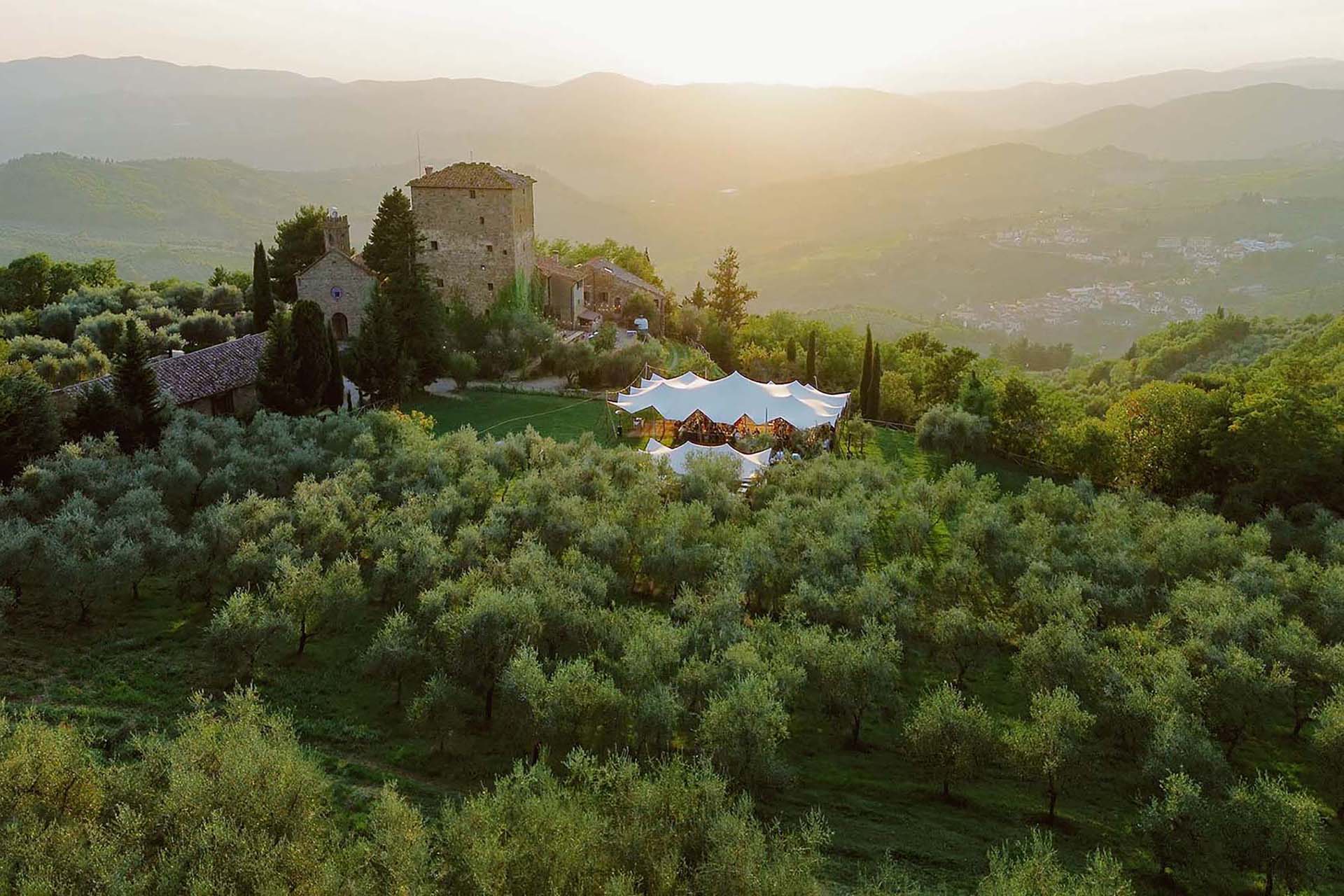
Think about the opening of a film you love. There’s almost always a wide shot that tells you where you are and makes you feel something before a single word is spoken. That’s exactly what a sweeping flyover of a Lake Como villa, Tuscan estate, or Amalfi Coast venue does for your wedding film. It sets the stage.
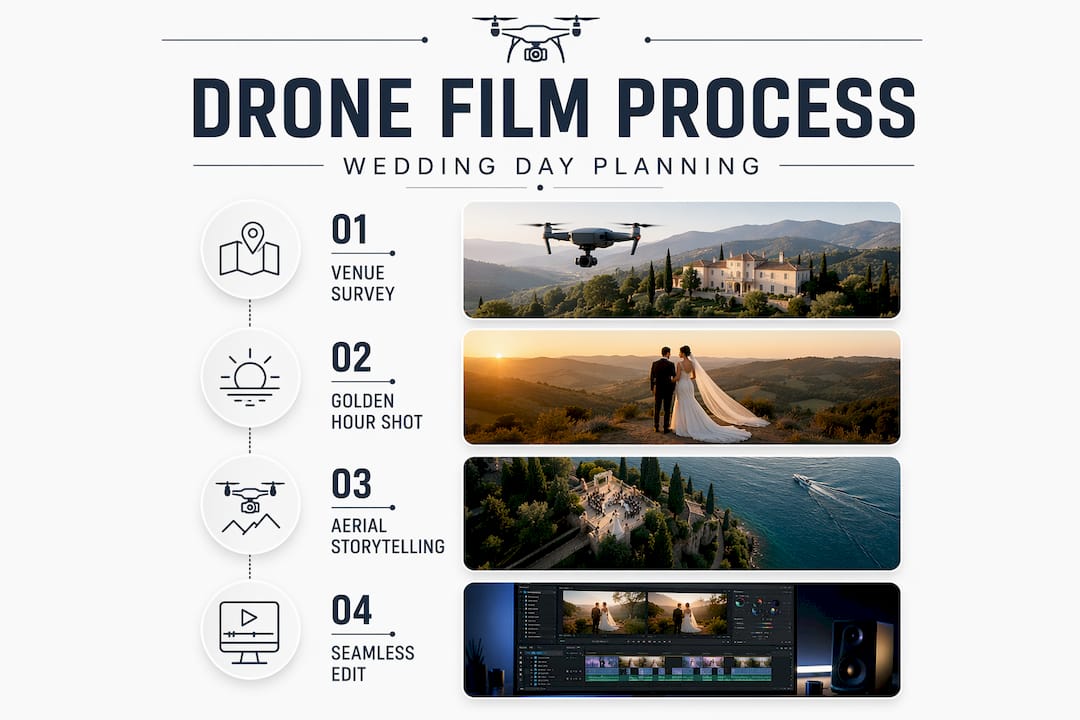
Here are the most impactful drone shots for weddings and what each one contributes to your story:
- Venue establishing shot. A slow, wide flyover showing the full property, surrounding landscape, and architecture. This is the shot that makes guests say “wow, I didn’t realize how beautiful it was.”
- Golden-hour aerial. Shot during the last 30 to 60 minutes of sunlight, this gives your film a warm, cinematic glow that feels genuinely emotional rather than produced.
- Top-down reveal. The camera looks straight down as the couple stands in a field, courtyard, or garden. It’s graphic, striking, and unlike anything shot at ground level.
- Orbiting shot. The drone circles the couple or a key location slowly. It creates a sense of intimacy and draws the viewer’s eye to what matters most.
- Transition shots. A drone rising above the treeline between scenes gives editors a natural, cinematic way to move from the ceremony to the reception without a jarring cut.
Pro Tip: Ask your videographer to plan the golden-hour drone shot before the couple’s portrait session ends. That 20-minute window of warm light is short, and it’s the single best time to fly.
The creative value of drone footage is highest when it’s woven into the film’s narrative, not dropped in as a random aerial interlude. A great drone shot earns its place in the story.
Practical planning for drone shots on your wedding day
Getting beautiful aerial footage requires more than just showing up with a drone. There are real operational factors that affect what’s possible, and knowing them ahead of time saves you from disappointment.
Scheduling matters more than most couples realize. Drone filming requires roughly 10 extra minutes built into your couple’s portrait session. Multiple takes are needed. A flyover, a static overhead, and an orbit all take time to set up, execute, and verify on the monitor. If your timeline is already tight, something gets cut. Make sure it’s not the drone.
Weather is the wildcard. Wind above 20 mph grounds most consumer and prosumer drones. Rain is an obvious issue, but even heavy overcast can flatten the light and make aerial footage look dull. Your videographer should have a backup plan for every drone shot so your film’s story holds together regardless of conditions. Planning around weather disruptions is what separates experienced operators from those who just own a drone.
Footage consistency depends on the right gear. ND filters on drones control exposure and create the natural motion blur that makes aerial footage look cinematic rather than sharp and video-like. Without them, your drone shots will look noticeably different from your ground footage, and the edit will feel disjointed. Ask your videographer specifically whether they use ND filters and custom camera profiles.
Here’s a quick checklist to review with your videographer before the wedding day:
- Confirm drone shots are scheduled during the couple’s portrait session, not squeezed in elsewhere
- Verify a weather contingency plan exists for every planned aerial shot
- Ask whether ND filters and color profiles are used to match ground camera footage
- Confirm the operator has checked the forecast and local airspace restrictions in advance
Pro Tip: If your venue has a stunning rooftop, courtyard, or garden that guests rarely see from above, flag it for your videographer early. Those hidden angles often become the most memorable shots in the final film.
Legal and safety rules you need to know
This is the section most couples skip. Don’t. Drone regulations directly affect what shots are possible at your wedding, and an operator who isn’t certified can put your event and your guests at risk.
In the United States, commercial drone operations are governed by FAA Part 107 regulations . Any videographer being paid to fly a drone must hold a Part 107 Remote Pilot Certificate. No exceptions. If they don’t have one, walk away.
| Scenario | FAA Rule | What It Means for Your Wedding |
|---|---|---|
| Drone under 0.55 lbs | Can fly over people without waiver | Very limited; most quality drones exceed this weight |
| Drone over 0.55 lbs | Requires Part 107.39 waiver to fly over people | Most wedding drones need a waiver for ceremony coverage |
| Flying near airports | Requires LAANC authorization | Many venues near cities need pre-approved airspace access |
| Flying over crowds | Restricted without specific waiver | Ceremony coverage over seated guests is often not permitted |
The practical impact is significant. Flying directly over guests during your ceremony is restricted under most conditions. That aerial shot of the bride walking down the aisle that everyone wants? It usually requires either a very lightweight drone or a pre-approved waiver. Experienced operators know this and plan accordingly.
Beyond federal rules, your venue may have its own restrictions. Some historic properties, national parks, and private estates prohibit drone use entirely. Always confirm venue permission in writing before booking a drone operator.
Safe, story-focused alternatives include:
- Pre-ceremony staged reveals shot before guests are seated
- Aisle-adjacent angles that frame the processional without flying directly overhead
- Post-ceremony flyovers of the empty venue space
Drone audio and ceremony etiquette
Here’s something most wedding planning articles don’t tell you: drones are loud. The propeller noise from even a quiet consumer drone is clearly audible to everyone nearby. That drone propeller sound makes aerial footage completely unusable for audio-critical moments like your vows, ring exchange, or speeches.
This isn’t a flaw in the technology. It’s simply physics, and it shapes how drone use should be planned around your ceremony.
The right approach is to treat drone footage as a visual-only tool during your wedding day. Your ground videographers, working with lapel microphones and dedicated audio recorders, capture every spoken word. The drone captures the sweeping visuals. In post-production, these two elements are combined to create a film that sounds intimate and looks cinematic.
Here’s how to plan drone use around your ceremony’s audio needs:
- Before the ceremony. Fly during venue setup or before guests arrive. Great for establishing shots with no audio concerns.
- During portraits. The couple’s session is the ideal drone window. No vows, no speeches, no audio to protect.
- Cocktail hour. Background music and ambient noise make this a workable window for aerial shots of the venue exterior.
- Reception exterior. Flyovers of the reception venue at golden hour work beautifully and don’t interfere with any spoken moments.
- Avoid during. Ceremony processional with guests present, vows, ring exchange, first dance (if indoors), and toasts.
Coordinating this with your videography team in advance means the drone never becomes a distraction for your guests or a problem in the edit.
Choosing the right drone videography service
Not every videographer who owns a drone is a drone videographer. The difference matters enormously when it comes to your wedding film.
When evaluating potential services, equipment is a reasonable starting point. The DJI Air 3S has been rated the top drone for videographers after extensive testing, offering excellent stability, image quality, and reliability. Operators using current, professional-grade equipment are more likely to deliver footage that holds up in a cinematic edit.
But equipment is secondary to expertise. Here’s a comparison to help you evaluate your options:
| What to ask | Red flag answer | Green flag answer |
|---|---|---|
| Are you FAA Part 107 certified? | “I have my license somewhere” | “Yes, here’s my certificate number” |
| Do you handle venue permissions? | “That’s usually up to you” | “We confirm in writing before the shoot” |
| How do you handle bad weather? | “We’ll figure it out that day” | “We have a shot-by-shot contingency plan” |
| Is drone footage separate or included? | Vague bundling with no details | Clear line item with defined deliverables |
| Can I see drone footage in past films? | Portfolio with no aerial examples | Multiple wedding films featuring aerial sequences |
Budget is another reality to address directly. Drone footage is an enhancement to your wedding film, not a replacement for ground coverage. Couples should prioritize comprehensive ground videography first. If conditions prevent flying on the day, you want a complete film regardless.
Pro Tip: When reviewing a videographer’s portfolio, watch how drone shots are edited into the film. If they feel like interruptions rather than part of the story, that’s a sign the operator can fly but doesn’t know how to film.
My honest take on drone footage at weddings
I’ve worked on wedding films where drone footage was the shot that made the entire edit click. I’ve also been on shoots where the drone sat in its case all day because the wind picked up, the venue said no at the last minute, or the timeline simply didn’t allow for it.
What I’ve learned is that drone footage rewards preparation and punishes improvisation. The couples who get the most out of aerial shots are the ones who planned specific moments for it, communicated openly with their videography team, and understood going in that the drone is a creative tool with real operational limits.
The shots that stay with people, the ones they screenshot and share, are almost never the ones captured spontaneously. They’re the ones someone thought about in advance: a particular angle of the venue at golden hour, a top-down shot of the couple in a flower field, a slow rise above the treeline as the ceremony ends.
My advice is to treat drone footage the way a film director treats a crane shot. It’s not something you do because you can. You do it because that specific shot, at that specific moment, tells the story better than anything else. When you approach it that way, the aerial footage in your wedding film won’t just look beautiful. It will mean something.
— Dumitru
How Imagestudio brings aerial cinematography to your wedding
Imagestudio has spent over 14 years producing cinematic films that have earned more than 150 million views worldwide. Drone videography is one of the tools that makes that level of storytelling possible, and it’s built into how the team approaches every wedding film production from the start.
Every Imagestudio drone operator holds FAA Part 107 certification and handles venue permissions as part of the pre-production process. Shot planning happens in advance, not on the day. The team uses professional-grade equipment with ND filters and matched camera profiles so aerial footage integrates naturally with ground coverage. Whether you’re planning an intimate garden ceremony or a large estate celebration, Imagestudio builds a drone strategy around your specific venue, timeline, and vision. Reach out to discuss your wedding and explore what cinematic aerial storytelling can look like for your film.
FAQ
What is the role of drone footage in wedding films?
Drone footage provides aerial establishing shots, cinematic transitions, and golden-hour visuals that ground cameras cannot capture. It adds emotional depth and a sense of place that transforms a wedding video into a cinematic film.
Can drones fly over guests during a wedding ceremony?
In most cases, no. FAA regulations restrict flying heavier drones over people without a Part 107 waiver. Certified operators use pre-ceremony staged shots or aisle-adjacent angles as compliant alternatives.
Does drone footage include audio from the ceremony?
No. Drone propeller noise makes aerial footage unsuitable for capturing vows or speeches. Ground microphones and lapel mics handle all ceremony audio, which is then combined with drone visuals in post-production.
How much extra time does drone filming add to a wedding day?
Plan for at least 10 additional minutes during your couple’s portrait session. Multiple takes including flyovers, static overhead shots, and orbits require buffer time to execute properly without disrupting your timeline.
What should I look for when hiring a drone videography service?
Confirm FAA Part 107 certification, ask to see drone footage in completed wedding films, and verify the operator manages venue permissions in advance. Equipment quality and a clear weather contingency plan are equally important factors.

