
A music video production crew brings together a director, DP, producers and editors, and knowing each role helps artists plan a shoot that looks and sounds right.
← Back to Editorial
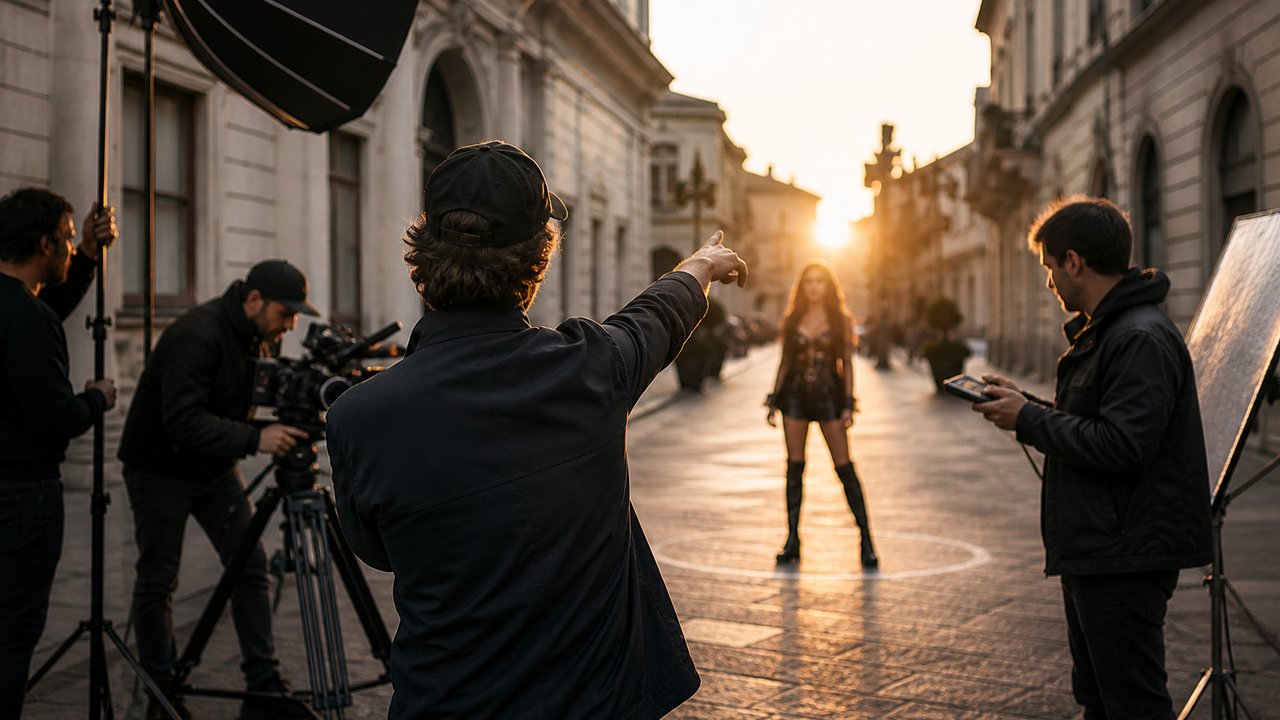
Building a Music Video Production Crew: Key Roles
October 16, 2026
The Key Roles on a Music Video Production Crew
A music video production crew is built around one idea: every role exists to serve the song’s narrative. Whether you’re working with three people or thirty, the structure is the same. Someone holds the creative vision, someone translates it into images, someone keeps the production running, and someone shapes the footage into a finished film. Understanding these roles, even on a small shoot, helps you know what you’re paying for and what you can’t skip.
Director and Creative Direction
The director holds creative authority. Every decision on set, from camera placement to wardrobe, should trace back to a single vision the director has agreed with the artist beforehand. On smaller productions, the director may also act as creative director, but on larger ones, a dedicated creative director works alongside the director to keep visual tone, styling and narrative consistent.
This is where I’ve found the gap between amateur and professional work is widest. A crew with excellent equipment but no clear creative direction produces footage that looks expensive and says nothing. Direction isn’t a luxury add-on, it’s the reason the other roles have something to execute.
Director of Photography and Camera Team
The director of photography, or DP, turns the concept into lighting, movement and framing. This person decides whether a scene reads as intimate or grand, whether the camera glides or cuts hard, whether the palette feels warm or desaturated. On larger shoots, the DP leads a camera team: a camera operator, a focus puller, and often a gaffer for lighting and a grip for rigging and movement.
Drone cinematography has become common in music videos, particularly for establishing shots in outdoor or destination locations, and usually requires a certified operator working alongside the DP rather than replacing the ground camera team.
Production and Logistics Roles
Producers and line producers are the roles artists most often underestimate. A producer secures locations, negotiates permits, manages the budget and builds the shoot schedule. A line producer handles the day-to-day logistics: call times, transport, catering, equipment rentals, contingency planning. Without this role, even a strong creative concept collapses under scheduling conflicts or missed permits.
Editing and Post-Production
Once filming wraps, editors, colorists and VFX artists take over. The editor builds the rhythm of the film against the track, deciding what the viewer sees and when. The colorist sets the final look, consistent across every scene. VFX artists, when the concept calls for them, add effects that couldn’t be achieved practically on set. These roles don’t just finish the video, they often define how it’s remembered.
How to Produce a Professional Music Video, Step by Step
Knowing how to produce professional music videos comes down to sequence as much as skill. Skipping a stage, usually pre-production, is the most common reason shoots run over budget or produce footage that doesn’t match the artist’s intent.
Pre-Production and Treatment
Before a single frame is filmed, the director writes a treatment: a document describing the visual concept, narrative arc, locations, styling and shot approach. This aligns the artist, the label if there is one, and the director on what the video will actually look like. I’ve seen more shoots saved by a strong treatment than by any amount of equipment.
Pre-production also covers casting, location scouting, scheduling and budgeting. This is the stage where most of the creative decisions are locked in, so it deserves more time than artists typically give it.
Shoot Day Coordination
On shoot day, a few documents keep everything moving: the shot list, the call sheet and the schedule. The shot list breaks the treatment into individual camera setups. The call sheet tells every crew member where to be and when. Without these, even a well-planned concept turns into wasted hours on set, which directly drives up cost.
A well-run shoot day usually follows this rhythm:
- Load-in and lighting setup before talent arrives
- Rehearsal or blocking for performance shots
- Coverage of wide, medium and close shots in planned sequence
- Buffer time for weather, equipment or location issues
- Wrap and equipment check before leaving the location
Post-Production Workflow
Post-production moves through several stages: a rough cut that establishes pacing, a fine cut that refines timing against the music, color grading that sets the final look, and sound design or mix review before delivery. VFX, if used, is typically integrated between the fine cut and color grading. Each round of revisions adds time, so it helps to agree on the number of review rounds before filming begins.
Creative direction should run through all three stages, pre-production, shoot and post, as one continuous thread rather than three separate jobs. That continuity is what makes a finished video feel like a single narrative instead of a collection of nice shots.
Building a Music Video Production Team That Fits Your Budget
There’s no fixed formula for crew size. A single-location performance video with controlled lighting might need five or six people. A multi-location narrative video with choreography, wardrobe changes and VFX can require twenty or more. The right question isn’t “how big should my crew be,” it’s “what does this concept actually require.”
Core roles, director, DP, producer, editor, are non-negotiable on any professional shoot. Specialist add-ons are brought in only when the concept calls for them:
- Choreographers for dance-driven performance sequences
- Drone operators for aerial or establishing shots
- SFX technicians for practical effects like fog, rain or pyrotechnics
- Stylists and makeup artists for narrative or fashion-forward concepts
- Steadicam or gimbal operators for continuous, fluid camera movement
In-House Crew vs Freelance Crew at a Glance
| Attribute | In-House Crew | Freelance Crew |
|---|---|---|
| Purpose | Recurring production needs | Project-specific needs |
| Cost structure | Fixed, ongoing | Variable, per project |
| Creative consistency | High, built over time | Depends on prior collaboration |
| Flexibility | Limited by team size | Scales to concept complexity |
| Best fit | Studios with constant output | One-off or occasional video projects |
| Main risk | Underused talent between projects | Scheduling conflicts with in-demand specialists |
For most artists and labels producing music videos occasionally rather than constantly, freelance specialists hired per project make more sense than maintaining a permanent team. A production company like Image Studio typically works this way by default, drawing on established relationships with camera operators, colorists and location specialists rather than keeping a fixed roster on payroll.
Choosing a Location for Your Video Shoot
The best place to shoot a music video is the one that reinforces the song’s mood, not the one that simply looks striking on camera. A beautiful location with no connection to the narrative reads as decorative. A modest location that matches the song’s atmosphere can carry more weight than an expensive set.
Studio Spaces
A studio offers control: consistent lighting, no weather risk, no ambient noise, and the ability to build a set exactly to the treatment’s specifications. This makes studios well suited to performance-driven videos or concepts that rely on controlled visual effects, projection or precise lighting design.
Outdoor and Urban Locations
Outdoor and urban video shoot locations bring authenticity a studio can’t replicate: natural texture, real architecture, and atmosphere shaped by actual light and weather. Destination locations, in particular, can give a video a sense of place that becomes part of its narrative identity. The tradeoff is reduced control over variables like noise, crowds and light consistency throughout the day.
Permits and Site Logistics
Scouting a location for a video shoot involves more than visual appeal. A few practical factors determine whether a location actually works on the day:
- Power access for lighting and equipment, or the need for generators
- Ambient noise levels, especially for live-sound performance scenes
- Crowd control in public or urban locations
- Weather contingency plans for outdoor shoots
- Permit requirements, which vary significantly by city, region and property type
Permits and local regulations differ widely depending on where you’re filming. A private studio requires none. A public square or historic site often requires formal permits, insurance, and sometimes a local fixer who understands regional procedures, something worth factoring into any production scouting across Italy or abroad.
What Drives Music Video Production Cost
Music video production cost is shaped by three main factors: crew, location and post-production scope. Rather than quoting a number, it’s more useful to understand what pushes cost up or down within each category.
Crew and Equipment
Crew size and specialist roles are usually the largest driver of cost. A director, DP and producer working with minimal gear costs far less than a full crew with gaffers, grips, a drone operator and a choreographer. Equipment rental, cameras, lenses, lighting rigs and stabilization gear, scales with the ambition of the shot list.
Location and Logistics
Location choice affects permits, equipment rental needs, travel and insurance. A single studio day is straightforward to budget. A multi-location shoot, especially across cities or countries, adds travel costs, location fees, and often additional insurance coverage for cast, crew and equipment.
Post-Production
Post-production scope, including the number of VFX shots and the number of edit revision rounds, adds time and expense after filming ends. A straightforward performance cut with color grading is relatively fast. A narrative video with VFX compositing and multiple stakeholder review rounds takes considerably longer and costs more accordingly.
Studio Shoot vs On-Location Shoot at a Glance
| Attribute | Studio Shoot | On-Location Shoot |
|---|---|---|
| Control over lighting | High | Dependent on weather and time of day |
| Permit requirements | Minimal | Often required, varies by site |
| Equipment needs | Standard lighting and grip | Portable rigs, generators, weatherproofing |
| Atmosphere | Built and controlled | Natural and site-specific |
| Travel and logistics | Minimal | Can add significant cost and time |
| Best fit | Performance or VFX-heavy concepts | Narrative or destination-driven concepts |
Hiring a Production Company vs Assembling Your Own Crew
Assembling your own crew demands coordination experience most artists simply haven’t built yet. Booking a DP, securing permits, scheduling a camera team and lining up post-production separately is a full-time job in itself, and mistakes at any one stage ripple through the entire shoot.
A production company brings vetted crew relationships and creative direction under one roof. Instead of managing six separate vendors, you work with a team that already knows how to work together, which reduces both coordination overhead and creative inconsistency. This is where a company that treats photography, film and creative direction as one connected process, rather than separate services, tends to produce a more cohesive final video.
That said, independent artists on tighter budgets sometimes mix approaches: hiring a DP and editor as specialists while handling location scouting and scheduling themselves. This can work well for simpler concepts, though it puts more coordination pressure on the artist or manager.
Before hiring a production company, it’s worth asking a few direct questions:
- Can they show previous music video work, not just commercial or wedding content
- What exactly is included in the deliverables, including revision rounds
- Who holds creative direction on set, and how is the treatment approved beforehand
- Do they handle location permits and insurance, or is that the artist’s responsibility
- What is the expected timeline from shoot day to final delivery
This article was powered by RepGet
FAQ
How many people do I actually need on a music video crew?
It depends entirely on the concept rather than a fixed number. A simple single-location performance video can work with a crew of five or six, while a multi-location narrative video with choreography or VFX may need twenty or more people.
Can I shoot a music video without hiring a full crew?
Yes, for simpler concepts. A minimal crew with a director, DP and producer can produce a strong result, especially for performance-focused videos, but narrative or multi-location concepts generally need more specialized support.
What's a reasonable timeline for producing a music video from start to finish?
Timelines vary with complexity, but pre-production, including treatment development, scouting and scheduling, typically takes longer than the shoot itself. Post-production, from rough cut through color grading, is often the longest single stage once filming wraps.
Do I need permits to film in public locations?
Usually, yes. Requirements vary widely depending on the city, the specific site and whether the location is public or private property, so this should be confirmed during location scouting rather than assumed.
How much does a professional music video actually cost?
Cost depends on crew size, location logistics and post-production scope rather than any fixed rate. A studio shoot with a lean crew and simple edit costs considerably less than a multi-location shoot with specialist roles and VFX.
Should I film in a studio or on location?
It depends on what the song's narrative needs. A studio offers control over lighting and eliminates weather risk, while an outdoor or destination location offers authenticity and atmosphere a studio can't replicate.

