Composition in Visual Storytelling Photography: A Pro Guide
June 24, 2026
Composition in visual storytelling photography is the intentional arrangement of visual elements to guide viewer attention, create emotional impact, and communicate narrative meaning through framing, visual hierarchy, light, color, and spatial relationships.
Composition in visual storytelling photography is defined as the intentional arrangement of visual elements within a frame to direct viewer attention and communicate meaning beyond the literal subject. Photographers and cinematographers call this the visual grammar of photography, the system that tells viewers where to look, in what order, and why it matters. Without deliberate composition, even technically perfect images fail to land emotionally. The role of composition in visual storytelling photography is not decorative. It is structural. Mastering it separates images that get scrolled past from images that stop people cold.
What are the fundamental elements of composition in visual storytelling photography?
Composition elements such as line, shape, form, texture, space, and color form the foundational visual vocabulary of every image. These are not abstract concepts. They are the tools photographers use to build meaning without words. Each element carries emotional weight and directs the eye in specific ways.
Here is how each element functions in practice:
Line guides the viewer’s gaze through the frame. Diagonal lines create tension and movement. Horizontal lines suggest calm. Curved lines feel organic and inviting.
Shape and form establish the identity of subjects. A silhouetted figure against a bright sky reads instantly as isolation or freedom depending on context.
Texture adds tactile depth. A close crop of weathered wood or cracked earth makes a viewer feel the surface, not just see it.
Color carries emotional associations that work faster than conscious thought. Warm tones feel intimate. Cool tones feel distant or melancholic.
Positive and negative space define the relationship between subject and environment. Generous negative space around a lone figure communicates solitude. Tight framing communicates intensity.
These elements work together, not in isolation. A strong composition crafts a viewer journey through the frame, establishing both visual and emotional tone simultaneously. The arrangement of these elements is what separates a snapshot from a story.
Pro Tip:Before you shoot, identify which single element will carry the most emotional weight in your frame. Build every other element around it rather than treating them as equals.
Unfiltered joy in the heart of Rome
How does composition control viewer attention and create narrative flow?
Visual hierarchy is the planned order in which a viewer’s eye moves through an image. Strong hierarchy prevents noisy images and enhances both clarity and emotional resonance. Weak hierarchy produces the opposite: a tiring, confusing frame where the eye bounces without settling.
Photographers build visual hierarchy through these mechanisms:
Primary focal point. The single element that receives attention first. Achieved through contrast, sharpness, scale, or placement at a power position in the frame.
Secondary support. Elements that reinforce or contextualize the primary subject. A supporting character, a background detail, or a leading line that points toward the main subject.
Detail tier. Subtle contextual information that rewards a second look. Texture in the background, a telling prop, or an environmental detail that deepens the narrative.
Research confirms that narrative context actively shapes where viewers look. A 2026 study found that participants fixated more on semantically important objects in coherent image sequences compared to shuffled ones, averaging 3.8 versus 3.6 fixations on meaningful elements. That difference signals that story comprehension physically redirects the eye toward what matters most.
“Narrative is more than subject matter; it governs attention shifts toward semantically meaningful image parts, indicating photographers must compose for comprehension, not just aesthetics.”
Leading lines, framing within the frame, contrast, and color saturation all function as attention-steering tools. A bright patch of color in the corner of a frame will pull the eye away from your subject if you do not manage it. Composition is the act of controlling those pulls deliberately.
What advanced compositional techniques enhance storytelling clarity?
Framing refinements borrowed from cinematography produce measurable improvements in narrative legibility. Headroom and lookroom are two of the most underused tools in still photography. Headroom is the space between the top of a subject’s head and the frame edge. Too little feels claustrophobic. Too much feels unanchored. Lookroom is the space in the direction a subject faces or moves. Without it, the subject appears to be running into a wall, and the viewer feels the tension without understanding why.
Technique
What it does
Common mistake
Lookroom
Creates narrative space in the direction of gaze or movement
Cutting off the implied direction, making the frame feel closed
Headroom
Balances the subject vertically within the frame
Too much space above the subject, which weakens the focal anchor
Negative space
Communicates isolation, freedom, or scale
Filling the frame entirely, which removes breathing room
Depth layering
Adds foreground, midground, and background for immersive context
Flat single-plane compositions that feel static
Eye-tracking research adds another layer of precision. Accidental visual salience, such as a bright edge, a high-contrast patch, or an out-of-focus highlight, can pull viewer fixation away from the intended subject before the narrative has a chance to redirect it. Managing these distractions is as important as placing your subject correctly.
Dynamic design and color use also significantly increase fixation duration. Research shows dynamic poster designs strongly outperform static ones in attention capture. Color attracts more attention than black and white. These findings apply directly to photography: a well-placed color accent or a sense of implied motion in a still frame holds the viewer longer.
Pro Tip:After composing your shot, scan the edges of your frame for any bright spots, high-contrast patches, or distracting elements. These are the first things the eye will find, and they will compete with your subject if you leave them in.
How to apply composition techniques for impactful visual storytelling
Practical application starts before you raise the camera. Planning your composition hierarchy in tiers, primary focal point first, then supporting elements, then contextual details, prevents competing focal points from fragmenting the narrative. Think of it as writing a sentence: one subject, one verb, one clear meaning.
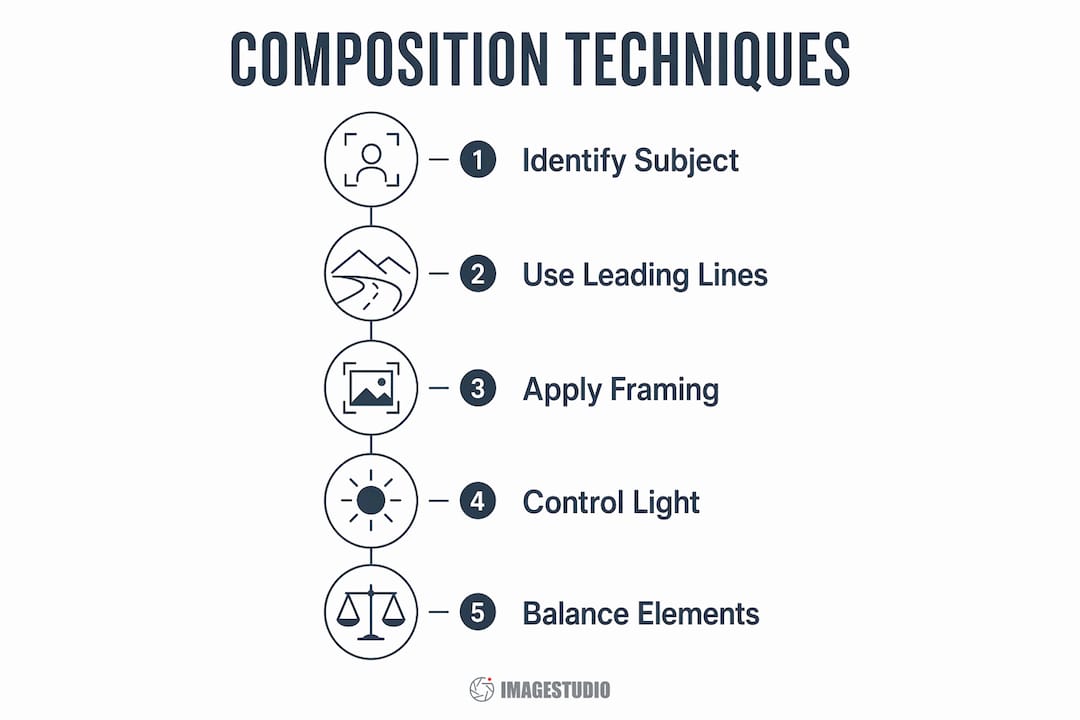
Here is a practical workflow for photographers and videographers:
Define the story beat first. Ask what single emotion or idea this frame needs to communicate. Every compositional choice follows from that answer.
Place your primary subject with intention. Use the rule of thirds, a leading line, or a natural frame within the environment to anchor the focal point.
Manage light as a compositional tool. The impact of light in storytelling is direct: light direction, quality, and color temperature all shift the emotional register of an image. Soft side light creates intimacy. Hard backlight creates drama.
Use negative space deliberately. A subject placed small within a large environment tells a story of scale or solitude. That is a narrative choice, not a compositional accident.
Review the full frame before shooting. Check edges, background elements, and competing bright spots. Adjust framing, focal length, or position to suppress distractions.
The importance of framing in photography extends beyond aesthetics. Framing defines what the viewer knows and does not know about the scene. A tight crop creates mystery. A wide establishing shot provides context. Both are valid storytelling tools, but each tells a different story. Choosing between them is a narrative decision, not a technical one.
Photographers who work in sequences, such as wedding filmmakers or documentary photographers, have an additional tool: temporal order. Research shows that coherent image sequences shift viewer gaze toward semantically meaningful elements more effectively than random arrangements. Building a visual narrative in sequence compounds the power of individual compositions.
Key takeaways
Composition is the primary tool photographers use to control how viewers read, feel, and remember an image. Every element in the frame either supports the story or competes with it.
Point
Details
Composition is visual grammar
It directs reading order and communicates meaning beyond the literal subject.
Visual hierarchy drives clarity
Plan primary, secondary, and detail tiers to prevent competing focal points.
Framing shapes narrative
Lookroom, headroom, and negative space control emotional tone and viewer comfort.
Light is a compositional element
Light direction and quality shift emotional register as powerfully as subject placement.
Suppress accidental salience
Bright edges and high-contrast patches steal fixation from your intended subject.
Why I stopped following composition rules and started building stories
The rules of composition photography, the rule of thirds, leading lines, the golden ratio, are taught as if they are the destination. They are not. They are the starting point. After 14 years working on productions for clients like National Geographic and earning recognition at international film festivals, the most consistent lesson I have learned is this: rigid rule-following produces technically correct images that feel emotionally empty.
The real skill is understanding why the rules work, so you know exactly when to break them. Centering a subject feels static in most contexts. But center a grieving person in a vast empty space, and the symmetry becomes devastating. The rule did not change. The story did.
The biggest mistake I see photographers make is composing for aesthetics first and story second. They chase a beautiful frame without asking what that frame is saying. Eye-tracking research backs this up: viewers are not passive. They actively search for meaning, and when the composition does not give them a clear path, they disengage. Your job is to make that path obvious without making it feel obvious.
Experiment constantly. Shoot the same subject with three different compositional approaches. Compare them. The differences will teach you more than any rule ever will. Composition is a language, and like any language, fluency comes from practice, not memorization.
— Image Studio
How Imagestudio approaches composition in cinematic production
Imagestudio has spent over 14 years building visual narratives that reach audiences at scale, with 250+ projects accumulating over 150 million views across platforms.
Every production at Imagestudio starts with a compositional brief, not a shot list. The team defines the story beat, the emotional register, and the visual hierarchy before a single frame is captured. That process is what separates content that performs from content that disappears. Whether you are producing a brand film, a music video, or a documentary, the cinematic production services at Imagestudio apply the same evidence-backed compositional thinking to every frame. If you want your visual story to land with the clarity and impact it deserves, the team at Imagestudio is ready to build it with you.
FAQ
What is the role of composition in visual storytelling photography?
Composition is the visual grammar that directs viewer attention and communicates meaning beyond the literal subject. It controls reading order, emotional tone, and narrative clarity in every frame.
How does visual hierarchy affect storytelling in photography?
Visual hierarchy establishes a planned attention sequence through contrast, focus, scale, and placement. Strong hierarchy guides the viewer through the story clearly; weak hierarchy produces visual noise that fatigues and confuses.
What are the most effective composition techniques for narrative photography?
Leading lines, framing within the frame, lookroom, headroom, and deliberate negative space are the most effective tools. Each one controls where the viewer looks and what emotional context they bring to the subject.
How does light function as a compositional element?
Light direction, quality, and color temperature shift the emotional register of an image as directly as subject placement does. Soft side light creates intimacy; hard backlight creates drama and separation.
Why does narrative context change where viewers look in an image?
Research shows that coherent narrative sequences shift viewer gaze from visually salient elements to semantically meaningful ones. Viewers actively search for story, and composition either supports or obstructs that search.