The world's finest hotels know that beautiful rooms are only the beginning. This editorial explores how photography, film, people, place and ritual become a storytelling system that builds recognition, trust and desire long before a guest arrives.
← Back to Editorial
← Back to Editorial
Why the World’s Finest Hotels Invest in Stories, Not Just Beautiful Images
August 22, 2026
HOSPITALITY • IMAGE STUDIO EDITORIAL
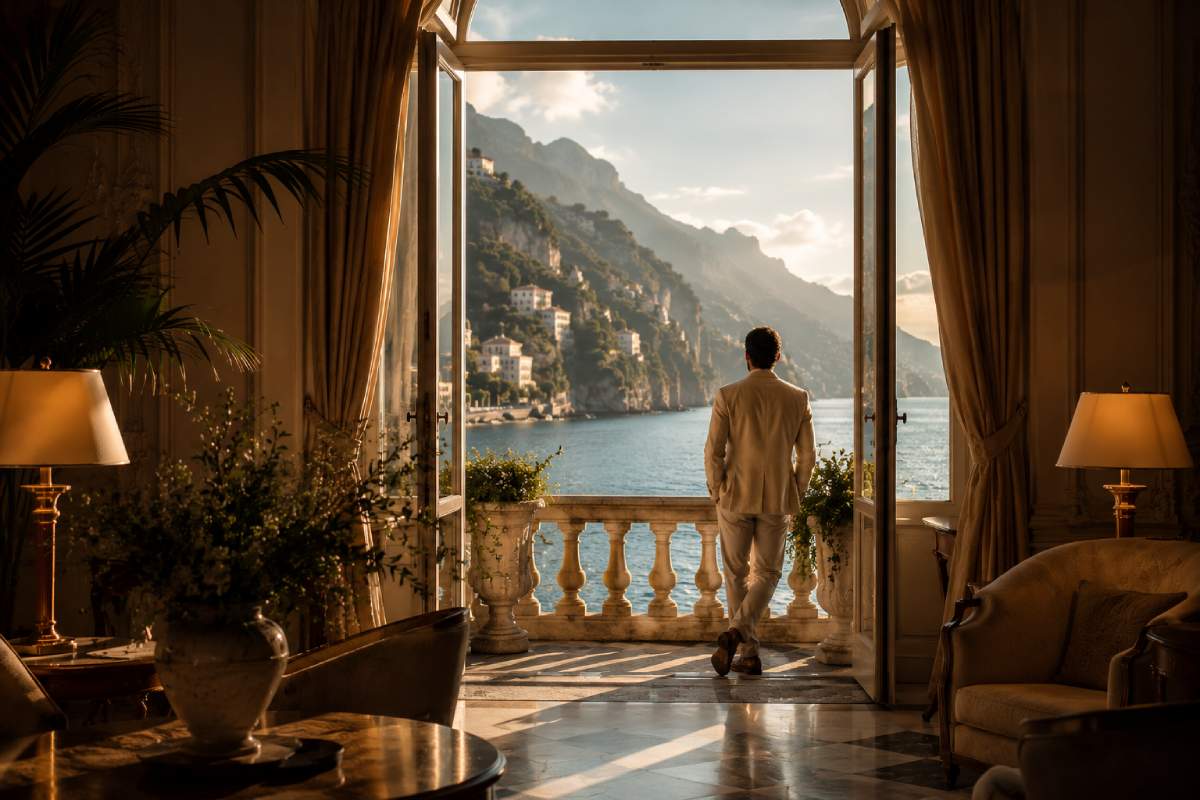
How luxury hospitality turns architecture, service, people and place into a visual world guests can imagine before they ever arrive.
| DIRECT ANSWER The finest hotels invest in storytelling because guests do not book rooms in isolation; they book an imagined experience. Beautiful images prove that a property looks desirable. Stories explain what it feels like to wake there, move through it, be recognised by its people, taste the place, and remember it afterwards. In luxury hospitality, that emotional continuity is what turns visual content into brand value. |
A perfect photograph of a hotel room can answer a practical question: what does it look like? It cannot, by itself, answer the question that matters most in luxury hospitality: what will it feel like to be there?
That difference explains why the world’s strongest hotels increasingly behave less like property advertisers and more like publishers. They document rituals, personalities, architecture, food, landscapes, craftsmanship and local culture. They build films around mornings rather than mattresses, around service rather than amenities, around the relationship between a hotel and its destination rather than a list of facilities.
The result is not simply more content. It is a more complete idea of the hotel.
| KEY INSIGHT A beautiful image can create desire. A story gives that desire direction: it tells the guest why this hotel, why this place and why this experience should matter to them. |
Hospitality Is Experienced Twice
A hotel stay happens once physically and once imaginatively. The first experience begins before booking, when a traveller encounters a photograph, film, review, social post, article or recommendation. The second begins when the guest arrives.
For luxury hotels, the first experience is not secondary. It sets expectations for the second. A website can make the service feel discreet before anyone has checked in. A short film can make a breakfast terrace feel like part of a morning ritual rather than an amenity. A social series can introduce the people, ingredients, neighbourhood and pace that make one property different from another.
This is why hospitality storytelling matters. It creates a bridge between what a property owns and what a guest hopes to experience.
By the Numbers: Why Story, Trust and Inspiration Matter
Recent travel research helps explain why a purely aesthetic content strategy is increasingly incomplete. Expedia Group’s 2025 Traveler Value Index surveyed 11,000 consumers across 11 markets. McKinsey’s 2024 luxury-traveller research surveyed more than 5,000 travellers who spend at least $500 per night on lodging.
|
61% |
76% |
77% |
68% |
| of consumers used social media as a source of travel inspiration in Expedia Group’s 2025 research. | would pay more for a hotel with better customer reviews. | of luxury travellers in McKinsey’s research said hotel brands matter when choosing accommodation. | of luxury travellers said loyalty programmes are an important accommodation-selection factor. |
The numbers describe different parts of the decision journey, but together they show something important: luxury hospitality is not judged only through the physical product. Travellers are influenced by inspiration, reputation, identity and trust before the stay begins.
| GOOD TO KNOW Expedia Group found that social media as a source of travel inspiration rose from 35% in its earlier study to more than 60% in 2025. A hotel’s visual world is increasingly part of discovery, not merely a final-stage sales asset. |
Beautiful Images Have Become the Baseline
Luxury hotels once differentiated themselves visually through access to better photographers, more dramatic architecture and more polished production. That advantage has narrowed. High-quality cameras are everywhere. Architectural photography has become sophisticated. Competitors can reproduce many of the visual codes once associated with luxury: neutral palettes, pools at dusk, breakfast trays, marble bathrooms, linen, symmetrical lobbies and carefully styled suites.
The problem is not that those images are bad. The problem is that many are interchangeable.
If the logo disappeared, could a traveller identify the hotel? Could they recognise the destination? Could they describe the personality of the service? Could they understand who the hotel is for?
Storytelling begins where generic beauty stops answering those questions.
From Property to World: What Storytelling Adds
|
Beautiful image |
Story-led content |
What changes |
| Shows the room | Shows a morning inside the room | The space becomes part of an experience |
| Shows the pool | Shows how guests move through the pool, landscape and service | The amenity gains atmosphere and human scale |
| Shows a dish | Shows ingredients, chef, table, timing and place | Food becomes culture, not inventory |
| Shows the spa | Shows ritual, quiet, material and transition | Wellness becomes an emotional promise |
| Shows the view | Connects the view to weather, sound, season and local geography | The destination becomes part of the brand |
| Shows staff | Reveals recognition, craft and service behaviour | Hospitality becomes human |
| THE DETAIL In hospitality, the same physical feature can carry completely different brand meaning. A terrace can communicate celebration, solitude, romance, gastronomy or place depending on the story built around it. |
The Six Story Territories Every Hotel Already Owns
A hotel does not need to invent a fictional narrative. Most of the strongest material already exists inside the property. The creative task is identifying which parts deserve emphasis and how they connect.
1. Place
Why does the hotel belong here? Geography, architecture, landscape, neighbourhood, weather and local culture give the property context. Place prevents a hotel from feeling transferable to any city or coastline.
2. People
Luxury service becomes believable when it has faces, gestures and expertise. Concierges, chefs, gardeners, bartenders, housekeepers, artisans and local collaborators can reveal the intelligence behind a seamless stay.
3. Ritual
Breakfast, aperitivo, turn-down, a boat departure, a spa sequence, the first coffee of the morning or the return from dinner can become recurring brand moments. Ritual turns amenities into memory.
4. Time
A hotel changes across a day and across a season. Morning light, afternoon energy, evening service and night atmosphere should not be flattened into one perpetual golden hour.
5. Detail
Materials, objects, food, flowers, uniforms, typography, sound and small acts of preparation communicate quality at close range. The detail matters most when it supports a larger idea.
6. Transformation
The deepest hospitality story is about the guest: how the experience changes their pace, attention, relationships or understanding of a place. The hotel is the setting for that transformation, not always the protagonist.
| KEY INSIGHT Luxury hotel storytelling becomes stronger when the property stops asking only, ‘What do we need to show?’ and starts asking, ‘What should a guest understand and feel after seeing this?’ |
The Guest Journey Is Also a Content Journey
Hotels often produce content by department: brand campaign, rooms, restaurant, spa, social media, weddings, events. Guests do not experience the hotel in departments. Their journey moves through stages, and each stage asks a different question.
|
Guest stage |
What the traveller is asking |
Content that helps |
| Discovery | Why should I care about this place? | Atmospheric film, editorial photography, destination stories, social-first content |
| Consideration | Is this right for me? | Rooms, service, food, wellness, location, guest scenarios, practical context |
| Booking | Can I trust the promise? | Consistent visuals, reviews, clear room/product information, brand credibility |
| Pre-arrival | What should I anticipate? | Destination guidance, rituals, itineraries, seasonal content, concierge stories |
| Stay | What should I notice or experience? | In-room editorial, social touchpoints, local recommendations, experiences |
| Post-stay | What will I remember and share? | Distinctive moments, social assets, cultural connection, recognisable visual identity |
Why Social Media Changed Hotel Storytelling
Social media did not make hotel storytelling important; it made the consequences of weak storytelling easier to see. A property can no longer rely on one annual campaign and assume every guest will discover the hotel through the same route.
Expedia Group’s 2025 research found that more than 60% of consumers cited social media as a source of travel inspiration, while 73% said an influencer recommendation had affected a booking decision. This does not mean every luxury hotel should chase creators or trends. It means the hotel now participates in a visual ecosystem where guests encounter fragments of the brand long before they visit the official website.
The strategic response is not simply to publish more often. It is to make each fragment recognisable as part of the same world.
For hotels developing that always-on visual system, Image Studio approaches social media production as an extension of brand storytelling rather than a separate stream of disposable posts.
Photography, Film and Social Content Do Different Jobs
|
Format |
Best at |
Hospitality role |
| Photography | Precision, atmosphere, detail, architecture, decisive moments | Creates the visual archive: website, press, campaigns, booking platforms, print and evergreen brand assets |
| Film | Time, movement, sound, rhythm, transformation | Shows what it feels like to move through the property and experience service |
| Social-first video | Immediacy, frequency, personality, discovery | Keeps the brand culturally present and reveals smaller stories too specific for a hero campaign |
| Editorial writing | Context, voice, knowledge, destination depth | Explains the culture, people and ideas behind the visuals |
The formats are strongest when they are conceived together. A commercial shoot should not produce only a hero film and a folder of stills. It should produce a connected visual library with enough range for campaigns, website modules, social sequences, editorial features, press, sales and future seasonal use.
That is the logic behind Image Studio’s commercial production: one creative direction, translated across the formats a brand actually needs.
The Luxury Paradox: The More Polished the Hotel, the More Human the Story Must Feel
Luxury hospitality faces a particular creative problem. As properties become more refined, it becomes easier for their content to become visually immaculate but emotionally distant.
McKinsey’s 2024 luxury-traveller research found that 77% of luxury travellers consider hotel brands important when choosing accommodation, compared with 53% of mass travellers. Yet luxury is increasingly experiential. Deloitte has similarly argued that luxury is moving beyond possession toward experiences shaped by lifestyle, authenticity and personal choice.
This creates a tension. The brand must feel controlled enough to communicate excellence, yet alive enough to communicate experience. The answer is not artificial informality. It is specificity: real places, real craft, real routines, real service behaviours and a recognisable point of view.
| FIELD NOTE The visual language of luxury is often strongest when the camera notices what the guest notices: the hand that prepares the table, the door opened at the right moment, the quiet before breakfast, the change of light across a room, the pace of service rather than the spectacle of service. |
Independent Hotels Have a Storytelling Advantage – If They Use It
McKinsey reported that roughly 70% of luxury-hotel properties are independent, even as branded chains and franchises represent a much larger share of the development pipeline. Independence can make distribution, loyalty and scale harder. Creatively, however, it can be an advantage.
An independent property can often speak with extraordinary specificity. Its building may have a particular history. Its owner may have a clear collecting philosophy. Its restaurant may work with producers from a precise radius. Its garden may change dramatically by season. Its service culture may have grown from a family or local tradition rather than a global brand manual.
The challenge is turning those details into a coherent identity instead of presenting them as disconnected facts.
What Hotel Storytelling Is Not
A cinematic montage of amenities with no clear point of view.
A beautiful model walking through the property without behaving like a guest.
A social feed where every post follows a different trend.
Generic captions that could belong to any hotel in any destination.
A once-a-year hero campaign with no plan for the remaining eleven months.
A room catalogue disguised as editorial content.
A claim of authenticity without specific people, places, rituals or evidence.
| KEY INSIGHT Storytelling does not mean making content more complicated. It means making the reason for each image clearer. |
A Practical Story System for a Luxury Hotel
A useful hotel-content strategy can be built around a small number of recurring story pillars rather than an endless list of shoots.
|
Pillar |
What to capture |
Where it works |
| Arrival & orientation | Approach, entrance, welcome, first view, first interaction | Hero film, website, paid campaigns |
| Rooms as lived spaces | Morning, evening, unpacking, views, materials, service | Website, CRM, social, booking support |
| Food & drink | Kitchen, producers, ritual, service, table, atmosphere | Editorial, social, restaurant campaigns |
| People & craft | Staff expertise, artisans, preparation, local collaborators | Brand film, recruitment, PR, social |
| Wellness & pace | Transitions, quiet, body, water, landscape, privacy | Campaigns, social, editorial |
| Destination | Culture, geography, streets, nature, access, local experiences | SEO/editorial, concierge content, social |
| Celebration & events | Weddings, private dinners, meetings, takeovers | Sales, event marketing, wedding campaigns |
| Seasonality | Weather, light, menus, landscape, rituals | Always-on social, CRM, repeat-guest campaigns |
The 90-Minute Content Audit
Before commissioning another shoot, a hotel can learn a great deal by auditing what it already has.
Remove every logo. How much of the current content is still recognisably yours?
Count how many images show spaces versus people actually experiencing them.
Check whether morning, afternoon, evening and night all exist in the visual library.
Review whether food is shown as dishes only or as part of hospitality and culture.
Look for employees, craft and service behaviour. Are they present or invisible?
Compare the website, Instagram, paid advertising and press photography. Do they feel like one brand?
Identify the most repeated generic shot and ask what story could replace it.
List the questions guests repeatedly ask before booking. Does existing content answer them?
Check whether the destination has a role in the brand beyond a view from the window.
Identify what can only be photographed or filmed in a specific season and plan accordingly.
| SAVE THIS If most of a hotel’s visual library could be licensed to a competitor without anyone noticing, the issue is not image quality. It is brand specificity. |
How to Measure Storytelling Without Reducing It to Likes
Storytelling is creative, but it should not be exempt from commercial evaluation. The mistake is measuring every format by the same metric.
|
Objective |
Useful signals |
What not to confuse it with |
| Awareness | Qualified reach, video completion, branded search, press pickup | Raw impressions alone |
| Consideration | Website depth, gallery engagement, room/experience exploration, return visits | Single-page traffic |
| Trust | Review strength, direct enquiries, assisted conversions, brand search | Aesthetic approval |
| Booking support | Conversion rate, direct-booking contribution, campaign-assisted revenue | Last-click attribution only |
| Retention | CRM engagement, repeat visits, loyalty interaction, social saves/shares | Follower count |
| Brand value | Recognition, consistency, higher-value enquiries, stronger partnerships | Short-term virality |
A single film may influence awareness, consideration and brand memory without being the final click before booking. A restaurant story may increase the perceived depth of the stay rather than sell a room directly. Measurement should reflect the role each asset plays in the guest journey.
Hotel Storytelling: Quick Reference
|
Question |
Concise answer |
| WHAT IS HOTEL BRAND STORYTELLING? | A system that uses photography, film, writing and social content to communicate how a property feels, who it is for and why it is distinct. |
| BEST FOR | Hotels that need to differentiate beyond rooms, amenities and generic luxury aesthetics. |
| CORE SUBJECTS | Place, people, ritual, time, detail and guest transformation. |
| PRIMARY FORMATS | Photography, film, social-first video and editorial content. |
| MAIN BUSINESS VALUE | Differentiation, trust, recognition, stronger consideration and a more coherent guest journey. |
| MAIN RISK | Producing beautiful content that could belong to any comparable hotel. |
| FIRST STEP | Audit the existing visual library and identify what is recognisably specific to the property. |
Frequently Asked Questions
Why do luxury hotels need storytelling if the property is already beautiful?
Because beauty proves quality but does not automatically create differentiation. Storytelling connects architecture and amenities to people, place, ritual and emotion, giving travellers a reason to remember one property rather than another.
What is the difference between hotel photography and hotel storytelling?
Hotel photography can document rooms, architecture, food and amenities. Storytelling uses those images as part of a larger narrative about how the hotel is experienced, who it serves and what makes its relationship with the destination distinctive.
Should a hotel prioritise photography or video?
Most luxury hotels need both. Photography remains essential for websites, booking platforms, press, print and campaigns. Film adds movement, sound, service, pace and emotional progression. Social-first video supports frequent discovery and smaller stories.
How often should a luxury hotel create new content?
There is no universal schedule. Production should follow genuine changes in season, menu, experience, audience and campaign needs. A strong evergreen library can reduce the need for constant reshooting, while social channels still require an ongoing flow of relevant material.
Does storytelling improve direct bookings?
Storytelling can support direct booking by strengthening differentiation, trust and consideration, but it should not be treated as a single-variable guarantee. Booking performance also depends on pricing, reviews, availability, distribution, website usability and the overall offer.
What stories should an independent hotel tell?
Independent hotels should begin with what competitors cannot easily copy: the building’s history, people, service culture, location, local relationships, rituals, food, design decisions and the specific experience of time and place.
How can hotels use social media without damaging a luxury image?
Consistency matters more than formality. Short-form content can still feel refined when the subject, typography, colour, pace, sound and editorial choices belong to the same brand world. Luxury does not require every post to look like an advertisement.
What should a hotel brief a production company before a shoot?
Clarify the audience, business objective, brand position, priority experiences, distribution channels, required formats, seasonality, access constraints and what should feel different after the audience sees the work. A shot list alone is not a creative strategy.
The Finest Hotels Do Not Sell Rooms. They Build Anticipation.
A traveller may first discover a hotel through six seconds of vertical video, a magazine photograph, a friend’s story, a restaurant image or a single frame of architecture. The hotel cannot control every path to discovery. It can control whether those fragments belong to the same idea.
That is why the strongest hospitality brands invest in stories. They understand that visual content has to do more than prove beauty. It has to introduce a world before the guest arrives, make the physical experience feel consistent with the promise, and leave behind an identity strong enough to be remembered after departure.
The room matters. The view matters. The design matters. But in a market where many properties are beautiful, the story is what gives those things meaning together.
| FINAL THOUGHT Beautiful images make a hotel desirable. A coherent story makes it recognisable. |
Building a Hospitality Story?
Image Studio creates photography, film and social content for hospitality brands that want to communicate more than how a property looks. Explore our commercial production and social media production, or start a conversation about your property.