Wedding Content Creator vs Videographer: What’s the Difference and Do You Need Both If you are asking whether a wedding content
Wedding Content Creator vs Videographer:
What’s the Difference and Do You Need Both
If you are asking whether a wedding content creator can replace a videographer, the most accurate answer is no not in the way most couples mean it. A content creator captures the day as it unfolds for your phone: vertical clips, behind-the-scenes moments, candid reactions, social-ready edits, and fast delivery, often within 24 hours. A videographer creates a cinematic wedding film: professional camera coverage, clean audio of vows and speeches, structured editing, highlight films, and longer-form keepsakes delivered on a much slower timeline. They are not competing vendors so much as two different memory formats.
That difference matters even more for a destination wedding in Italy, where the story rarely fits inside one ceremony block. ENIT and Convention Bureau-backed reporting describe Italy as a leading destination wedding market, with more than 15,100 foreign-couple weddings in 2024, continued growth into 2025, and average event budgets in the roughly €61,500 to €67,000 range depending on the source and methodology. At the same time, The Knot and Zola both show that destination and modern weddings increasingly stretch into welcome events, farewell moments, and multi-day itineraries rather than a single, self-contained day.
So the modern decision is not really wedding content creator or videographer. It is this: do you want only the polished film, only the immediate social-first layer, or a combination of both? For many couples planning Lake Como, Tuscany, the Amalfi Coast, or Venice, the most intelligent answer is both because one captures the atmosphere while it is still alive, and the other turns the emotional architecture of the day into something you can revisit for years.
A wedding content creator captures fast, behind-the-scenes, vertical, social-ready footage usually on a smartphone or compact setup-and often delivers it within 24 hours. A wedding videographer creates a cinematic wedding film using professional cameras, audio gear, and longer post-production. Most destination weddings in Italy do not need one instead of the other; they benefit from each role for different reasons.
Table of Contents
Introduction
What a wedding content creator does
What a wedding videographer does
Wedding content creator vs videographer comparison
Can one replace the other
Why destination weddings in Italy often benefit from both
Real wedding-day example
Introduction
The reason this topic is suddenly everywhere is simple: wedding media expectations have changed faster than wedding vocabulary. Zola’s 2026 First Look Report, based on more than 11,500 couples, says social media now influences wedding decisions for 87% of couples, more than half now get wedding inspiration from TikTok, and Gen Z couples are especially likely to want social-first documentation alongside traditional coverage. Zola’s vendor research also shows wedding content creators have become the most requested type of “unique or niche” vendor among surveyed couples who book one.
But the best current guides still tend to stop at a surface-level distinction: content creator equals instant and vertical; videographer equals polished and cinematic. That is true, but it is not yet enough to help a couple planning a real wedding weekend in Italy. It does not tell you what each vendor is actually doing from welcome drinks to first dance, where the overlap really ends, or why one team often improves the performance of the other rather than duplicating it.
For couples planning in Italy specifically, that missing nuance matters. Official Italian tourism sources frame the country’s destination wedding market around experience, hospitality, place identity, and multi-day travel moments rather than ceremony alone. That means the most useful question is not “which vendor shoots video?” It is “which vendor captures which layer of the experience?”
If you want a destination-focused foundation before you decide, Image Studio’s own Wedding Content Creator Italy Guide explains how the role works within Italian wedding weekends, and the Wedding Content Creator Italy service page shows what an editorial, 24-hour delivery format can include in practice. Both position content creation as a complement to photography and videography, not a substitute for either.
What Each Professional Actually Does
What Does a Wedding Content Creator Do?
A wedding content creator captures the wedding in the language people now use to relive and share a day: vertical video, candid behind-the-scenes coverage, raw clips, Stories, Reels, quick edits, and organized camera-roll content delivered fast. The role is typically smartphone-first, though not always smartphone-only; some creators use a hybrid of phones and small cameras. The defining feature is less the exact device and more the combination of short-form framing, social-native thinking, and accelerated turnaround.
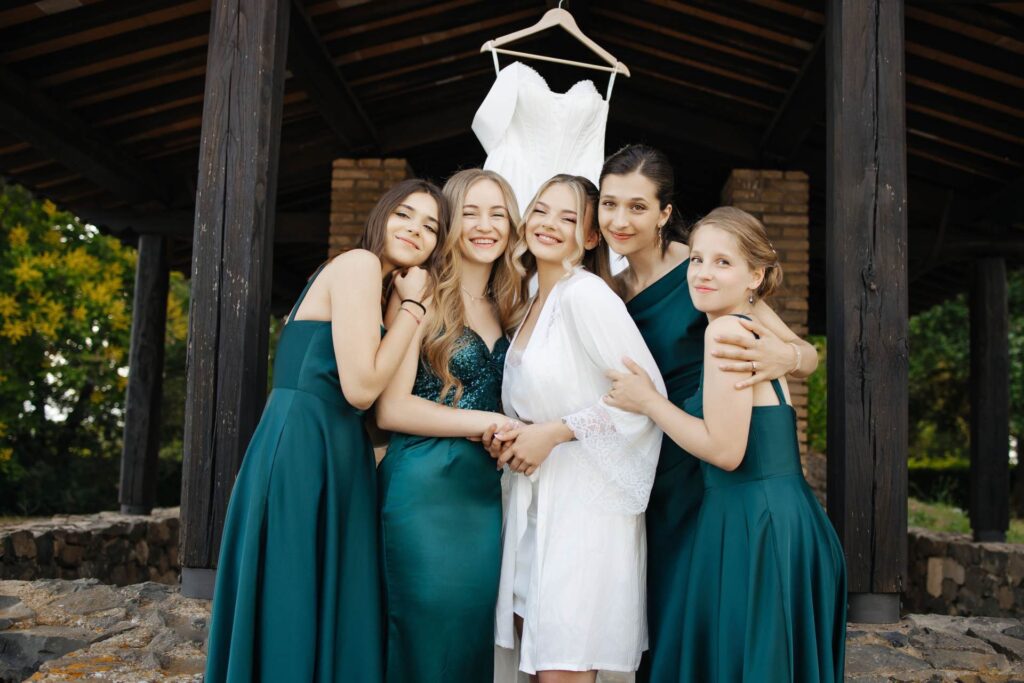
In practice, that means a content creator is often documenting the emotional margins of the day: the robe-and-coffee quiet before hair and makeup is finished, the planner steaming a veil, the group-chat energy of bridesmaids on a terrace, the groom fixing cufflinks, a parent’s expression before the aisle reveal, the movement from ceremony to aperitivo, and the late-night dance-floor chaos guests usually capture badly on their own phones. Image Studio’s service page describes the value clearly: editorial vertical reels, emotional behind-the-scenes moments, same-day content, and delivery within 24 hours, all designed to work alongside the rest of the media team.
Just as important is what the content creator often delivers within 24 hours. Current market guidance and reporting point to organized raw footage, selected edited vertical reels, social-ready highlights, and sometimes even near-live posting or overnight folder delivery. Vogue’s reporting describes creators editing through the night so couples wake up to labeled folders the next morning, while Image Studio and Italy-based providers position 24-hour delivery as a core part of the service, not a bonus add-on.
This is why calling the role “just TikTok” misses the point. Yes, the format is shaped by Instagram Reels, Stories, and TikTok habits. But the deeper value is immediacy. Vogue frames the category around a broader shift toward candid, less hyper-polished memory-making, and Image Studio’s own editorial guide argues that the strongest luxury positioning is not “viral clips,” but preserving the emotional life of the celebration in a form couples can actually live with immediately.
A professional content creator also does more pre-planning than many couples realize. Brides and The Knot both emphasize discussing deliverables, equipment, collaboration style, privacy preferences, and contract compatibility with other vendors in advance. That matters because the best creators do not just gather footage; they move discreetly, stay out of the photographer’s frame, respect private moments, and know when not to turn a real interaction into a performance.
What Does a Wedding Videographer Do?
A wedding videographer is not primarily making feed content. A videographer is building a film. That requires a different production logic from the moment the day begins: multi-camera coverage, audio setup, scene sequencing, establishing shots, intentional lens choices, and post-production shaped around narrative, rhythm, and sound. Image Studio’s editorial wedding pages describe wedding film production in exactly those terms: cinematic storytelling, multi-camera shooting, professional audio capture, narrative construction, color grading, and carefully structured delivery.
The technical distinction matters because sound is where videography pulls away decisively. A content creator may capture atmosphere and native audio beautifully, but a videographer is usually mic’ing the officiant, the groom, the ceremony space, speeches, and ambient room tone. According to Image Studio’s film-editing guide, wedding films routinely involve syncing and cleaning multiple audio sources; vows, speeches, and ambient sound then become the emotional spine of the final edit. That is why a wedding film feels different from a highlight cut made from social clips: it does not just show the day, it lets you hear it and re-enter it.
A videographer’s deliverables are also different in scope. Typical packages include some combination of a highlight film, full ceremony edit, speeches or toasts edit, and sometimes a longer documentary-style film. Image Studio’s editorial workflow articles place these outputs on a weeks-long or months-long timeline, with 8 to 12 weeks common for finished films and longer waits possible in solo workflows or peak season.
This is why videography is still the clearest choice if you care about professional vows audio, the full emotional architecture of speeches, or a film you expect to watch on anniversaries and share with future family. And it is why the strongest answer to “can a wedding content creator replace a videographer?” is usually no unless you are consciously giving up those outcomes, not merely assuming you will get them another way.
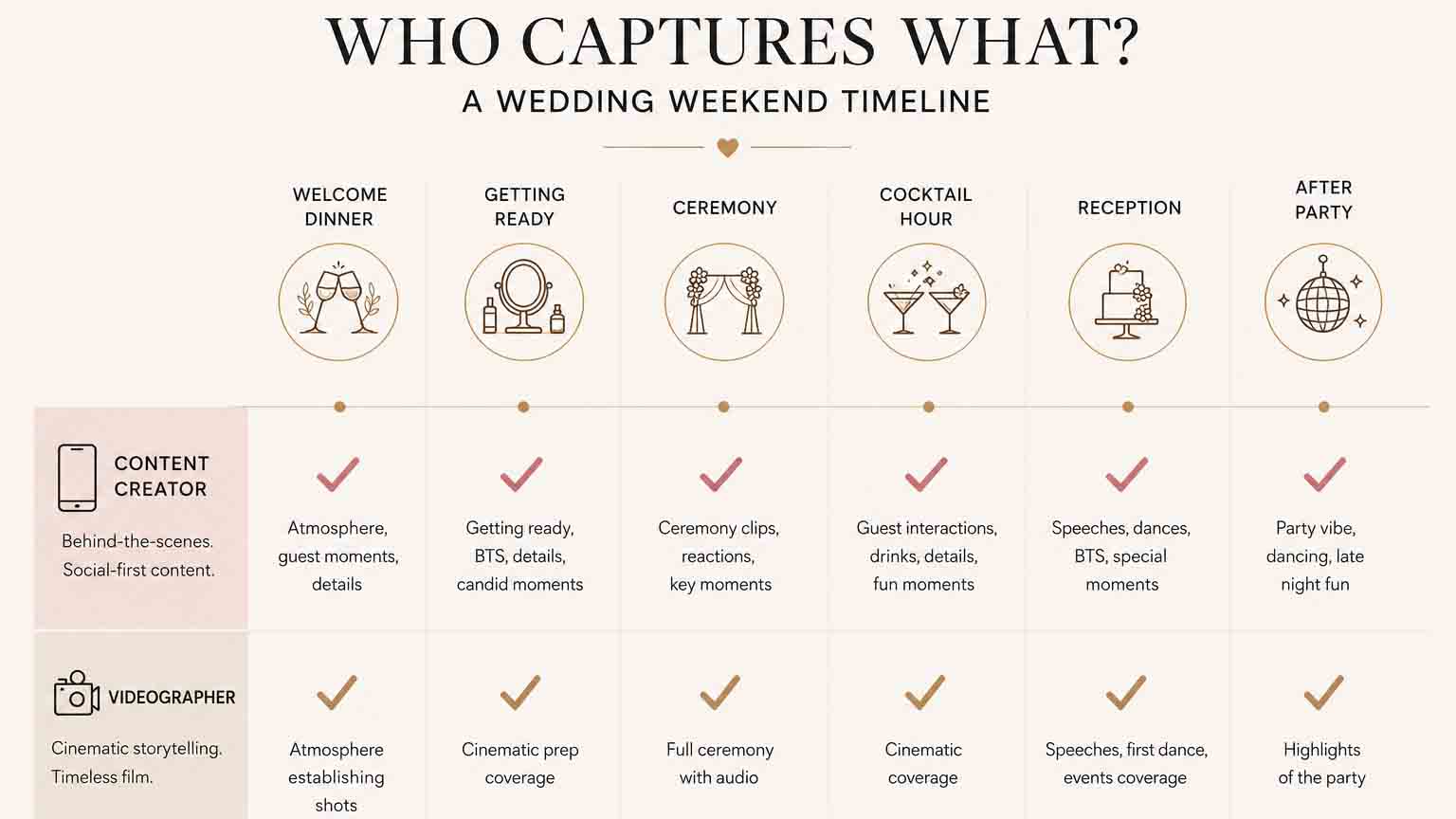
A side-by-side wedding weekend timeline showing how content creators and videographers capture different moments, from getting ready and ceremony coverage to reception and after-party highlights.
The Practical Difference in One Sentence
A content creator preserves the present tense of the wedding. A videographer preserves the cinematic memory of it. For modern couples, especially at a destination wedding in Italy, those are often two separate needs rather than one duplicated service.
Wedding Content Creator vs Videographer
Side-by-Side Comparison
Criteria
Wedding Content Creator
Wedding Videographer
Equipment
Usually smartphone-first, with compact stabilizers and sometimes a small hybrid kit
Professional video setup with cinema or mirrorless cameras, lenses, gimbals, drones, and external audio
Same day to 72 hours is common; 24 hours is a major selling point
Often several weeks; 8 to 12 weeks is common for finished films
Final product
Vertical reels, Stories, camera-roll clips, raw footage, fast edits
Highlight film, ceremony edit, speeches, documentary or long-form film
Social media use
Built specifically for phones, sharing, and near-immediate posting
Secondary unless the videographer offers social add-ons
Emotional storytelling
Captures energy, atmosphere, and in-between reactions in real time
Captures vows, speeches, pacing, and the full emotional arc
Cost expectations
In Italy, public guides commonly place professional coverage around €1,200 to €3,500+, depending on hours, team size, and extras
Italy destination ranges can start around €1,500 to €3,000, move through €3,500 to €6,000 mid-range, and rise sharply for premium and luxury productions
Ideal couples
Want instant reliving, BTS moments, social-ready coverage, and fast shareability
Want cinematic film, clean audio, narrative editing, and a long-term keepsake
Comparison note: this table synthesizes current guidance from Image Studio, Zola, The Knot, Vogue, and active category explainers, plus Italy-based pricing guides. Exact quotes vary by hours, region, travel, team size, and delivery package.
The most important distinction is not aesthetic; it is purpose. The content creator is optimizing for speed, intimacy, and usability on a phone. The videographer is optimizing for narrative depth, professional finish, and emotional replay value. That is why the same wedding can justify both roles without any contradiction at all.
Pros and Cons Table
Option
Advantages
Trade-offs
Best Fit
Content creator only
Fast delivery, lower entry cost, more candid BTS coverage, excellent for social sharing and next-day reliving
No true cinematic film, limited professional audio, less suited to vows/speeches as lasting film assets
Couples who prioritize immediacy over film and are happy without a traditional wedding movie
Videographer only
Professional audio, cinematic storytelling, long-term keepsake, stronger coverage of ceremony and speeches
Slower delivery, less social-native output, less emphasis on in-between moments and phone-ready sharing
Couples who want a classic heirloom film and care less about immediate social content
Both together
Best of both worlds: instant coverage plus a timeless film, better coverage of multi-day events, fewer conflicting expectations placed on one vendor
Higher overall budget and more coordination required
Destination weddings, luxury weddings, weekend weddings, and couples who want both immediacy and legacy
Pros and cons note: these trade-offs reflect the dominant differences repeatedly described by Zola, The Knot, Vogue, Image Studio, and current ranking articles in the category.
Can a Wedding Content Creator Replace a Videographer?
Nuanced answer: a content creator can replace a videographer only if you do not actually want videography outcomes. If what you want is fast, phone-native coverage, candid behind-the-scenes footage, edited Reels, and the ability to relive the wedding by breakfast the next morning, then yes—a content creator may be the better choice for your priorities. But that is not the same thing as replacing professional film coverage.
A content creator does not usually replace clean vows audio, multiple lav mics, ceremony-wide coverage, carefully mixed speeches, drone-led scene setting, or a color-graded film built to hold emotional weight years later. If hearing your partner’s voice during the vows matters to you, if speeches are central, or if you want a film that behaves like an heirloom rather than a social asset, you still want a videographer.
So the fairest answer is this: a wedding content creator can replace a videographer as a budget choice, but not as a technical or emotional equivalent. That distinction is where many couples get clarity.
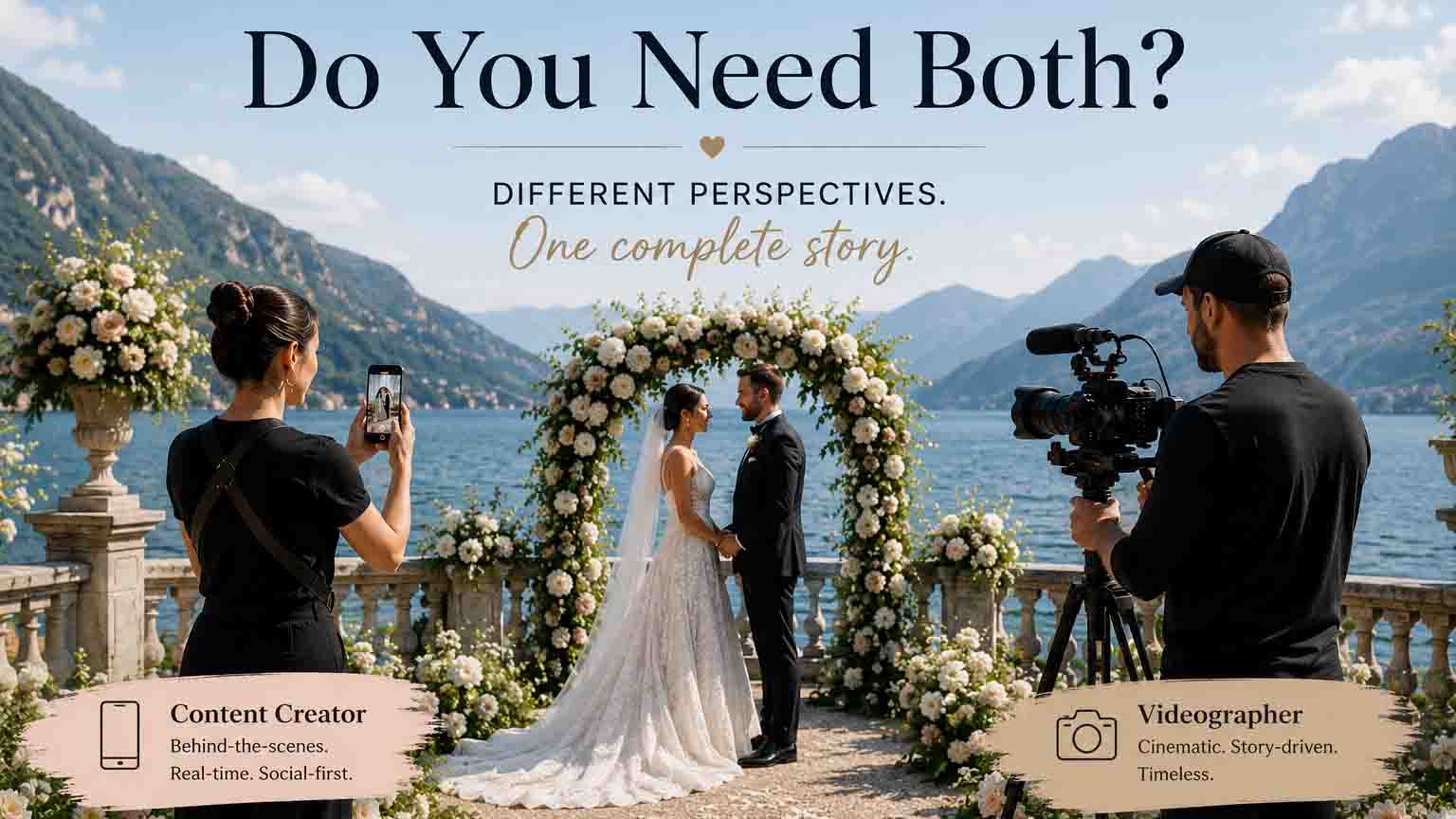
A wedding content creator and videographer document the same ceremony from different perspectives, combining real-time social content with cinematic storytelling.
Can a Videographer Replace a Wedding Content Creator?
Also nuanced. A videographer can sometimes cover part of the content-creator brief, especially now that some wedding photographers and videographers offer social-media sharing or same-day-edit add-ons. The Knot notes that those services are increasingly visible in vendor marketplaces, and Zola’s 2026 data shows many couples are explicitly asking traditional media teams to gather social-first content as part of the overall plan.
But that still is not always the same as hiring a dedicated content creator. The mindset is different. A videographer is thinking in scenes, audio, pacing, and film structure. A content creator is thinking in rapid-turnaround folders, vertical framing, short edits, and the constant collection of in-between moments that may never make it into a formal wedding film. If next-day delivery, behind-the-scenes quantity, and feed-native formatting are priorities, a social add-on often only partially closes the gap.
In practical terms, a videographer can replace a content creator only when you are comfortable sacrificing the dedicated immediacy, volume, and phone-native thinking that define the role. For some couples that is fine. For others, especially destination couples juggling multiple events, it becomes obvious very quickly that the two jobs do not feel the same on the ground.
Cost Expectations in Italy
Because many search results are U.S.-based, couples planning Italy often underestimate how different destination pricing can feel. Zola’s U.S. marketplace data places many wedding content creators below the cost of videography and reports a large share of couples spending under $1,000 for content creation, while U.S. videography averages sit around the low-$4,000 range depending on methodology. But Italy-focused public guides place professional wedding content creator coverage more commonly around €1,200 to €3,500, while Image Studio’s editorial pricing guide places destination videography across tiers from roughly €1,500 to €3,000 starter, €3,500 to €6,000 mid-range, and well above that for premium and luxury destination production.
That divergence makes sense. Italy destination weddings are often travel-heavy, multi-location, multi-day, and higher-budget overall, with official tourism reporting average destination wedding budgets in the €60,000-plus bracket. In other words, if you are planning Lake Como, Tuscany, Venice, or the Amalfi Coast at a luxury or editorial level, treat Italy-specific quotes as more relevant than generic English-language averages.
Why Modern Destination Weddings in Italy Often Benefit from Both
Italy is exactly where the “wedding content creator and videographer” pairing starts to make unusually strong sense. ENIT describes the country’s wedding tourism economy as a high-growth, high-value sector built around hospitality, landscape, culture, and immersive travel experiences. The Knot calls destination weddings a multi-day guest experience, and Zola reports that 37% of couples now host at least one additional event while 18% opt for a full two- to three-day wedding weekend. Those are not small formatting details; they create more moments than one cinematic highlight film can comfortably absorb.
A content creator is especially valuable whenever the wedding story includes movement, travel, atmosphere, and fast-changing social moments. A videographer becomes especially valuable whenever the wedding story includes ceremony sound, meaningful speeches, architectural sequencing, and a long-form emotional payoff. Italian destination weddings usually contain all of that.
Lake Como
Official Lake Como tourism leans heavily on a few defining images: historic villas, alpine grandeur, villages and gardens, and boat experiences across the water. That is almost a perfect recipe for split-role coverage. A content creator is brilliant at capturing the energy of arrival: the boat docking, sunglasses-off excitement, room reveals, welcome drinks on the terrace, and those fleeting transitions that feel cinematic in real life but ephemeral by the next week. A videographer, meanwhile, can turn the place itself into a film language through wider establishing shots, ceremony sound, and structured sequences that slow the day down enough to feel timeless.
Refined wedding details set the tone for Victoria and Matteo’s elegant celebration on Lake Maggiore.
Tuscany
Tuscany gives couples an entirely different rhythm: countryside villas, historic houses, vineyard roads, wine estates, gardens, and long-table dinners that unfold gradually rather than explosively. Official Tuscany tourism sources repeatedly foreground villas, countryside stays, vineyards, and heritage environments. That makes the content creator especially effective across the layers of the weekend—getting ready in a villa room, olive-grove walks, aperitivo movement, dinner details, post-sunset candles, and the social texture of a welcome party or day-after brunch. The videographer then anchors the weekend with filmic continuity: vows, speeches, landscape-to-portrait transitions, and the emotional pacing that turns “beautiful location” into “story.”
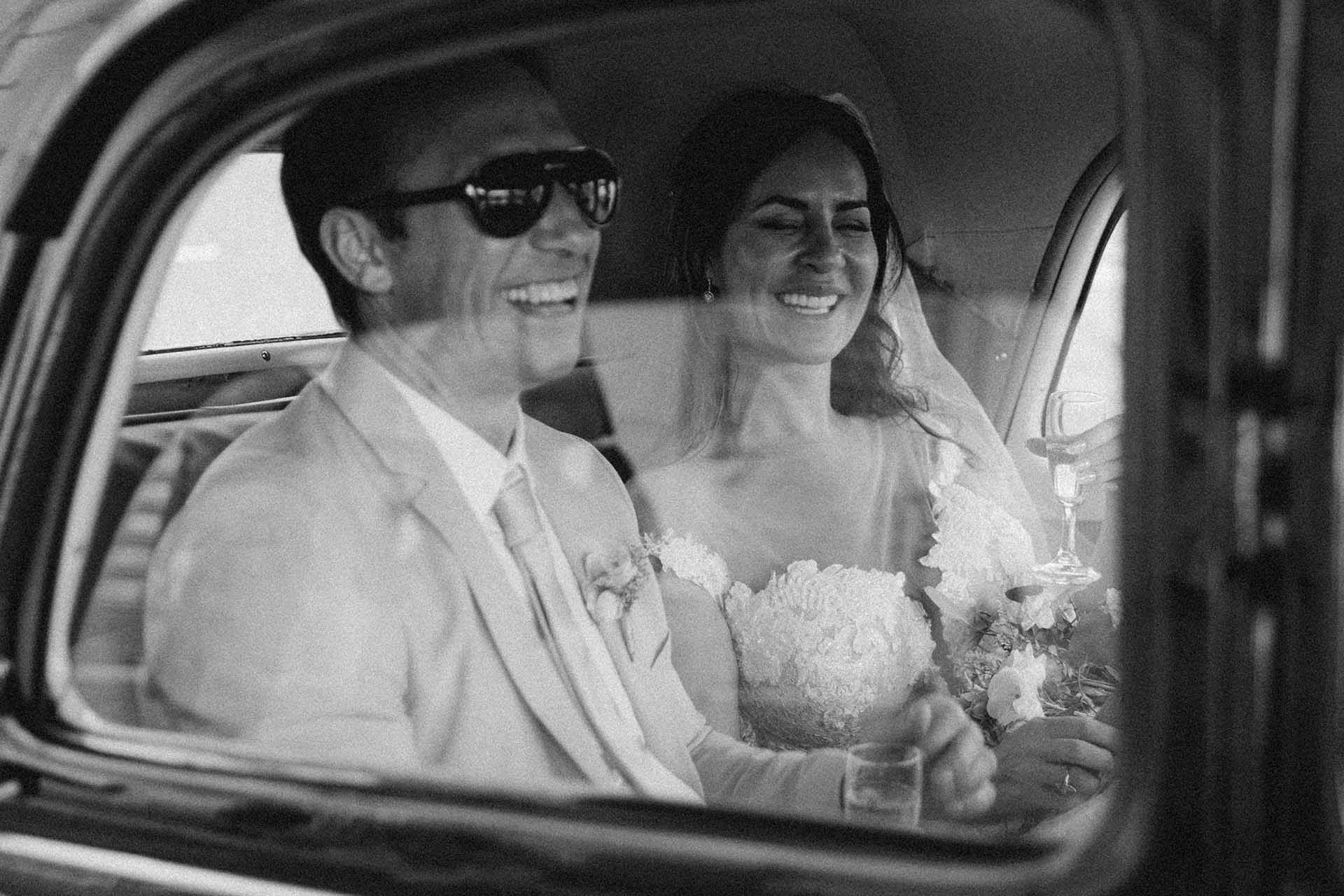
A joyful moment inside the car.
Amalfi Coast
Amalfi is about motion as much as scenery: sea, terraces, vertical geography, water taxis, boats, roads, blue light, golden-hour facades, and social spaces that naturally produce highly shareable moments. The official destination site emphasizes the Mediterranean setting, romantic and premium experiences, sea-based activity, and the emotional pull of the place; Vogue’s reporting on a creator’s Amalfi Coast wedding also underlines why digital-friendly iPhone memory capture can matter in a destination format. On the Amalfi Coast, a content creator excels at pre-ceremony energy, spontaneous guest moments, transit between spaces, and near-immediate sharing. A videographer gives the geography emotional structure-turning movement into narrative rather than fragmentation.
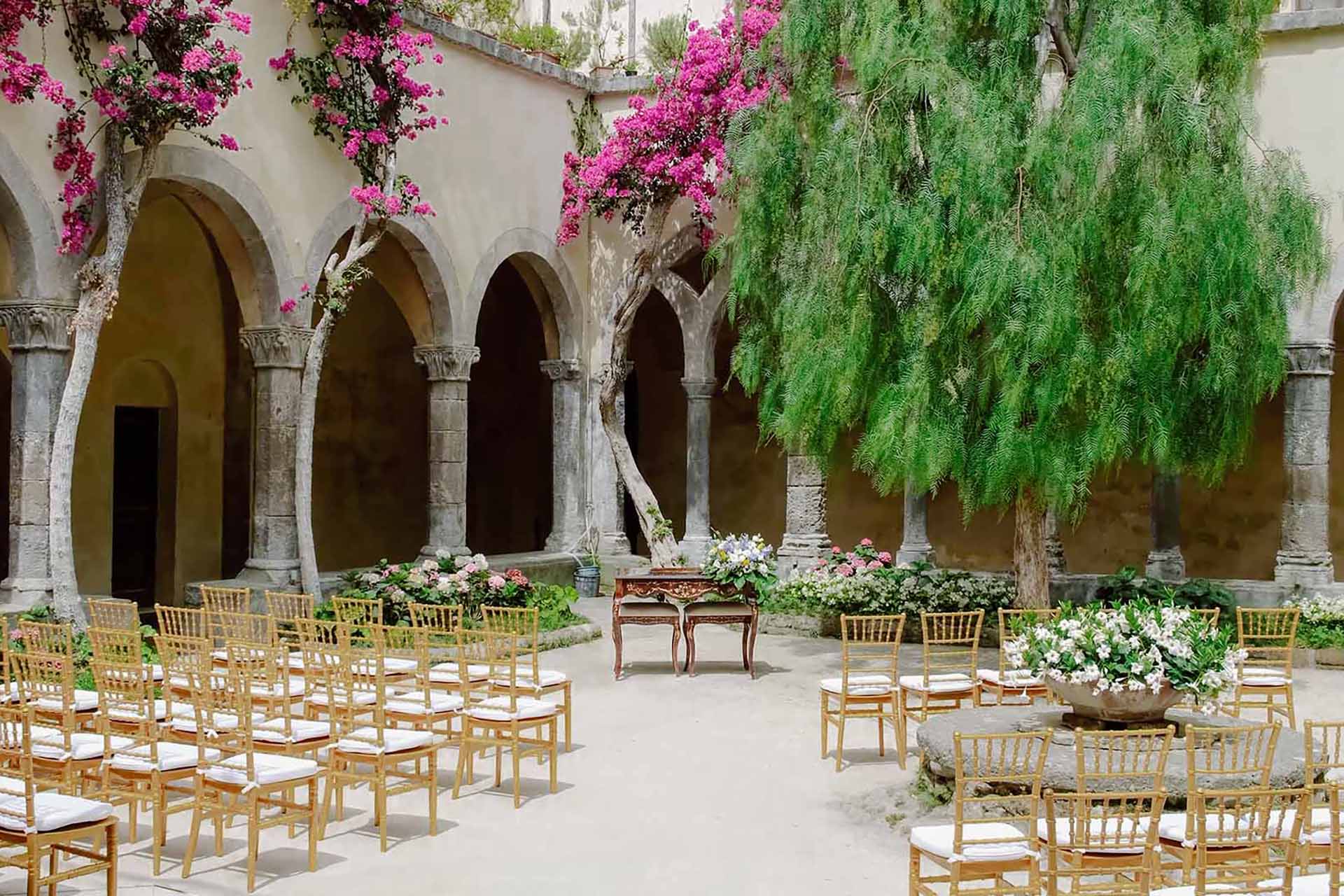
Romantic wedding ceremony setup inside the historic Chiostro di San Francesco cloister in Sorrento, Italy
Venice
Venice is less about open landscape and more about atmosphere, transition, and texture. The city guide emphasizes transport by ferry and boat, Grand Canal palaces, and the power of short video storytelling in showing the city’s essence. That plays directly into the content creator’s strengths: water-taxi arrivals, veil movement in narrow calli, behind-the-scenes portraits on steps, and the intimate social side of a candlelit dinner. The videographer then takes over where Venice becomes most cinematic-layering sound, architecture, and pacing into a film that does justice to the city’s mood rather than just its visuals.
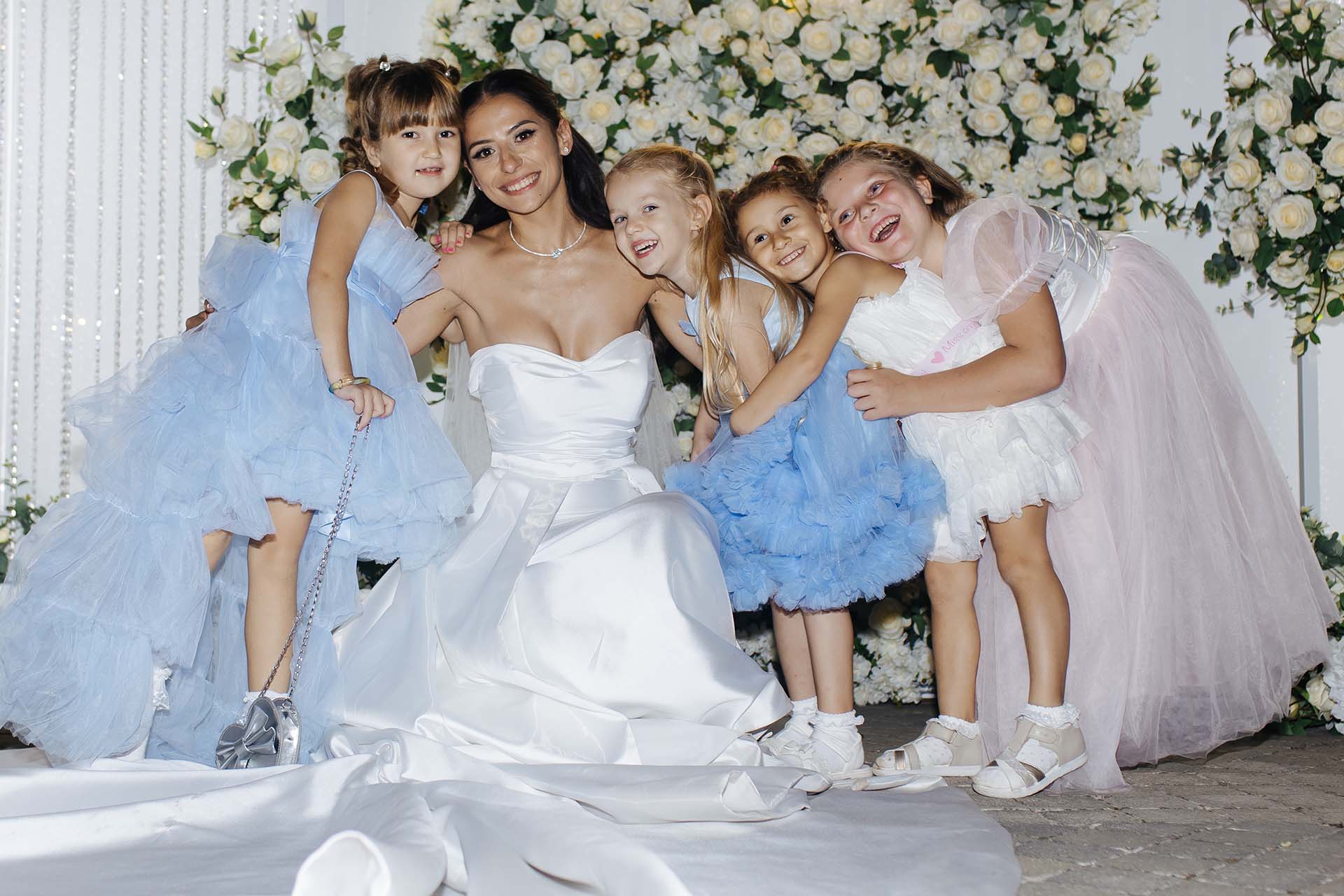
Joyful moment between the bride and flower girls during a wedding reception in Rome, Italy
Planner builds the timeline
Content creator defines social-first priorities
Videographer plans cinematic scenes and audio capture
Edited highlight film and longer-form deliverables
Immediate sharing and next-day reliving
Long-term keepsake and anniversary rewatching
This workflow reflects how the two roles tend to divide labor at modern destination weddings: one protects immediacy, the other protects depth. Used well, they reduce creative overload rather than increase it.
Real Wedding Day Example and Decision Guide
A Realistic Wedding-Day Timeline
Assume a 130-guest destination wedding at a Tuscan villa with a welcome dinner the night before and a brunch the day after. The wedding day itself might look like this:
Time
What the Content Creator Captures
What the Videographer Captures
How They Complement Each Other
Late morning
Robes, details on phones and mirrors, planner BTS, voice-note style reactions, candid bridal party energy
Full speeches audio, reaction shots, candlelit atmosphere, dinner narrative
One captures social texture; one captures the emotional backbone
First dance
Immediate phone POV, guest circles, BTS of band and floor energy
Master coverage, secondary angles, sound mix, story progression into party
One feels like being there; one feels like watching the film later
Late party and exit
Dance-floor chaos, flash clips, shoes-off energy, final reel moments
Party climax, selected dance coverage, exit sequence for film ending
One is pure immediacy; one is controlled emotional finale
Timeline note: this is a realistic editorial model informed by destination wedding trends, Image Studio’s destination workflow, and current distinctions between content creator and videographer deliverables. Exact times vary by venue and culture, but the logic of the split is consistent.
Late Morning Getting ready BTS moments forcontent creator Detail and audio preparation for videographer Early Afternoon First look andpre-ceremony transitions Vertical reactions and candid clips Cinematic sequences and sound checks Ceremony Social atmosphere and guest emotion Full vows coverage and multi-angle film capture Aperitivo Quick highlights, hugs, movement, behind-the-scenes Scenic transitions and environmental storytelling Dinner Table details, candid laughter, short-form edits Speeches, reactions, audio-led narrative PartyDance-floor clips and instant reliving Structured finale for the wedding film Real Wedding Day Coverage
The key insight is not that each vendor shoots at different times. It is that they look for different things at the same time. That is why hiring both often feels more complementary than redundant.
Common Myths
Myth: It is just TikTok.
No. TikTok and Reels changed the visual language, but the stronger reason couples hire a content creator is not virality; it is authenticity, speed, and emotional access. Vogue explicitly ties the rise of the category to candid, digital-native memory habits, while Image Studio’s editorial positioning emphasizes immediate yet elevated storytelling rather than trend-chasing.
Myth: It replaces videography.
Only if you no longer want the things videography is built to do. The moment you care about professional audio, vows, speeches, narrative structure, and long-term film value, the replacement argument breaks down. That is why the most consistent guidance in the category still frames the two roles as complementary.
Myth: It is only for influencers.
Influencers helped normalize the category, but they did not define its full market. Zola’s recent data shows content creators are now the most-requested “niche” vendor category among surveyed couples who hire one, and Vogue’s reporting shows the client base already extends beyond creators and public-facing professionals.
Myth: It is unnecessary.
Sometimes it is unnecessary—but not because it lacks value. It is unnecessary when your priorities are private, classic, and entirely film- or photo-led. It becomes highly useful when the wedding includes travel, multiple events, meaningful behind-the-scenes moments, or a strong desire to relive the celebration quickly without outsourcing memory-making to guests. Vogue even notes guests can enjoy the evening more fully when they are not the ones trying to document everything.
Who Should Hire Both?
Couples most likely to benefit from both usually fall into one of four categories.
A destination couple planning a multi-day weekend should strongly consider both. If your celebration includes a welcome dinner, rehearsal gathering, boat transfer, brunch, villa buyout, or after-party, the content creator protects the texture of the weekend while the videographer protects the core cinematic arc.
A luxury couple with a design-forward wedding also benefits from both. In high-investment weddings, the issue is not whether the day deserves to be filmed. It is whether every layer of the experience deserves a format suited to it. ENIT’s luxury wedding reporting repeatedly frames Italy’s market around personalization, hospitality, and experiential storytelling, which naturally supports richer media coverage rather than less.
A couple who wants to be fully present but still share and relive the day immediately is another strong candidate. This is one of the clearest reasons content creators keep growing: couples want something they can see right away without asking guests to become unpaid documentarians.
And finally, couples who care about different audiences benefit from both. The content creator serves the immediate private circle—friends, family group chats, next-day rewatching, and social sharing. The videographer serves the future audience—anniversaries, children, older relatives, and the version of you who wants the day translated into film rather than fragments.
Who May Only Need One?
A couple may only need a content creator if the wedding is intimate, speeches are minimal, formal ceremony audio is not a major priority, and the real desire is fast reliving rather than a traditional film. This is especially plausible for city weddings, fashion-led elopements, or celebrations where the couple already values phone-native memory over cinematic production.
A couple may only need a videographer if they care deeply about a keepsake film but have little interest in social posting, same-day delivery, or behind-the-scenes content. This often suits more private couples, more classic weddings, and couples whose emotional priority is hearing vows and speeches preserved well.
And some couples may need neither-at least not beyond photography-if they are intentionally keeping the celebration quiet, short, and offline. The right answer is not always “more vendors.” It is media coverage that matches how you actually want to remember the day. That balance is what makes the decision intelligent rather than trend-driven.
FAQ
Do I need a wedding content creator if I already have a videographer?
If you want fast, behind-the-scenes, phone-ready coverage in addition to a cinematic film, yes. A videographer gives you the film; a content creator gives you the immediate social and camera-roll layer that usually arrives within a day.
Is a wedding content creator worth it for a destination wedding in Italy?
Often, yes—especially if your wedding includes multiple events, travel moments, villa or hotel transitions, boat or city movement, and the kind of guest-experience detail that does not always make it into the formal film. Italy’s destination market is increasingly experiential, which makes that immediate layer more valuable, not less.
Can a wedding content creator replace a videographer?
They can replace videography only if you are intentionally giving up cinematic film outcomes such as professional vows audio, fuller ceremony coverage, and a long-term highlight or documentary edit. They are not a true technical equivalent.
Can a videographer provide social media content too?
Sometimes. Some videographers now offer social-first add-ons or same-day edits. But that still is not always the same as a dedicated content creator whose entire workflow is built around vertical clips, BTS coverage, and rapid delivery.
How fast do wedding content creators usually deliver content?
Fast delivery is one of the role’s defining traits. Same-day and 24-hour delivery are common promises in the category, though what is actually included varies by package—raw clips, edited reels, labeled folders, Stories, or a mix of those.
How much does a wedding content creator cost in Italy?
Public Italy-focused guides place professional wedding content creator pricing broadly around €1,200 to €3,500, with lower entry points for simpler coverage and higher pricing for longer hours, extra operators, drone use, or more ambitious edit packages.
Will a content creator get in the way of my photographer or videographer?
A good one should not. Current vendor guidance repeatedly emphasizes discreet collaboration, clear pre-wedding communication, and respecting the workflow of the planner, photographer, and film team.
Conclusion
The cleanest answer to wedding videographer vs content creator is this: they do not do the same job, and the smartest couples stop expecting them to. One is there to preserve the feeling of the day while it is still unfolding on your phone. The other is there to preserve the meaning of the day in a film you will come back to later. When you understand that distinction, the question changes from “which one is better?” to “which memory formats matter most to us?”
For many modern destination weddings in Italy, especially those stretched across welcome dinners, rehearsal events, and immersive guest experiences, hiring both is not indulgent. It is simply precise. It gives every layer of the wedding the format it deserves.
If you are planning a celebration in Lake Como, Tuscany, the Amalfi Coast, Venice, or elsewhere in Italy and want to understand how this works in a real destination-wedding context, read the Wedding Content Creator Italy Guide for a deeper editorial breakdown, then explore the Wedding Content Creator Italy service page to see what a 24-hour social-first delivery experience can look like when it is designed to complement not compete with your wedding film coverage.