7 Wedding Photography Gallery Examples and Layouts
October 15, 2026
Explore 7 exceptional wedding photography galleries, comparing editorial styles, cinematic storytelling, portfolio presentation, and destination wedding photography from leading studios.
For most couples, a wedding photography gallery is the first real taste of a photographer’s work. It shouldn’t behave like a folder of favorites. It should read like an edit, with an opening frame, a clear movement from preparations to ceremony and portraits, a reception that doesn’t disappear, and a final image that leaves the day open rather than abruptly finished. Professional photography is already a foundation of modern wedding planning, with 85% of couples hiring a professional photographer on average across the countries surveyed in the 2023 Global Wedding Report. This roundup examines seven wedding photography galleries as sequencing and layout systems. You’ll see how each studio handles the first image, the arc of the day, color and light, and the evidence of range. The same principles can sharpen a photographer’s portfolio or help a couple look beyond a polished highlight, much like a streamer’s guide to viral highlights looks beyond a single clip.
1. Image Studio brings film language into the wedding gallery
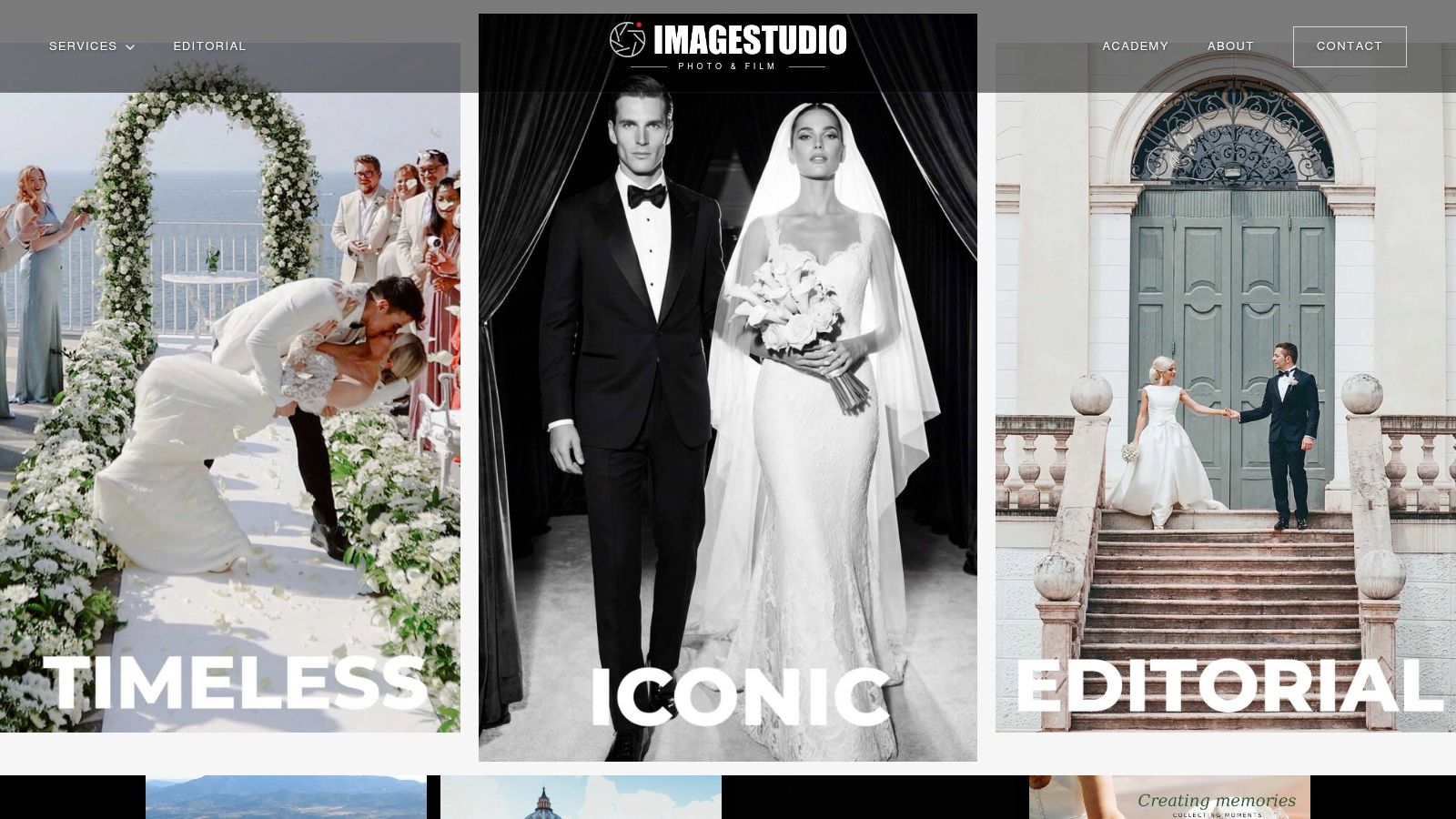
Image Studio’s wedding photography and videography gallery in Italy is built around a film-first idea. The opening impression is not “here are some beautiful portraits.” It establishes a visual world, then lets the viewer move through real wedding stories across Italy and destination events. The useful distinction is between a gallery that displays isolated talent and one that shows how a coordinated team handles a complete production.
The sequencing is strongest when the story moves from atmosphere to human detail, then into directed portraits and celebration. Getting ready, architecture, fabric, florals, ceremony emotion, movement at the reception, and the quieter aftermath each have a role. That range matters because a wedding photographer has to work across changing light, crowded rooms, family groups, and unplanned moments without making the final edit feel visually fragmented.
Why the coordinated format matters
Image Studio combines editorial, fashion-informed photography with cinematic wedding films through one coordinated team. That gives couples and venues a clearer visual language across stills, motion, post-production, private online gallery delivery, and platform-ready social assets. The studio is based in Rome and Milan and works across Italy and internationally, which is useful for destination celebrations that require local production knowledge as well as a consistent creative direction.
Its stated background includes 14+ years of experience, more than 250 projects, and content exceeding 150 million views across platforms, as described in the publisher information. Those figures establish scale, but the gallery still has to prove the practical question: can the team carry the viewer from vows to final edit without losing emotional or visual continuity?
Practical rule: A strong wedding photography gallery should let you test the whole day, not just the photographer’s best three portraits.
The trade-off is clear. An editorial and cinematic approach suits couples who want direction, atmosphere, and a unified photo-film result. It may be less suitable for couples seeking an entirely unposed, snapshot-led record. The best takeaway is to build each project as a complete visual narrative, then make the inquiry path obvious without interrupting the story.
2. KT Merry uses editorial control without losing the wedding arc
KT Merry presents a wedding gallery through a refined fashion-editorial lens, but the important design decision is curation. The work is arranged to create a coherent visual experience rather than a random sequence of technically impressive frames. Natural light, styling, architecture, and restrained tonal treatment do the heavy lifting.
The opening image typically needs to establish both place and mood. A strong destination gallery might begin with a wide environmental frame, then narrow into a portrait, a detail, and an interaction. That progression gives the viewer orientation before asking them to admire the styling. It also makes a larger or multi-day event feel intentional rather than sprawling.
What couples can inspect
KT Merry’s “Explore” structure mixes wedding work with fashion and editorial projects. That helps communicate art direction, but it also means couples should separate inspiration from proof of full-day coverage. Look for the transition from preparation to ceremony, family photographs, dinner, dancing, and the less controlled moments between formal scenes.
The consistent color and tonal treatment are particularly useful for evaluating a photographer. A gallery can contain different venues and lighting conditions while still feeling like one body of work. That consistency is more valuable than a dramatic single frame if you’re comparing photographers for a complex destination celebration.
For readers trying to understand the distinction between polished direction and documentary observation, this guide to types of wedding photography offers a useful vocabulary. The terms overlap in practice, so the images matter more than the label.
Copyable takeaway: Open with place, follow with people, and use details as connective tissue rather than treating them as filler.
The trade-offs are practical. KT Merry’s pricing isn’t publicly listed, and availability may require planning well ahead. The style is a strong fit for couples who want fashion-aware composition and a composed visual identity, but less so for anyone who wants an intentionally rough, unstyled record.
3. Jose Villa makes restraint feel luxurious
Jose Villa is a useful reference for couples drawn to fine-art wedding photography because the gallery’s power comes from restraint. Natural light, gentle contrast, luminous skin tones, and classic composition create a calm viewing rhythm. The images don’t need aggressive effects to signal refinement.
The sequencing tends to work through tonal continuity. A quiet portrait can sit beside a ceremony moment, a wide scenic view, or a family interaction without the edit feeling disjointed. That’s a valuable lesson for photographers who rely on a recognizable color palette. Consistency doesn’t mean every frame has identical brightness. It means the viewer understands the visual rules.
Reading the full gallery, not the hero image
A fine-art portfolio can make a wedding look effortless, but couples should inspect what happens after the opening portraits. Does the gallery include difficult reception light, guests who aren’t styled for the camera, family combinations, and transitions between locations? These frames reveal whether the photographer’s visual language survives the practical demands of the day.
Jose Villa’s film-forward identity also makes color a decision point. Film-inspired work can feel organic and timeless, but the couple should ask how the photographer handles mixed lighting, darker skin tones, strong indoor color, and fast-moving celebrations. A polished gallery should still show technical flexibility.
For a wider look at film-informed direction and movement, compare the visual principles in this guide to cinematic wedding photography. The point isn’t to copy one look. It’s to identify whether the photographer’s edit supports the atmosphere you want to remember.
A beautiful opening portrait earns attention. The transitions prove whether the photographer can cover a wedding.
The advantages are a distinctive fine-art benchmark, refined skin tones, and a cohesive natural-light approach. The drawbacks are equally important: premium positioning, limited public pricing information, and potentially limited availability. Couples who want loose, high-energy coverage should review reception galleries carefully before assuming that the calm portfolio style reflects the entire day.
4. Greg Finck balances fashion discipline with documentary movement
Greg Finck occupies a productive middle ground between fashion photography and wedding storytelling. The galleries show how a photographer can bring editorial discipline to portraits while preserving the movement of a destination celebration. France, Italy, and other international settings provide varied visual context, but the curation keeps the work recognizable.
The first frame should be judged for more than beauty. Ask whether it introduces the couple, the venue, or the atmosphere in a way that makes the following images easier to understand. Greg Finck’s approach is particularly effective when a wide location frame gives way to a closer human moment, then returns to architecture before the next emotional beat.
A useful test for full-day coverage
A wedding photography gallery should have changes in pace. Preparation images can be intimate and quiet. Ceremony coverage may need restraint. Portraits can become more directed, while the reception should loosen the rhythm through movement, flash, laughter, and overlapping groups. If every image has the same emotional volume, the gallery loses the shape of the day.
Greg Finck’s film and hybrid sensibility makes that pacing easier to see. Elegant tones can support formal portraits, while candid frames keep the edit from becoming a fashion lookbook. Couples should look for whether the studio captures guests as participants rather than background decoration.
There’s a practical trade-off between polish and transparency. Destination galleries can make the venue look exceptional, but they should also reveal how the photographer works in shadow, crowded spaces, and transitional moments. Consistent curation is useful because it lets couples assess more than the photographer’s preferred hero frame.
Copyable takeaway: Use one visual rule for portraits and another for movement, but grade both so they belong to the same day.
Greg Finck’s strengths are the combination of global editorial sensibility and candid storytelling. Pricing and packages aren’t listed publicly, and high-demand European dates may be difficult to secure. Couples should request a complete gallery from a comparable venue if the public portfolio contains mostly highlights.
5. Cinzia Bruschini Studio builds galleries for complex celebrations
Cinzia Bruschini Studio is particularly relevant to couples planning weddings in Italy or across Europe, where the event may extend across several locations, days, and cultural moments. The gallery system needs to communicate more than portrait style. It needs to show whether the photographer can maintain a narrative through welcome events, preparations, ceremony, dinner, and late-night celebration.
The strongest sequencing choice is the use of dedicated event stories rather than one continuous wall of unrelated images. Curated Pic-Time portfolios can separate chapters while keeping the overall visual identity intact. That structure helps a viewer understand how the photographer handles a multi-event celebration without forcing every frame into one chronological stream.
Editorial direction needs documentary evidence
Cinzia Bruschini Studio’s polished, fashion-aware direction is well suited to couples who want strong portraits and a refined destination atmosphere. The gallery should still be read for unplanned interactions, family dynamics, ceremony rituals, and the visual complexity of dinner or dancing. Those sections show whether editorial control complements the story or replaces it.
For couples comparing photographers in Italy, the practical questions include local logistics, language, travel between venues, and how quickly the team can adapt when weather or timing changes. The guide to choosing a wedding photographer in Italy is useful because it frames style as only one part of the decision.
Gallery test: Find the point where the event stops looking styled and starts looking lived in. That section often tells you more than the opening portrait.
The strengths are intentional curation, destination expertise, and a hybrid editorial-documentary balance suited to multi-day celebrations. Pricing isn’t listed publicly, and prime Italian dates can fill quickly. Couples should ask to see an entire event sequence, not only the public portfolio’s most polished images.
6. Christian Oth Studio turns portfolio navigation into positioning
Christian Oth Studio makes a clear structural choice by separating weddings, editorial work, and engagements. That taxonomy helps visitors arrive with a specific purpose. A couple can study wedding coverage, then use editorial work to understand the studio’s fashion background, rather than trying to infer everything from one mixed feed.
The opening of a wedding gallery benefits from that clarity. A strong first image can establish the studio’s portrait language, while the following sequence should prove that the photographer can shift from styled couple portraits to guests, ceremony coverage, details, and reception energy. The separate engagement category also gives couples a way to evaluate how the team handles a smaller, more controlled session.
What the taxonomy reveals
Christian Oth Studio’s New York and Miami bases, global commissions, and fashion credentials create a premium editorial position. Those references can build confidence in portraiture and styling, but they shouldn’t substitute for checking the wedding narrative. Look for the visual handoffs between controlled scenes and spontaneous moments.
The studio’s articulation of creative process and client experience is another useful layout decision. Couples need to know how a photographer directs, prepares, and communicates, especially when the visual style is highly composed. A gallery can attract attention, but process information helps a couple decide whether the actual experience will suit them.
The trade-off is that a fashion pedigree may appeal strongly to couples who care about wardrobe, architecture, and portrait polish. It may be less persuasive for couples whose priority is unobtrusive documentary coverage. The principal’s availability can be limited, and pricing isn’t publicly shown, so a direct consultation remains important.
Copyable takeaway: Give weddings, engagements, and editorial work separate doors, then make each door prove its own promise.
7. Norman & Blake makes destination context part of the story
Norman & Blake uses event-specific galleries to show how a full wedding unfolds in a recognizable place. Stories connected with Big Sur, Hotel du Cap-Eden-Roc, and Mallorca give couples more useful evidence than a generic collection of couples’ portraits. Venue context reveals how the photographers compose around natural scenery, architecture, weather, and guest movement.
The sequence should be read as a relationship between place and people. A wide frame can establish the setting, but it needs to lead into preparations, ceremony, portraits, dinner, and dancing. When the location remains present without overwhelming the couple, the gallery feels like a record of an event rather than a travel editorial.
Why deliverables belong in the gallery conversation
Norman & Blake’s emphasis on fine art albums and presentation options adds a long-term dimension. An online gallery is useful for viewing and sharing, but an album requires a different edit. Images need to work as facing pages, across changes in scale, and within a physical rhythm that doesn’t depend on scrolling.
That distinction also raises an operational question: what happens after delivery? A resilient archive should follow the 3-2-1 backup structure, with three copies on two types of media and at least one copy off-site, according to this wedding photography backup guide. Couples should ask what the photographer retains, what they receive, and how long the access link remains active.
A private gallery can also be designed for guests, not only the couple. The 2025 behavioral survey on wedding galleries reported that 78% of guests asked for photos at least twice, while more than 60% never downloaded a photo because they couldn’t find themselves. That supports searchable sections, mobile-friendly access, simple download instructions, favorites, and clear privacy controls.
Copyable takeaway: Show the venue as a character, then deliver the story in a format people can revisit without assistance.
The strengths are destination breadth, consistent event-level curation, and explicit attention to albums and archival presentation. There’s no public rate card, and top dates book quickly. Couples should compare both the online gallery and the proposed print experience before choosing.
Top 7 Wedding Photography Gallery Comparison
Vendor
Style & Signature
Implementation Complexity
Resource Requirements
Expected Outcomes
Ideal Use Cases
Key Advantages
Image Studio
Cinematic, editorial; film-first photo + film
High, coordinated single team, on-location direction, full production
Premium budget; destination logistics; integrated photo+video crew; AI-assisted post
Balanced editorial/documentary with narrative focus; heirloom emphasis
Medium, event-specific narrative curation plus album production
Premium; destination logistics; emphasis on print/album production
Full-day narrative coverage and archival fine-art albums
Destination couples seeking narrative coverage and archival products
Strong destination breadth; explicit print and album craftsmanship
Turn These Galleries Into Your Own Shot Plan
Before choosing a photographer or editing your own portfolio, write a shot list that follows the sequence of the day. Mark the three frames that would open your gallery, then identify the image that would close it. The opening should establish a place, person, or feeling. The closing should feel like a natural release, whether that’s the last dance, a quiet exit, an empty room, or an intimate image after the guests have gone.
Check each candidate against the same rules for color, pacing, and full-day coverage. Don’t let a strong ceremony portrait hide the absence of family groups. Don’t let a beautiful venue frame compensate for weak reception work. Look for preparation, ceremony, portraits, guests, transitions, difficult light, and the moments that happen when nobody is performing for the camera.
Gallery performance also depends on the interface. For an image-heavy page, a practical target is Largest Contentful Paint of 2.5 seconds or less at the 75th percentile, Interaction to Next Paint below 200 milliseconds, and Cumulative Layout Shift at or below 0.1, as outlined in this photography website performance guidance. Responsive thumbnails, reserved image dimensions, lazy loading, and AVIF or WebP with JPEG fallback keep the visual story from becoming a usability problem.
Start by rebuilding one gallery from this list in your own order and notice what it makes you feel. Then ask whether the same sequence would help a couple trust the photographer, understand the day, and take the next step. A reported redesign case study connected immersive visual storytelling and clearer booking pathways with a 73% increase in portfolio exploration, a 3.8-fold rise in average engagement across portfolio pages, and a 58% increase in qualified wedding inquiries. Treat those figures as a specific reported case, not a universal forecast, and measure story starts, completed galleries, contact clicks, qualified inquiries, and bookings rather than time on page alone.
If you’re weighing editorial, film-led coverage for a wedding in Italy or abroad, Image Studio is a useful reference point to compare against. Its private online galleries, coordinated photography and film teams, destination capability, social-ready assets, and end-to-end post-production make the delivery system part of the creative offer rather than an afterthought.
Image Studio creates editorial wedding photography galleries and cinematic films for couples planning celebrations in Italy and worldwide, with coordinated direction, production, post-production, and private online delivery. Visit Image Studio to compare a film-led approach, review complete wedding stories, and discuss coverage for your destination event.