Why Video Content Dominates Social Media Algorithms
January 2, 2026
Why Video content dominates social media algorithms is the top-ranked format across TikTok, Meta Reels, and Instagram because it generates
Why Video content dominates social media algorithms is the top-ranked format across TikTok, Meta Reels, and Instagram because it generates denser, faster, and more measurable behavioral signals than any other content type. While a static post might collect a like or a comment, a video collects watch duration, completion rate, rewatch behavior, and swipe-away timing, all within a single viewing session. These signals give recommendation engines far more confidence when deciding who sees what next. For marketing professionals and content creators trying to crack why video content dominates social algorithms, the answer lives in the data richness of the viewing experience itself. Video ad spend is projected to reach $236B in 2026, which reflects how completely platforms and advertisers have aligned around this format.
What behavioral signals make video favorable to social algorithms?
Video content generates a stream of real-time behavioral data that static posts simply cannot match. Every second a viewer watches, pauses, replays, or swipes away feeds directly into the algorithm’s confidence score for that piece of content. Platforms use these signals to decide whether to push a video to a wider audience or quietly retire it from the feed.
The most weighted signals across platforms include:
Watch completion: Finishing a video tells the algorithm the content delivered on its promise. Algorithms treat completion as a quality vote.
Rewatch rate: Replaying a clip signals genuine interest or emotional resonance, both of which rank higher than a passive scroll-through.
Swipe-away timing: Leaving in the first two seconds is a hard negative signal. It tells the system the video failed to hook its viewer and reduces distribution.
Saves and shares: These indicate intent beyond passive consumption and carry strong weight in Meta’s and TikTok’s ranking models.
Short videos generate rapid feedback loops that allow algorithms to update rankings within a single viewing session, reducing uncertainty and expanding distribution tiers faster than longer formats. A 15-second clip can accumulate hundreds of completion signals in the time it takes a long-form article to collect ten page views. That speed advantage is why short-form video in particular has become the engine of content discovery.
Pro Tip:Design your video’s first two seconds as a standalone hook. If the opening frame doesn’t create a reason to keep watching, the algorithm will register the swipe-away and throttle your reach before most of your audience ever sees it.
Video generates richer engagement signals than any other content format, making it the preferred choice for modern social media algorithms.
How do platform algorithms rank and prioritize video differently?
TikTok, Meta, and YouTube each use distinct ranking architectures, but all three share a core preference for video over static content. Understanding the differences helps creators tailor their approach by platform. “This is exactly the challenge many brands face. They understand that video matters, but translating algorithm theory into content people actually watch is where most strategies break down.”
Platform
Primary ranking signal
Key differentiator
TikTok
Watch duration and completion probability
Re-ranks content in real time during playback for ultra-fast personalization
Meta (Reels)
Watch completion plus user perception feedback
Incorporates audio, mood, and production style for interest matching
YouTube
Session watch time and downstream engagement
Optimizes for longer sessions rather than single-video virality
TikTok’s For You feed updates rankings rapidly during video playback, which is why a video can go from zero to a million views in hours. The system tests content continuously, expanding distribution when early signals are strong and pulling back when they are not. This creates a meritocratic discovery engine where even accounts with zero followers can reach massive audiences if the video performs well in its first test pool.
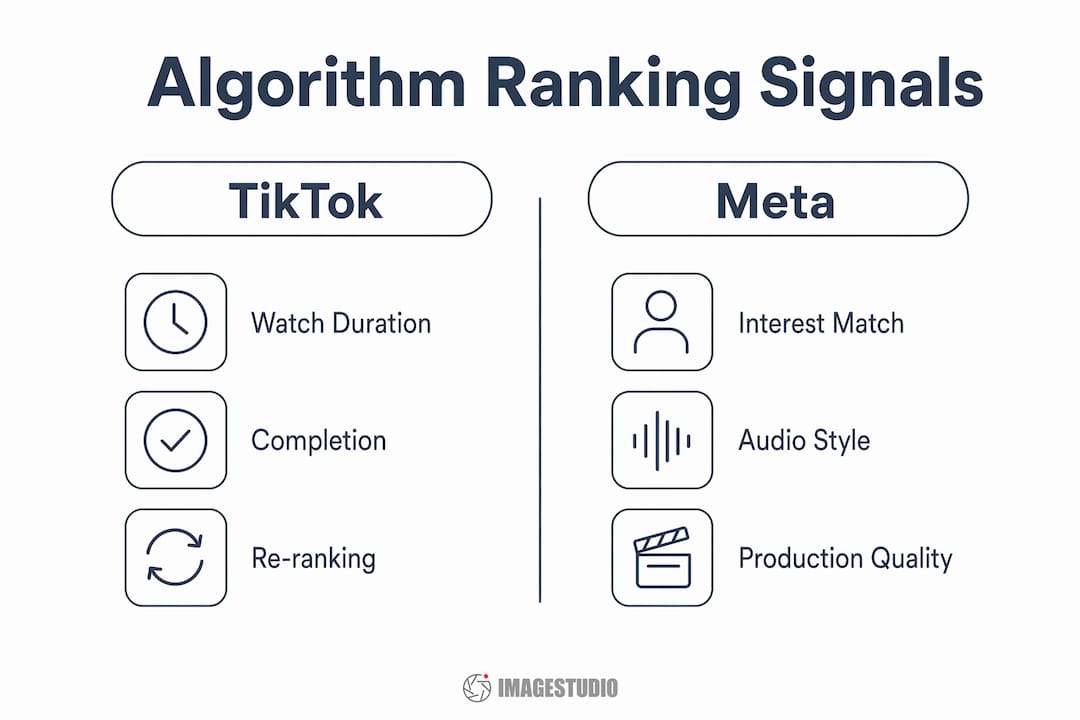
TikTok prioritizes watch duration and completion, while Meta places greater emphasis on interest matching, audio style, and production quality.
Meta’s approach goes deeper than raw engagement. Interest matching at Meta incorporates audio style, production quality, mood, and content motivation, going well beyond likes and comments. This means a polished, coherent Reel with clear audio and a defined visual identity outperforms a noisy, inconsistent one even if both collect similar raw engagement numbers. After incorporating this interest-matching model, Meta saw +5.2% total engagement and +5.4% higher user satisfaction, which confirms that quality perception directly influences reach.
YouTube sits at the other end of the spectrum, prioritizing session length over single-video virality. A video that leads viewers to watch three more videos performs better than one that gets a million views and nothing else. This makes YouTube the platform most aligned with long-form storytelling and series-based content strategies.
Why short-form video has overtaken every other content format
Short-form video’s rise is not just a trend. It reflects a structural shift in how audiences discover and consume content, and platforms have built their entire recommendation infrastructure around it. “Last year we produced two versions of the same campaign. The higher-budget version generated fewer views than the simpler version because the opening hook delayed the payoff by seven seconds…”
Here is why short-form specifically outperforms everything else in 2026:
Attention economics favor brevity. A 30-second clip can be tested, ranked, and distributed to a new audience segment before a 10-minute video has finished its first play. Speed of feedback is speed of growth.
Discovery funnels are built on clips. 77% of viewers who see TV or film clips on social media go on to watch the full program. Short-form video is not a replacement for long-form content. It is the entry point.
Younger audiences are shaped by it. YouTube, Instagram, and TikTok shape content choices for 78%, 65%, and 57% of 16 to 24-year-olds respectively, making short-form the dominant discovery channel for the most valuable demographic.
Trending audio and meme formats accelerate reach. Clips that use trending sounds or participate in viral formats get surfaced to interest-matched audiences who are already primed to engage.
Testing is cheap and fast. A brand can publish five short clips in the time it takes to produce one long video, generating five separate data points about what resonates with their audience.
49% of 16 to 24-year-olds discover shows on social media, with 25% citing creators as their primary discovery source. For marketers, this means short-form video is not just a content tactic. It is the top of the funnel for almost every downstream engagement goal.
Why video resists AI search and why platforms are betting on it
Text content faces an existential threat from AI search tools. When Google’s AI Overviews or Perplexity summarize an article, the original publisher loses the click. Video is significantly more resistant to AI-mediated consumption than text because the value often lies in the experience itself.
“Video’s experiential value makes it irreplaceable by AI summaries, driving platforms and publishers to prioritize immersive video content to retain users.” — Digiday
Watching a video cannot be substituted by reading a transcript. The emotional response, the pacing, the visual storytelling, and the audio design are all part of the experience. This makes video content irreplaceable in a way that written content is not, and publishers are responding by shifting budgets aggressively toward video formats.
The financial logic is equally clear. Advertisers pay premium CPMs for immersive video placements because viewers are more engaged and more likely to act. Vertical video formats optimized for mobile consumption command even higher rates because they occupy the full screen and eliminate competing distractions. Platforms know this, which is why Instagram, TikTok, and YouTube have all redesigned their interfaces to center video as the default experience.
For brands and creators, this creates a strategic imperative. Building a content library around video is not just about social reach today. It is about securing an audience that AI-driven search cannot redirect away from you.
Practical strategies to optimize video for social algorithms
Knowing why algorithms favor video is only useful if you translate it into production decisions. Here is what the research actually points to for improving algorithmic performance.
Nail the first three seconds. Ranking depends on in-session behavior inference, which means the opening moments determine whether the algorithm expands or limits your distribution. Open with the payoff, not the setup.
Maintain audio-visual coherence. Meta’s engineering data shows that classic engagement signals can be noisy, meaning a video with clear audio, consistent visual style, and a defined content motivation scores better on interest perception than a high-energy but chaotic clip.
Use captions. A significant portion of social video is watched without sound. Captions increase accessibility, extend watch time, and improve completion rates across all platforms.
Balance novelty with relevance. Trending audio and formats increase discoverability, but the content itself needs to align with your audience’s existing interests to convert new viewers into followers.
Treat video and static as partners, not rivals. Video attracts new viewers with higher reach, while static posts nurture existing audiences. A strategy that uses both formats performs better than one that abandons either.
Pro Tip:When testing new video formats, publish at least three variations before drawing conclusions. One underperforming clip tells you almost nothing. Three clips with consistent patterns tell you exactly what to adjust.
For creators looking to sharpen their video SEO strategy, pairing strong on-platform signals with off-platform discoverability creates a compounding visibility advantage.
Key takeaways
Video dominates social algorithms because it produces richer behavioral signals, resists AI substitution, and creates discovery funnels that no other content format can replicate.
Point
Details
Completion signals drive distribution
Watch completion is the single strongest quality signal across TikTok, Meta, and YouTube.
Interest matching goes beyond engagement
Meta’s algorithm scores audio, mood, and production style, not just likes and shares.
Short-form is the top discovery funnel
77% of viewers who see clips on social media go on to watch the full program.
Video resists AI search disruption
Watching cannot be summarized, making video the most defensible content format for publishers.
First seconds determine algorithmic fate
Algorithms rank content in real time during playback, so the opening frames are critical.
What 14 years of production taught me about algorithms and quality
Here is something I have seen play out repeatedly across hundreds of projects: creators who obsess over algorithmic tactics without investing in the quality of the viewing experience almost always plateau. The platforms have gotten genuinely good at detecting whether a viewer actually enjoyed something, not just whether they clicked. Over the past 14 years, working from Italy with brands, artists, and organizations across Europe and international markets, I’ve seen one pattern repeat itself: creators who focus exclusively on algorithm hacks eventually plateau. The teams that consistently win are the ones that understand human attention first and platform mechanics second.
The shift toward interest-matching signals at Meta is the clearest example. A video that looks polished, sounds clean, and delivers on a clear premise will outperform a technically “optimized” video that feels incoherent. Algorithms reward nuanced behavioral signals now, not vanity metrics. A million impressions with a 15% completion rate is a worse outcome than 50,000 impressions with an 80% completion rate, because the second scenario tells the algorithm you have something worth showing more people.
What I tell every creator and marketing team we work with at Imagestudio is this: treat the algorithm as a proxy for your audience. If real people are watching to the end, sharing, and coming back, the algorithm will find that signal and amplify it. If they are not, no amount of hashtag strategy or posting frequency will save you. The most durable social media algorithm tip is also the oldest one: make something genuinely worth watching.
Platform updates will keep coming. TikTok’s ranking logic will shift. Meta will introduce new perception dimensions. YouTube will adjust its session-weight formulas. The creators who adapt fastest are the ones who understand the underlying principle: algorithms exist to keep people watching. Build for that, and the distribution follows.
— Image Studio
Ready to make video that algorithms actually reward?
Understanding the mechanics behind algorithmic prioritization is one thing. Producing video that consistently hits those signals is another. Imagestudio has spent 14 years creating content that performs, with 250+ projects generating over 150 million views across platforms. From short-form social clips to cinematic brand films, the team knows how to build video that holds attention from the first frame to the last.
Whether you need social media video production built around platform-specific algorithm behavior, or want to explore AI-driven video creation for faster, scalable content output, Imagestudio brings the technical understanding and creative craft to make it count. Explore what a production partner with real algorithmic insight can do for your brand’s visibility and reach. While the platforms evolve globally, one thing has remained consistent throughout our 14 years of production work from Italy: audiences respond to stories that earn their attention. The algorithms simply became better at measuring that reality. Whether the viewer is in Milan, London, New York, or Dubai, the fundamentals of engagement remain surprisingly universal.
FAQ
Why do social media algorithms favor video over static posts?
Video generates denser behavioral signals, including watch completion, rewatch rate, and swipe-away timing, that give algorithms far more data to rank content accurately than a static image or text post can provide.
What is the most important signal for video ranking on TikTok?
Watch duration and completion probability are TikTok’s primary ranking signals, with the system re-ranking content in real time during playback to optimize viewer retention.
How does short-form video drive discovery for longer content?
77% of viewers who see clips on social media go on to watch the full program, making short-form video the most effective top-of-funnel format for driving downstream engagement.
Why is video harder for AI search to replace than written content?
Watching a video is an experience that cannot be substituted by a text summary. The emotional, visual, and audio dimensions of video retain users on platforms in ways that AI-generated overviews cannot replicate.
How does Meta’s algorithm evaluate video quality beyond basic engagement?
Meta’s interest-matching model scores videos on audio style, production quality, mood, and content motivation, meaning a coherent and well-produced video outperforms a chaotic one even with similar raw engagement numbers.