Editorial or Documentary? Discovering the Photography Style That Reflects Your Story
August 20, 2026
Editorial and documentary wedding photography create very different experiences, yet the strongest stories often use both. This guide explains how each approach works, where each is strongest, and how to choose the balance that genuinely reflects your wedding.
IMAGE STUDIO • EDITORIAL
The most meaningful wedding photography rarely belongs entirely to one category. Editorial photography can bring intention, composition and refinement. Documentary photography can preserve spontaneity, relationships and the parts of a wedding nobody could have planned. The real decision is not which label sounds better. It is whether your photographer knows when to observe, when to guide and when to disappear.
That distinction matters especially for a destination wedding in Italy. A celebration may move from a quiet preparation room to a formal ceremony, from architecture and gardens to a boat transfer, from editorial portraits to candlelit speeches and a crowded dance floor. No single photographic behaviour works equally well in every chapter.
KEY INSIGHT
Editorial and documentary photography are not opposing philosophies. They are different tools. The strongest wedding stories often depend on knowing when each one belongs.
1.Editorial vs Documentary Wedding Photography: The Short Answer
Editorial wedding photography uses more intentional composition, direction and visual control to create refined, magazine-influenced images. Documentary wedding photography prioritises observation and real-time moments, allowing people and events to unfold with minimal intervention.
Neither is inherently more sophisticated, emotional or authentic. What matters is how the photographer applies the approach. A wedding can benefit from editorial direction during portraits and still be photographed documentary-style during the ceremony, dinner, speeches and spontaneous interactions.
Ceremony, family interactions, speeches, cocktail hour, dance floor
Important visual opportunities may be left entirely to chance
Hybrid / story-led
Adaptability
Changes according to the moment
Complete wedding stories
Requires strong judgement rather than a fixed formula
2.Why the Labels Can Be Misleading
Wedding photography terminology is useful until it becomes too rigid. Two photographers may both call themselves editorial and work in completely different ways. One may build highly controlled portraits with significant direction. Another may use an editorial eye for composition while intervening only for a few minutes during the entire day.
The same problem exists with documentary photography. “Candid” can describe genuine anticipatory storytelling, but it can also become shorthand for simply avoiding direction. True documentary skill requires far more than standing back. It requires anticipation, visual organisation, sensitivity to relationships and the ability to recognise when a small interaction is about to become meaningful.
This is why choosing a photographer by label alone is unreliable. If you want a broader framework for evaluating consistency, communication, adaptability and full galleries, read our guide to choosing the right wedding photographer in Italy.
GOOD TO KNOW
Ask photographers to describe how they work during different parts of a wedding, not simply which style they identify with. Process is often more revealing than terminology.
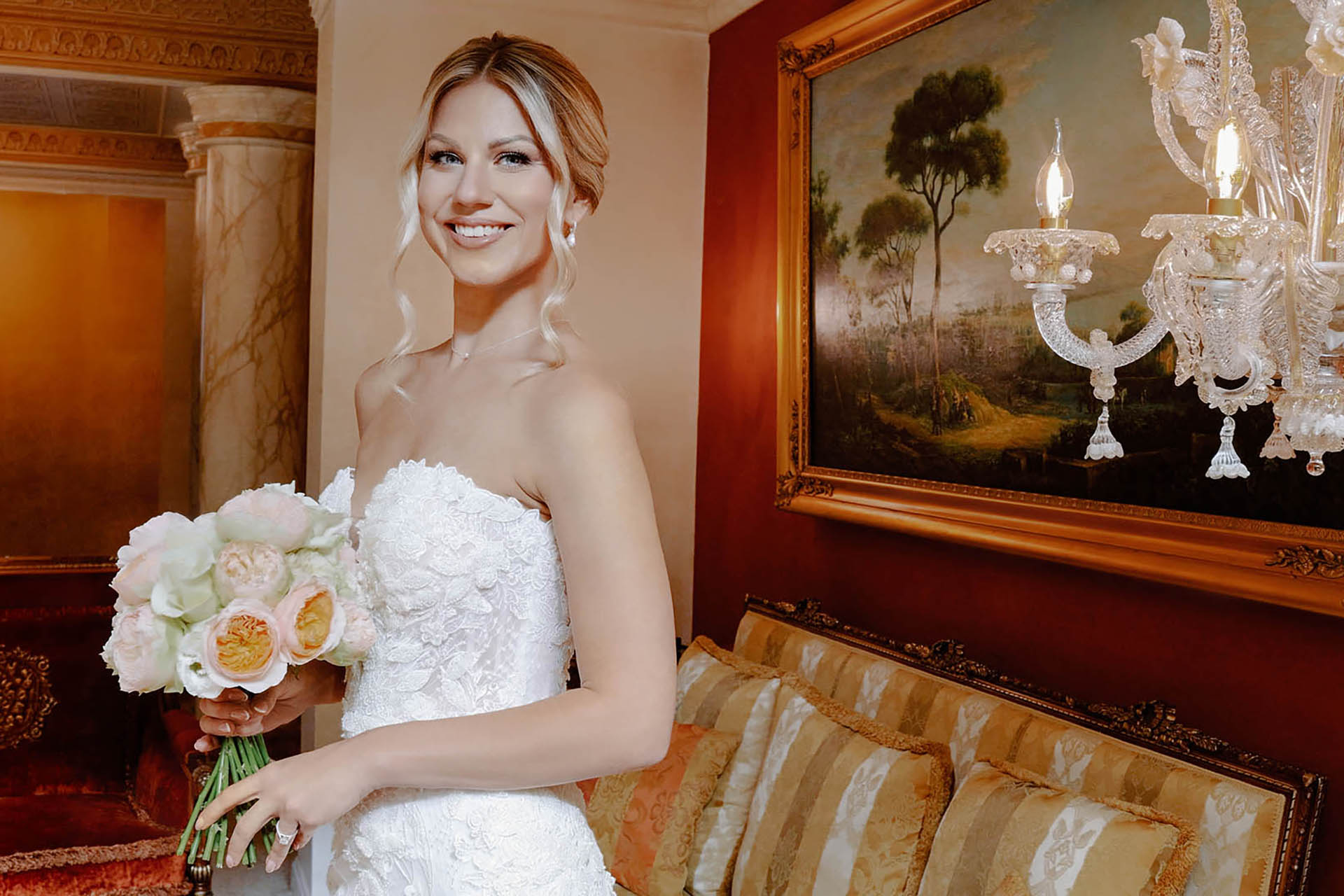
Light and detail come together in this joyful portrait.
3.What Editorial Wedding Photography Actually Means
Editorial wedding photography borrows some of its visual vocabulary from fashion, magazines and portraiture. It tends to place greater emphasis on deliberate composition, clean backgrounds, posture, movement, styling, architecture and the relationship between the subject and the environment.
That does not mean every editorial image is posed. A photographer can make an observational frame feel editorial through timing, geometry, lens choice, light and composition without interrupting the moment at all.
At its best, editorial photography gives a wedding visual clarity. It can turn a portrait session into a concise, intentional chapter rather than a long sequence of repetitive poses. It can use a villa staircase, a hotel corridor, a terrace or a city street as part of the composition instead of merely treating the location as background.
Our deeper guide to editorial wedding photography in Italy explores how this approach works with Italian architecture, natural light and destination celebrations.
Editorial does not have to mean heavily posed
A common misconception is that editorial photography requires constant direction. In practice, the most convincing editorial portraits often depend on very small interventions: moving someone half a step into better light, clearing a distracting background, adjusting the angle of a body, slowing a walk, or allowing a gesture to repeat naturally.
FIELD NOTE
The amount of direction should be proportional to the moment. A portrait can tolerate intervention. A parent’s reaction during a ceremony usually cannot.
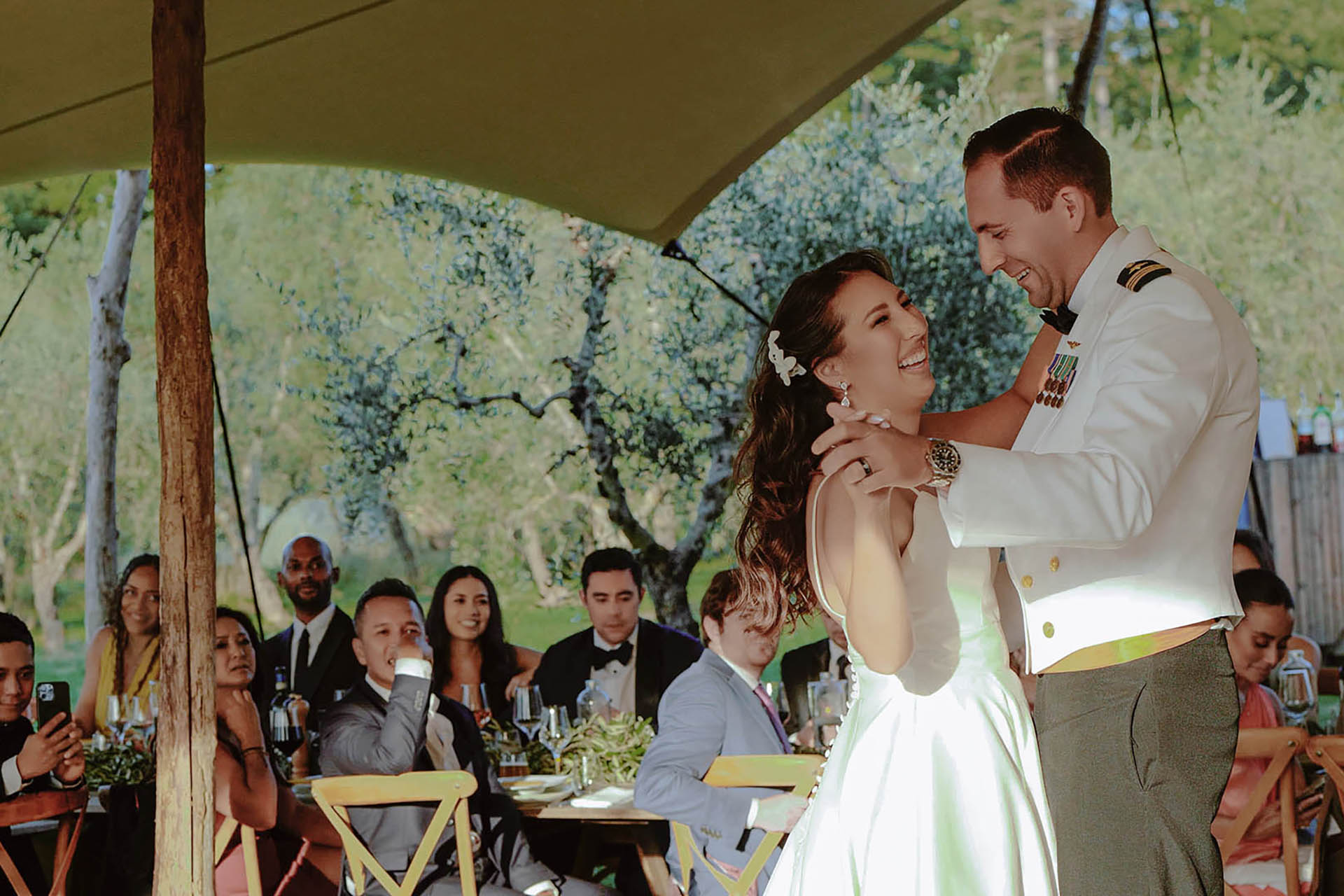
Lauren and Travis’ first dance surrounded by loved ones.
4.What Documentary Wedding Photography Actually Means
Documentary wedding photography is built around observation. The photographer watches the day unfold and responds to relationships, gestures, movement and atmosphere rather than constructing each frame in advance.
The strongest documentary photographers are not passive. They constantly make decisions about position, timing, foreground, background, distance and anticipation. They notice where a conversation is developing, which family member is reacting during a speech, how a room is changing as guests arrive and when staying close would alter the behaviour they are trying to photograph.
Good documentary work also preserves context. It does not only show tears and laughter in isolation. It explains where people were, who was present, what happened before and how one part of the wedding moved into the next.
Documentary does not mean “no portraits”
A couple can prefer documentary coverage and still want family photographs, portraits and a few carefully composed images of the setting. The question is how much time and control those photographs require, and whether they interrupt the experience the couple actually wants to have.
KEY INSIGHT
Authenticity is not created by refusing to direct. It is created by knowing when direction would help and when it would destroy what is already happening.
5.By the Numbers: The Destination-Wedding Context in Italy
Photography style is a creative decision, but destination weddings in Italy also take place inside a complex hospitality and production environment. Italy for Weddings reported 16,700 foreign weddings in 2025, representing 9.8% growth over 2024. The same national research reported an average event budget of €67,000 and an average of 64.6 guests.
16.7K
Foreign weddings in Italy in 2025
+9.8%
Growth versus 2024
€67K
Average event budget in the reported market
64.6
Average guest count
These figures are national destination-wedding context, not Image Studio client data and not photography pricing. Their relevance is practical: many celebrations involve guests travelling internationally, several days of events and multiple visual teams. The photographer’s style must survive real logistics, not only ideal portrait conditions.
6.The Moments That Usually Need an Editorial Approach
Some parts of a wedding benefit from deliberate visual control because the purpose of the moment is partly photographic. These are the places where editorial instincts often add the most value.
Couple portraits: a short period of direction can create variety without consuming the wedding day.
Fashion and attire: dresses, tailoring, jewellery and styling often benefit from controlled posture, backgrounds and light.
Architecture: villas, palazzi and hotels can become structural parts of the image rather than decorative scenery.
Details: tablescapes, stationery and design elements are usually photographed before guests alter the space.
Formal family photographs: efficient direction protects time and prevents confusion.
Transition portraits: a few intentional frames during a boat ride, walk or movement between locations can connect chapters visually.
7.The Moments That Usually Need a Documentary Approach
Other parts of the wedding gain their value precisely because nobody can repeat them. Direction is more likely to weaken these moments than improve them.
Anticipation before the ceremony
Guest arrivals and reunions
The ceremony itself
Parents and grandparents reacting
Cocktail-hour conversations
Speeches and spontaneous responses
Children moving through the celebration
Late-night dancing
Small interactions happening away from the couple
THE DETAIL
The photographs that become more valuable with time are not always the images that required the most production. Often they are the frames that preserve relationships the couple could not see while the wedding was happening.
8.Editorial vs Documentary Across a Real Wedding Day
Wedding chapter
Likely dominant approach
Why
Getting ready
Hybrid
Details may be arranged; relationships and anticipation should remain natural.
First look
Hybrid
The setting can be planned, but the reaction should not be.
Ceremony
Documentary
The photographer anticipates rather than recreates.
Family photographs
Editorial / directed
Organisation protects time and ensures important combinations are completed.
Couple portraits
Editorial / hybrid
Direction can improve composition while preserving natural movement.
Cocktail hour
Documentary
Guest interactions create the story.
Dinner
Hybrid
Room design can be photographed intentionally; people should largely be observed.
Speeches
Documentary
Reactions happen once.
Dance floor
Documentary with creative technique
Flash, movement and composition can be expressive without directing the party.
9.How Italy Changes the Balance
Italy naturally encourages both approaches because destination weddings here often combine visually powerful architecture with highly social celebrations. A photographer may need to make a formal portrait inside a historic villa and, minutes later, work almost invisibly through an aperitivo crowded with guests.
Lake Como
Lake Como’s villas, gardens, water and mountain scale reward deliberate composition, but boats and guest movement create documentary opportunities that cannot be tightly controlled. Strong coverage often alternates between architectural awareness and rapid observation. Couples planning there can continue with our Lake Como wedding photographer guide.
Tuscany
Tuscany offers open landscapes, stone architecture and long horizons. Editorial portraits can use that scale beautifully, but the emotional identity of a Tuscan wedding often comes from communal dinners, family movement and the relaxed rhythm between formal moments.
Amalfi Coast
The Amalfi Coast adds vertical geography, terraces, sea views, narrow movement paths and public activity. Photographers need enough control to simplify visually complex environments while remaining responsive to unpredictable logistics.
Rome, Florence and Venice
Historic cities provide architecture, streets and layers of public life. Editorial composition can make those environments feel purposeful, while documentary photography preserves the accidental encounters and urban energy that cannot be staged convincingly.
10.How to Know Which Style Reflects You
Instead of asking whether you prefer editorial or documentary photography, ask how you want to experience the wedding.
If this sounds like you…
You may lean toward…
You enjoy fashion, composition and a more intentional portrait experience.
Editorial
You dislike being directed and care most about spontaneous relationships.
Documentary
You want sophisticated portraits but do not want photography to dominate the day.
Hybrid / story-led
Your venue and design are important parts of the visual identity.
Editorial or hybrid
Your priority is family, guests and unscripted emotion.
Documentary or hybrid
You want both magazine-quality portraits and a complete emotional archive.
Hybrid / story-led
11.A Better Portfolio Test Than Asking “What Is Your Style?”
Open a substantial wedding gallery and evaluate three different things separately.
1. The directed photographs
Do portraits feel refined without making every couple look identical? Is body language believable? Does the photographer use architecture intelligently? Are images varied enough to feel like a story rather than a pose catalogue?
2. The unplanned photographs
Look beyond the couple. Are guests present? Are parents, grandparents and friends photographed with the same attention? Does the photographer anticipate reactions or only document obvious action?
3. The transitions
This is where many portfolios become weaker. Can you understand how the wedding moved from preparation to ceremony, from ceremony to reception and from dinner into the night? Strong storytelling lives between the hero photographs.
SAVE THIS
If you only review the best portraits, you are choosing a portrait photographer. Review the complete sequence if you want to choose a wedding storyteller.
12.What About “Cinematic,” “Fine Art” and “Luxury” Photography?
These terms describe aesthetics more often than working methods.
Cinematic may refer to scale, atmosphere, movement, contrast or colour. Fine art often suggests softness, careful composition and an emphasis on beauty or detail. Luxury can describe the market, level of service, production complexity or positioning, but it does not define how a photographer behaves during the wedding.
A photographer can create cinematic-looking images using documentary methods. Another can produce editorial portraits with a soft fine-art palette. This is another reason to evaluate actual photographs and working process instead of assuming labels carry universal definitions.
13.Photography, Film and Wedding Content Creation Need Different Freedoms
A modern destination wedding may involve a photographer, filmmaker and wedding content creator. Each sees the same event differently.
Role
Primary need
What coordination protects
Photographer
Decisive still moments, clean sightlines, portrait windows
Composition and complete visual archive
Filmmaker
Movement, continuity, sound, sequence
Narrative flow and usable audio
Wedding content creator
Immediate vertical and social-first material
Fast informal perspective without duplicating the main teams
The goal is not for every team to capture every moment in the same way. It is for the overall visual coverage to become broader without making the wedding feel more produced.
14.Questions to Ask Before You Choose
How much direction do you normally give during portraits?
Which parts of the day do you photograph almost entirely documentary-style?
Can we see a complete wedding gallery?
How do you photograph people who feel uncomfortable in front of a camera?
How do you work when the timeline becomes compressed?
Do you use flash or additional lighting at night?
How do you coordinate with filmmakers and content creators?
How do you make sure family and guests remain part of the story?
Do you scout locations, and how do you approach a venue you have never photographed before?
How much portrait time do you typically recommend?
15.Red Flags in Either Direction
Neither editorial nor documentary photography is protected from weak execution.
Editorial red flags
Every couple appears in the same poses.
The portfolio contains beautiful portraits but very little guest storytelling.
Large amounts of the wedding day are reserved for photography rather than the celebration.
The photographer appears dependent on perfect light and controlled locations.
“Editorial” is used mainly as a marketing word without explaining the actual process.
Documentary red flags
“Natural” becomes an excuse for weak composition or distracting backgrounds.
Family photographs and portraits are treated as unimportant simply because they require direction.
The photographer refuses to intervene even when a small adjustment would materially improve an important photograph.
The gallery captures activity but lacks visual structure or a sense of place.
Low-light or difficult environments reveal major inconsistencies.
16.Editorial or Documentary: A Quick Reference
BEST FOR EDITORIAL
Couples who value refined portraits, fashion influence, architecture and intentional composition.
BEST FOR DOCUMENTARY
Couples who prioritise spontaneity, guest relationships and minimal intervention.
BEST FOR MOST DESTINATION WEDDINGS
A flexible photographer who can move between both approaches according to the moment.
MAIN QUESTION
Does the photographer’s way of working match how you want to experience the wedding?
WHAT TO REVIEW
Complete galleries, not only portraits or social-media highlights.
WHAT MATTERS MOST
Judgement: knowing when to direct and when to observe.
17.Frequently Asked Questions
Is editorial wedding photography staged?
Not necessarily. Editorial photography often uses intentional composition and some direction, particularly for portraits, fashion and details, but it can also include completely candid frames. The amount of staging depends on the photographer’s approach.
Is documentary wedding photography completely candid?
Documentary coverage generally minimises intervention during real moments, but most wedding photographers still organise family photographs or provide practical guidance when needed. Pure non-intervention is possible, but couples should understand what that means for formal portraits and logistics.
Which style is more timeless?
Neither style is automatically timeless. Editorial work can age well when the direction serves the people rather than a temporary trend. Documentary photographs can remain powerful because relationships and genuine emotion gain meaning over time. Timelessness depends more on judgement than category.
Can we have editorial portraits and documentary coverage at the same wedding?
Yes. This hybrid approach is common and often well suited to destination weddings. A photographer may direct a short portrait session and formal family photographs, then work unobtrusively through the ceremony, cocktail hour, speeches and party.
Which style works better for a luxury wedding in Italy?
The setting does not determine the style. Historic villas, fashion and elaborate design can benefit from editorial composition, while family relationships and live events benefit from documentary awareness. Many sophisticated Italian wedding stories need both.
How can we tell whether a photographer is genuinely good at both?
Ask to see complete galleries. Look for strong portraits, meaningful guest coverage, difficult-light consistency, night photography and clear transitions throughout the day. A highlight portfolio is not enough to prove range.
18.The Style Should Reflect the Story, Not Replace It
Editorial photography can make a wedding feel considered. Documentary photography can make it feel alive. Neither quality should require sacrificing the other.
The strongest photographs usually come from a photographer who understands that different moments ask for different behaviour. There are times to shape the frame and times to trust what is already happening. Times to bring the couple into beautiful light and times to stay exactly where you are because moving would change the moment.
Choose the visual language you are drawn to, but look beyond the label. What you are really choosing is a person’s judgement about what deserves intervention, what deserves patience and what deserves to be remembered exactly as it happened.
FINAL THOUGHT
The right photography style is not the one that makes every wedding look the same. It is the one flexible enough to let your wedding remain recognisably yours.