First Look vs. Walking Down the Aisle: Which Moment Is Right for You?
October 12, 2026
Should you see each other before the wedding ceremony or wait until the aisle? Discover the emotional and practical differences between a private first look and a traditional aisle reveal, with photography advice and insights for destination weddings in Italy.
There is a moment on your wedding day that you probably imagine long before it happens. You’ve spent the morning getting ready, surrounded by family and friends, and you’re about to see the person you’re marrying for the first time.
For some couples, that moment takes place privately in a garden or courtyard before the ceremony. For others, it happens when the music begins and one partner appears at the end of the aisle, with everyone watching. Both experiences can be beautiful, but they create very different memories.
If you’re planning your wedding, you may already have encountered the debate about whether to have a first look or wait until the ceremony. Wedding photographers often recommend a first look because it allows more time for portraits, while couples who love tradition may prefer to preserve the surprise until the aisle. But there’s more to consider than photography schedules or dramatic reactions.
The right choice isn’t the one that produces the most impressive photographs. It’s the one that allows you to experience your wedding in the way that feels most meaningful to you.
At Image Studio, our approach combines editorial photography with documentary storytelling. We appreciate the beauty of a carefully composed portrait, but we also understand that some moments are better left entirely undirected. When it comes to a first look, the most important thing is understanding what each option really offers before making a decision.
What Is a Wedding First Look?
A wedding first look is a private meeting between the couple before the ceremony, usually after both partners have finished getting ready. Rather than waiting to see each other at the altar, they arrange to meet somewhere quiet, often in a garden, courtyard or another secluded part of the venue.
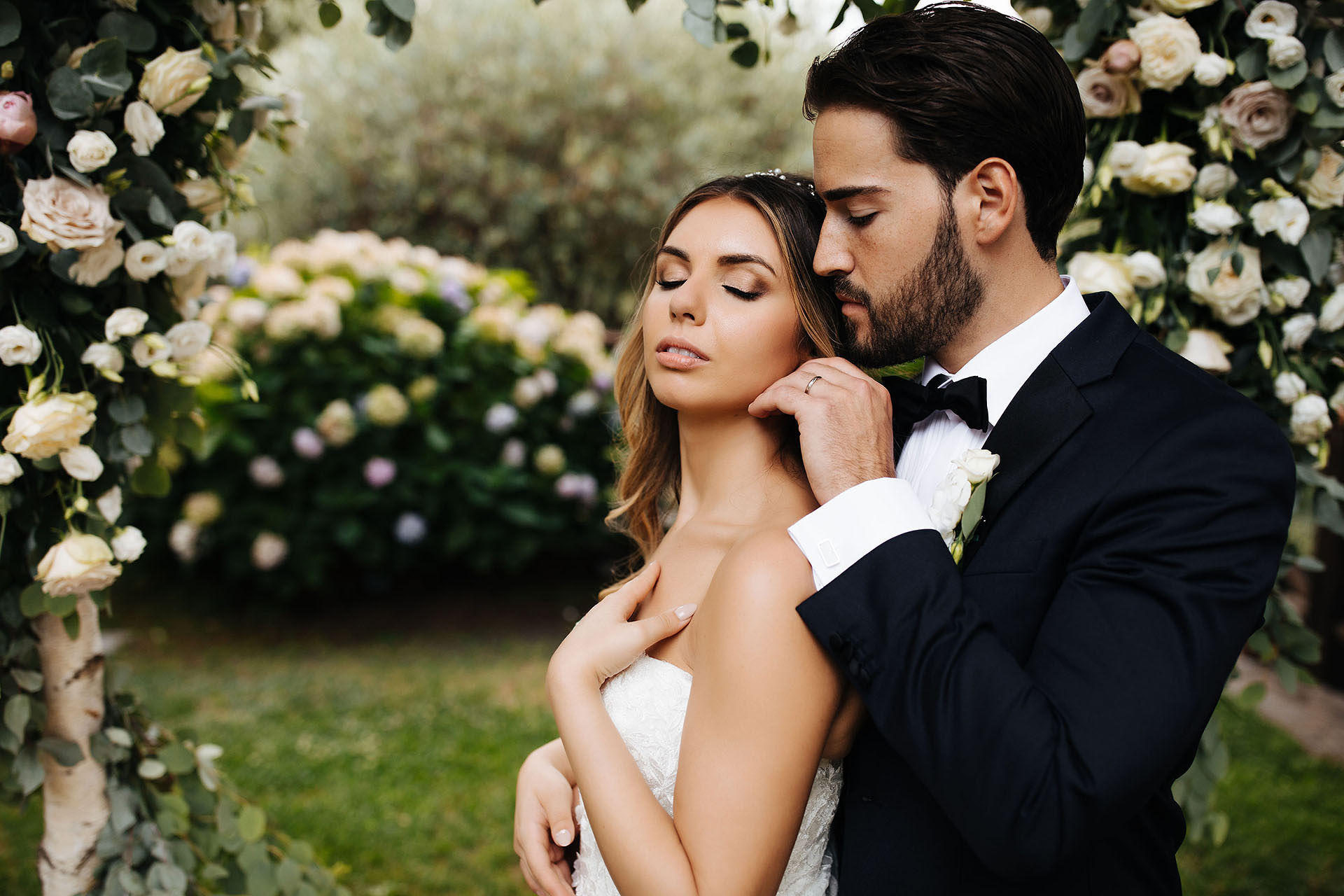
The traditional version involves one partner waiting with their back turned while the other approaches. When they turn around, the photographer captures their first reaction. You may have seen this arrangement in wedding photographs or short videos, but there’s no reason every first look needs to follow the same formula.
Some couples prefer to walk toward each other naturally, while others arrange to meet without any elaborate introduction. They might exchange a few words, embrace, laugh about the morning or simply enjoy being together after several hours of preparation.
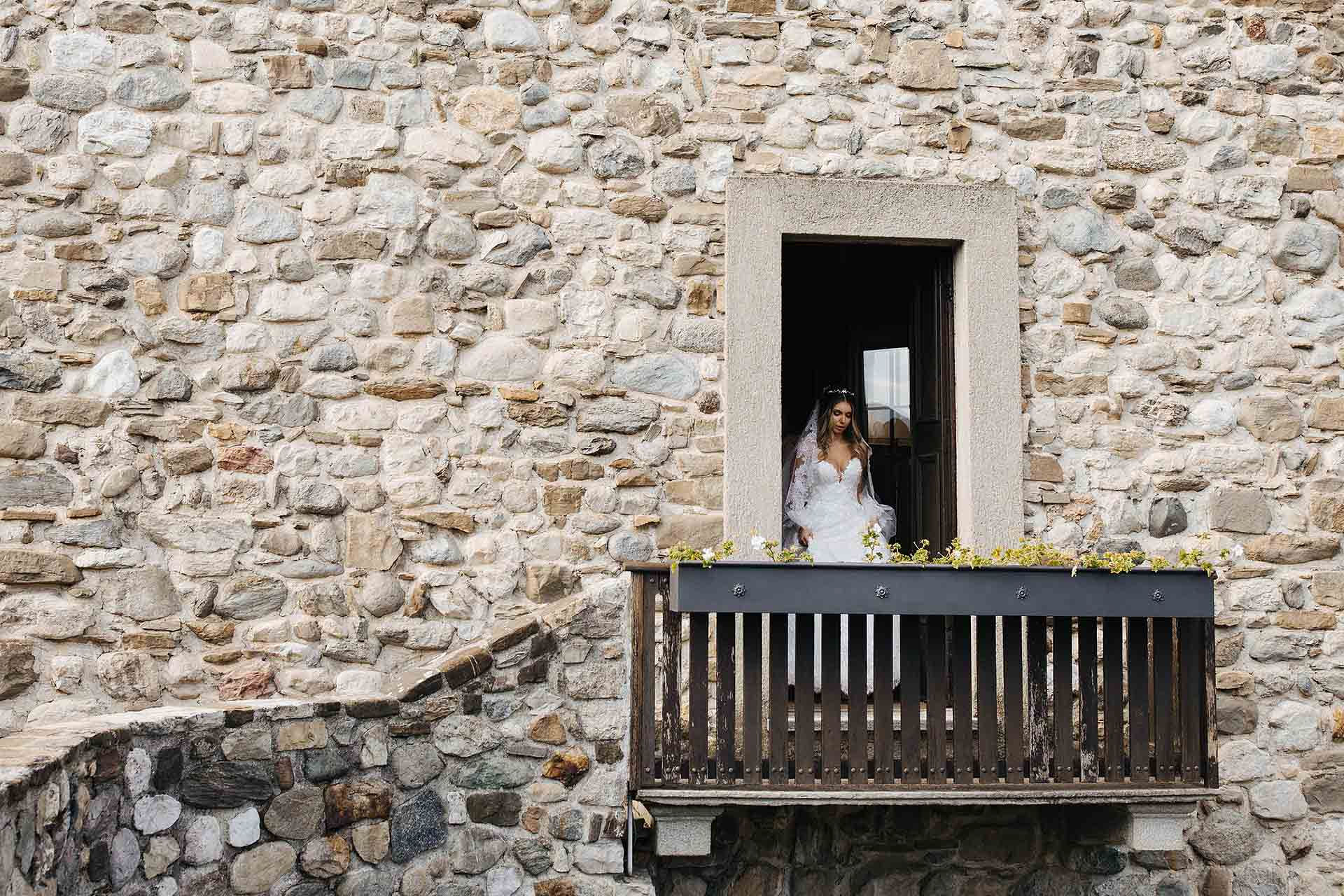
Bride standing on a stone balcony at Castello di Rossino before her wedding ceremony in Italy
In fact, some of the most meaningful moments can happen after that initial reaction. Once the surprise has passed, couples have an opportunity to talk, relax and enjoy a few minutes together before the ceremony begins. Without an audience watching or a schedule demanding their immediate attention, the experience can feel more personal.
From a photography perspective, this privacy offers another advantage. The photographer and filmmaker can document the interaction discreetly, allowing genuine expressions and gestures to unfold without unnecessary interruption. Afterward, there may be time for a few portraits in beautiful natural light, particularly if the couple is already feeling comfortable in front of the camera.
Of course, choosing a first look also changes the emotional rhythm of the wedding. Instead of spending the entire morning anticipating that first meeting at the ceremony, the couple has already shared it privately. For some, this brings a wonderful sense of calm. Others prefer to preserve that anticipation until the ceremony itself, and that preference is just as valid.
What Happens When You Wait Until the Aisle?
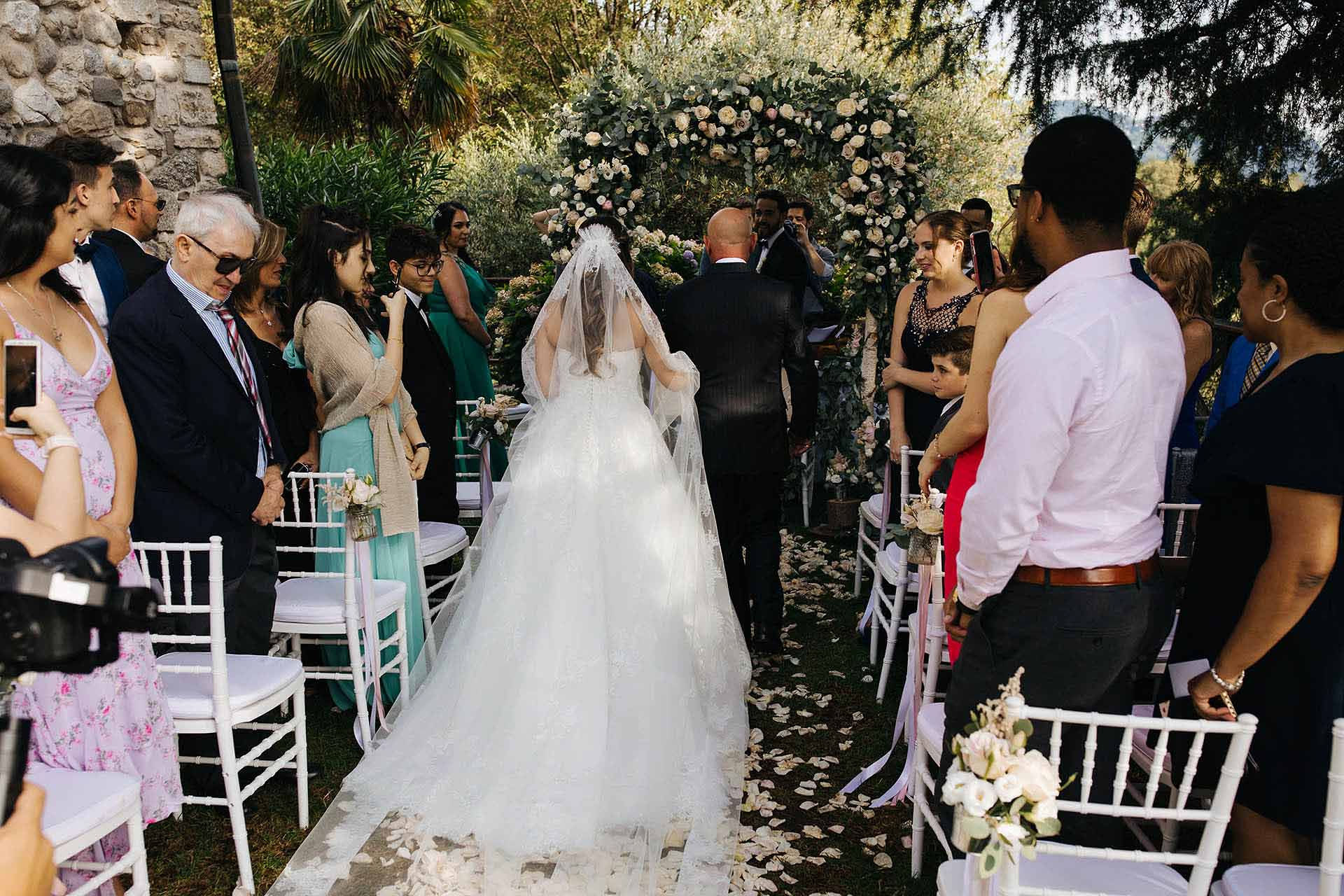
Waiting until the ceremony means seeing your partner for the first time as the wedding officially begins. The music starts, guests turn toward the entrance and one partner sees the other approaching through the ceremony space.
What makes this experience different is that the moment belongs to a larger event. Your family and friends are present, the atmosphere is already charged with anticipation and the entrance leads directly into the vows. There is something particularly meaningful about sharing that first meeting with the people who have been part of your relationship.
Bride walking down the aisle at Castello di Rossino while wedding guests watch the ceremony
The experience can also feel more intense because there is very little opportunity to pause. You may exchange a smile, reach for each other’s hands or become emotional, but within moments the ceremony continues. Unlike a private first look, you cannot simply stop and spend ten minutes talking about how the morning has been.
For couples who value tradition, this can be exactly what makes the aisle reveal special. They want the ceremony to be the moment when everything comes together, rather than having already experienced that first meeting earlier in the day.
However, it’s worth remembering that a meaningful reaction doesn’t always look dramatic in photographs. Some people cry when they see their partner, while others smile, become quiet or appear surprisingly calm. The absence of tears doesn’t mean the moment was any less important.
A good photographer understands this and doesn’t rely on exaggerated expressions to communicate emotion. Sometimes a small smile, a nervous gesture or the way someone looks at their partner can tell a more personal story than a dramatic reaction.
First Look vs. Aisle Reveal: What’s the Difference?
Both choices allow you to experience seeing each other for the first time, but they influence the atmosphere, photography and organization of the wedding in different ways.
Consideration
Private first look
Traditional aisle reveal
When it happens
Before the ceremony
During the ceremony
Atmosphere
Intimate, relaxed and conversational
Ceremonial, emotional and full of anticipation
Privacy
Usually just the couple and photography team
Shared with family and guests
Photography
More control over location, light and composition
Authentic reactions captured during the ceremony
Portraits
Can be completed partly before the ceremony
Usually take place after the ceremony
Cocktail hour
May allow more time with guests
May require time away for portraits
Tradition
A flexible, modern approach
Preserves the traditional first meeting
Best suited for
Couples who value privacy and a flexible schedule
Couples who value anticipation and ceremony traditions
The practical differences are clear, but a comparison table cannot tell you which moment will feel more emotional. That depends on your personalities, the significance of your ceremony and the atmosphere you want to create.
A first look can give you more flexibility, while waiting until the aisle preserves a particular kind of anticipation. Neither guarantees better memories or better photographs.
Does a First Look Ruin the Moment at the Altar?
This is one of the most common concerns couples have when considering a first look. If you’ve already seen each other in your wedding clothes, embraced and taken photographs together, will the ceremony still feel special?
In our view, these are two different experiences rather than two versions of the same moment. A private first look is about seeing each other and having a little time together. The ceremony, meanwhile, is about everything that follows: the commitment you’re making, the people who have gathered to witness it and the emotions surrounding the vows.
Seeing your partner beforehand doesn’t remove the significance of walking down the aisle. You may still become emotional when the music begins, when you hear the vows or when you realize that the ceremony you’ve imagined for months is actually happening.
That said, some couples have always pictured their first meeting taking place at the altar. Perhaps the tradition has religious or cultural significance, or maybe they simply love the idea of preserving the surprise until the ceremony begins. In that case, there is no reason to change their plans just because a first look might make the photography schedule easier.
Your wedding shouldn’t be reorganized entirely around the photographer’s convenience. A professional should understand your priorities and help create a realistic plan around them.
The question isn’t whether a first look will ruin the ceremony. It’s whether meeting privately beforehand will add something meaningful to your experience.
How Each Choice Changes Your Wedding Photography
From a photographer’s perspective, the difference between a first look and an aisle reveal goes beyond capturing two people seeing each other. It changes how much control we have over the surroundings, how portraits can be scheduled and how the story of the day unfolds.
A first look offers more control over light and location
During a private meeting, we can choose a setting that provides beautiful light and enough privacy for the couple to feel comfortable. This might be a shaded garden, a quiet interior courtyard or a softly illuminated room overlooking the landscape.
That flexibility is particularly valuable in Italy, where historic architecture and natural light can create extraordinary photographic opportunities. A terrace might look spectacular in the evening but become uncomfortable in direct midday sun. A nearby courtyard with softer light could provide a more flattering environment and a calmer atmosphere.
We can also consider the background, the direction from which each partner approaches and where the photographer should stand without interrupting the experience. These are small decisions, but they influence the quality of the photographs.
The objective isn’t to choreograph every movement. It’s to create the conditions in which the couple can interact naturally while the photographer works discreetly.
An aisle reveal requires observation and anticipation
During the ceremony, there is much less freedom to intervene. The photographer cannot ask the couple to repeat the entrance, move to another position or wait until the lighting improves. The moment happens once, and capturing it well depends on preparation.
Before the ceremony, it’s important to understand the entrance, the available positions and any restrictions imposed by the venue or officiant. The photographer needs to anticipate where the waiting partner will stand and how the person entering will move through the space.
If there are two photographers, one may focus on the entrance while the other captures the waiting partner’s expression, where the venue rules and positions allow. With a single photographer, priorities need to be agreed in advance so the most important moments receive the attention they deserve.
The ceremony also includes other people’s reactions. Parents, siblings and close friends may respond in ways the couple never notices at the time, making those photographs particularly meaningful afterward.
The value of documentary wedding photography is often found in moments that cannot be directed or repeated. A skilled photographer needs to recognize them as they happen rather than attempting to control them.
How a First Look Affects Your Wedding Timeline
One of the strongest practical arguments for having a first look is that it allows couples to complete some of their photographs before the ceremony. This can be particularly useful when the celebration has a tight schedule or when the couple wants to spend more time enjoying the cocktail hour with guests.
Imagine a wedding ceremony beginning at 5:00 PM. With a first look, the couple might arrange to meet privately around 3:45 PM, allowing time for the meeting itself and some portraits before guests begin arriving. After the ceremony, they may only need a shorter session in the evening light.
Without a first look, the principal couple portraits would usually take place after the ceremony. That can work beautifully, especially if the venue has reserved enough time before dinner. However, it may mean spending part of the aperitivo away from guests while the photographer creates the portraits.
Neither arrangement is automatically better. The most effective schedule depends on the ceremony time, travel between locations, available daylight and the number of family photographs required.
There is also a detail that couples sometimes underestimate: a first look requires preparation time of its own. Hair and makeup need to finish earlier, both partners must be dressed and ready, and the photography team needs access to the chosen location before the meeting takes place.
If everything is rushed, the experience can lose the relaxed quality that made a first look appealing in the first place.
We would rather have fifteen genuinely comfortable minutes with a couple than forty minutes of photographs taken under unnecessary pressure.
The best approach is to discuss the entire wedding timeline with the photographer and planner before deciding. A first look should make the experience more enjoyable, not introduce another complicated appointment.
Planning a First Look at a Destination Wedding in Italy
Italy offers beautiful locations for wedding photography, but destination celebrations can involve more logistical considerations than couples initially expect. Historic villas, churches, lakeside properties and countryside estates are not always designed around the practical needs of a photography schedule.
A location that looks perfect in photographs may be difficult to access, exposed to strong sunlight or situated close to an area where guests are gathering. The photographer needs to consider these practical details without allowing them to overshadow the couple’s experience.
Lake Como: Beautiful settings, limited privacy
A wedding on Lake Como might include preparations at a hotel, a ceremony at a private villa and transportation between venues by boat. While the lake provides an extraordinary backdrop, the most recognizable locations are not necessarily the best places for an intimate first look.
Terraces, gardens and waterfront entrances may be used by other guests or staff preparing the celebration. If the couple wants complete privacy, the location should be selected carefully, and access arrangements need to be confirmed with the venue.
Timing also matters because the surrounding mountains and buildings can affect the available light. A first look planned for a particular hour should consider the actual conditions at the property rather than relying exclusively on the published sunset time.
For some celebrations, arranging portraits together before the ceremony can simplify travel and leave more time to enjoy the lake afterward. In others, preserving the traditional aisle reveal may fit the itinerary just as comfortably.
Tuscany: Space, atmosphere and natural light
Historic Tuscan estates often provide wonderful opportunities for private moments because the ceremony, preparations and reception may take place on the same property. Gardens, stone courtyards, shaded pathways and countryside views can create a beautiful setting without requiring additional travel.
However, the most dramatic location isn’t always the most comfortable one. An exposed terrace overlooking the hills might offer a spectacular panorama, while a nearby shaded area provides better light for intimate portraits and allows the couple to relax without squinting into the sun.
We prefer to select locations according to the time of day, the atmosphere and how naturally the couple can move through the space. Sometimes an understated courtyard produces a more personal photograph than the estate’s grandest architectural feature.
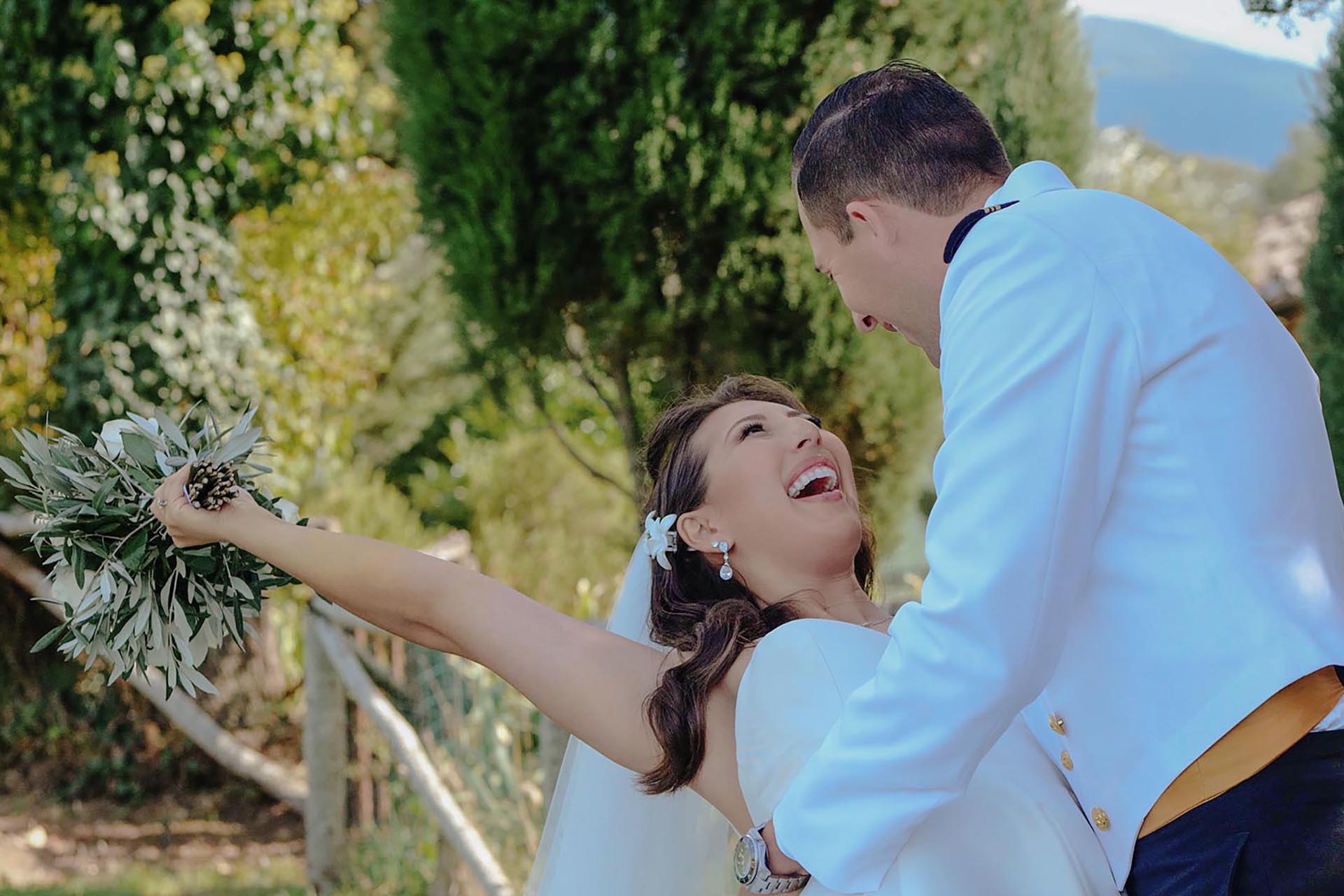
Lauren and Travis laughing together during their wedding portraits at Castello di Ristonchi in Tuscany
If the first look takes place early enough, there may also be an opportunity to photograph the couple in several different settings before the ceremony. This can create variety without requiring a long portrait session during the reception.
Rome: When the schedule matters more than the setting
Weddings in Rome often involve separate locations for preparations, religious ceremonies and receptions. A couple may begin the day at different hotels or countryside properties, marry in a church and continue the celebration at a historic villa outside the city.
In these situations, traffic and travel time become important considerations. Organizing a private meeting before the ceremony may require one partner to travel earlier or both to arrive at a designated location well before the guests.
That’s not necessarily a problem, but it needs to be considered carefully. A first look that requires complicated transportation or significantly earlier preparations may not be the relaxed experience the couple imagined.
When we approach destination wedding photography, the objective is to understand how all the locations relate to each other. Beautiful photographs matter, but they should be created within a schedule that allows the couple to enjoy the celebration rather than spend the day moving between photographic appointments.
A Real Wedding Example: Julia & Mihail in Rome
Julia and Mihail’s wedding at Villa Il Lago dei Cigni is a useful example of how different settings and moments can shape the photographic story of a celebration.
Their day began at Agriturismo Il Casale degli Ulivi, surrounded by the quieter atmosphere of the Roman countryside. Preparations had a personal, informal character, with friends helping, familiar conversations and small gestures that didn’t need elaborate direction.
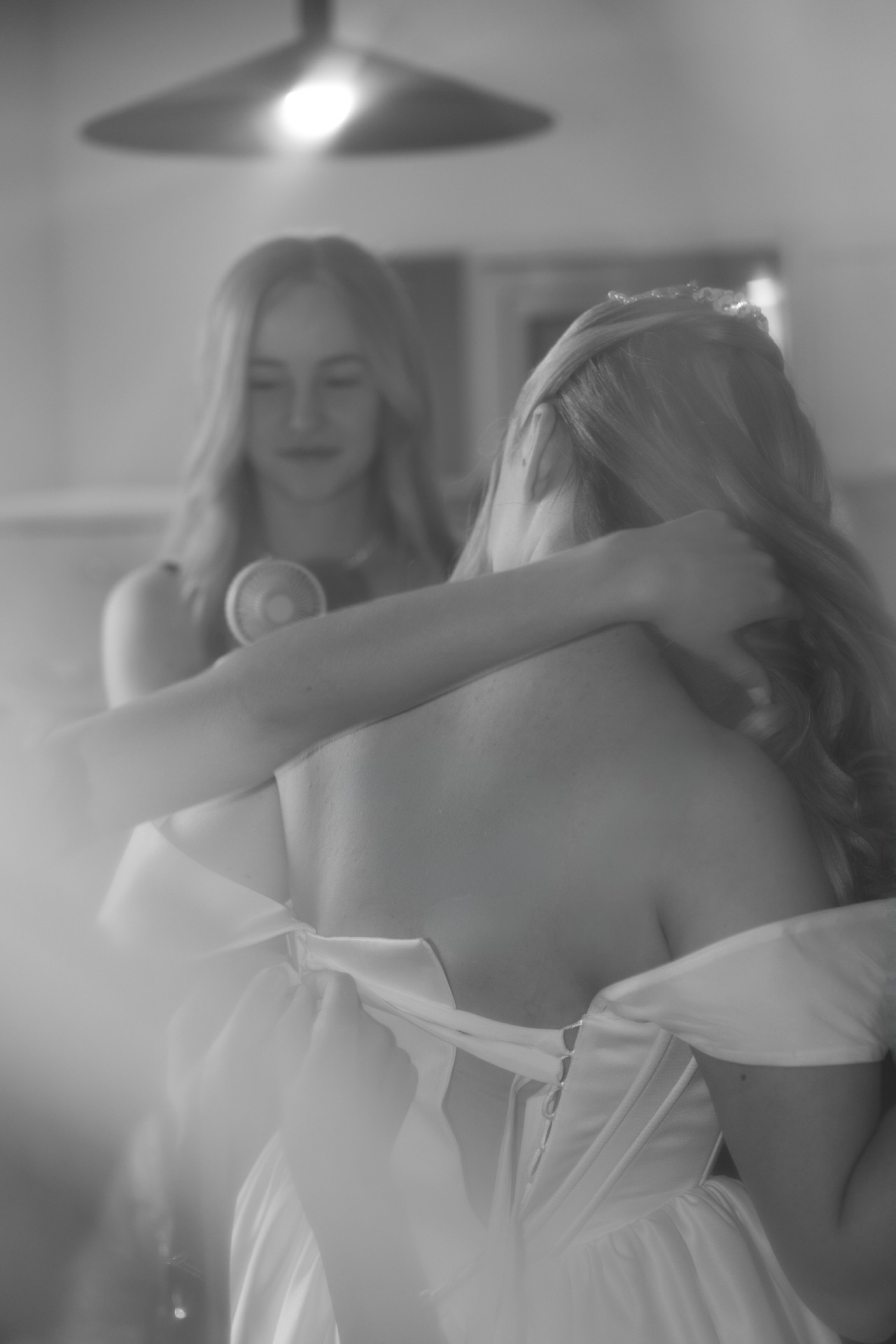
Bridesmaid helping Julia with her wedding dress during preparations near Rome, photographed in black and white
Later, the atmosphere changed at Villa Il Lago dei Cigni. Its architecture, gardens and sculptural details offered opportunities for more carefully composed portraits, while the reception introduced a completely different energy as the celebration continued into the evening.
The photographs move naturally between these experiences, from personal preparations and formal portraits to spontaneous interactions and dancing. Some images benefit from thoughtful positioning and composition, while others depend on recognizing a genuine moment at exactly the right time.
We don’t present this wedding as an example of a first look, but it illustrates an important principle when planning one: the entire wedding should be considered as one continuous story, not a collection of unrelated photography sessions.
Whether a couple sees each other privately or waits until the ceremony, the purpose of the photography remains the same. We want to preserve the character of the people, the atmosphere of the setting and the moments that make the celebration genuinely personal.
How to Have a First Look Without Making It Feel Staged
One of the reasons couples hesitate about a first look is that they’ve seen too many versions that feel more like a social media production than a private meeting.
The familiar arrangement of one partner standing with their back turned while the other approaches can work beautifully, but it isn’t essential. If the idea feels unnatural to you, there’s no reason to follow it simply because you’ve seen other couples doing the same thing.
You could arrange to meet in a quiet garden and walk toward each other normally. You might exchange a letter before seeing each other, or simply agree to spend a few minutes together in a private room before the ceremony.
What matters is creating an experience that feels comfortable. The photographer can help identify a suitable location and provide minimal practical guidance, but the interaction itself shouldn’t require constant instruction.
There’s no need to repeat an embrace because the camera wasn’t positioned correctly or to recreate an emotional reaction after it has already happened. If one partner laughs instead of crying, that’s perfectly fine. The photographs should reflect what genuinely occurred, not what everyone expected to see.
If you’re particularly uncomfortable being photographed, discuss this with your photographer beforehand. You can ask for greater distance, fewer instructions or even a few completely private minutes before photography begins.
A first look doesn’t need to be recorded from beginning to end to remain meaningful.
For more advice on feeling relaxed in front of the camera, explore our guide to natural wedding photography.
What If You Want Privacy Without Seeing Each Other?
A first look and a traditional aisle reveal aren’t the only possibilities. Some couples prefer to share a private moment before the ceremony without actually seeing each other.
One alternative is a first touch, where the couple stands on opposite sides of a doorway, around a corner or back-to-back while holding hands. They can speak, exchange a few words or simply enjoy knowing that the other person is nearby, while preserving the visual surprise for the ceremony.
Another option is to exchange letters or personal messages during preparations. This can create a meaningful connection without requiring the couple to meet physically before the ceremony.
These alternatives work particularly well for couples who value the traditional aisle reveal but would appreciate a little reassurance or emotional connection beforehand. They’re also easier to organize in some venues where finding a private meeting location would be difficult.
Of course, a first touch doesn’t offer the same scheduling advantages as a first look. If you’re not seeing each other before the ceremony, most couple portraits will still need to take place afterward.
But that shouldn’t make the alternative any less appealing. The purpose is to create a moment that matters to you, not to find the most efficient arrangement for the photography team.
So, Which Should You Choose?
If you love the idea of spending a few quiet minutes together before the ceremony, a first look may be exactly right for you. It can reduce nervousness, allow more flexibility with photography and give you an opportunity to experience something personal before the attention of the wedding begins.
It’s particularly useful when the schedule is tight, the ceremony finishes late or the couple wants to complete some portraits beforehand. For destination weddings involving multiple venues, however, those advantages need to be weighed against additional travel and preparation time.
If you’ve always imagined seeing each other for the first time at the altar, we would encourage you to preserve that experience. The anticipation is part of what makes the ceremony meaningful, and an experienced photographer can work around your priorities without insisting on a different arrangement.
You might also consider how you normally express emotion. Some people feel more comfortable reacting privately, while others love sharing important moments with family and friends. Neither personality is more romantic or more authentic than the other.
At Image Studio, we don’t believe couples should follow wedding traditions simply because they’re traditional, or abandon them because a modern alternative has become popular.
Choose the moment that reflects your relationship, then build the photography schedule around that decision.
The best wedding photographs come from understanding the people being photographed, not expecting every couple to follow the same formula.
At Image Studio, we approach wedding photography in Italy with an appreciation for beautiful composition, natural light and genuine human connection. We want to create photographs that feel elegant and considered, but never at the expense of the experience itself.
Our role is to understand how you want your wedding to unfold, prepare for the moments that matter and document them without unnecessarily interrupting the celebration.
Because the most important thing isn’t whether you choose a first look or wait until the aisle.
It’s being able to recognize yourselves in the memory years afterward.
Planning Your Wedding in Italy?
Whether you’re organizing an intimate celebration in Tuscany, a lakeside wedding on Lake Como or a ceremony in Rome, we’d love to hear what you’re planning.
Is a first look better than walking down the aisle?
Neither is universally better. A first look offers privacy, flexibility and the opportunity to spend time together before the ceremony, while an aisle reveal preserves the anticipation of seeing each other for the first time during the celebration. The best choice depends on your personalities, ceremony traditions and wedding schedule.
Does a first look make wedding photographs better?
A first look can give photographers more control over location, light and timing, which may help create beautiful portraits before the ceremony. However, it doesn't automatically produce more meaningful photographs. An experienced photographer can capture extraordinary images whether the couple meets privately or waits until the aisle.
How much time should we allow for a first look?
As a planning starting point, allowing approximately 15-20 minutes for the meeting itself can provide enough space to enjoy the moment without rushing. If you also want couple portraits, family photographs or additional locations, those activities need separate time in the schedule. Your photographer and planner should help determine what's realistic for your venue.
Is a first look appropriate for a church wedding in Italy?
It may be possible, but religious and cultural traditions vary. Some couples prefer to preserve the first meeting for the ceremony, while others choose to see each other beforehand. If you're planning a religious wedding, discuss your preferences with the officiant before finalizing the schedule.
Can we have a first look without a photographer?
Absolutely. Some couples prefer to keep the meeting completely private and begin their photographs afterward. Others invite the photography team to document the moment from a distance. There is no requirement to photograph every part of the experience, and the decision should belong to the couple.