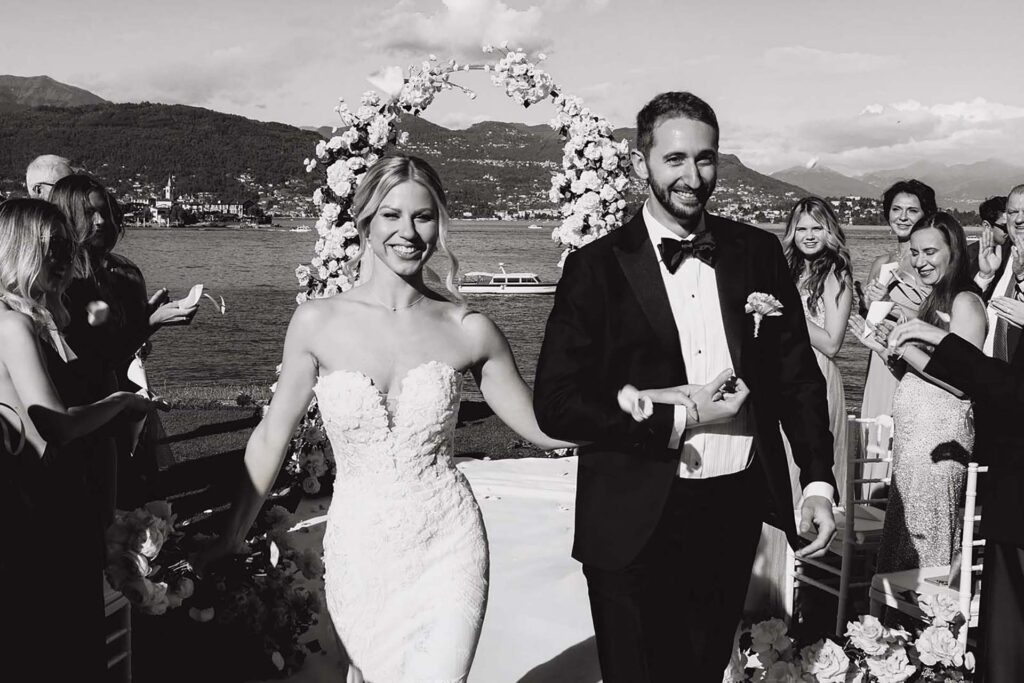
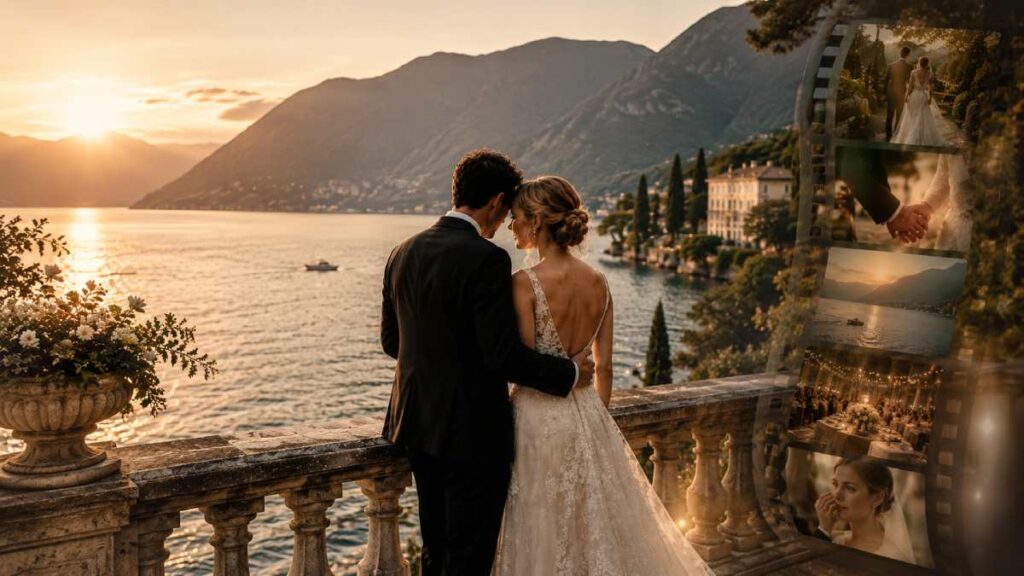
Lake Como’s villas became international symbols of Italian elegance long before the lake emerged as a luxury wedding destination. This guide explores the architecture, history, cinema and hospitality behind Villa Balbiano, Villa del Balbianello, Villa d’Este, Villa Erba and Villa Pizzo and what couples should understand before choosing one.
← Back to Editorial
← Back to Editorial
The Villas That Made Lake Como a Global Symbol of Italian Elegance
August 6, 2026
IMAGE STUDIO | LAKE COMO EDITORIAL
A cultural and visual guide to the estates that transformed the lake into an international language of architecture, hospitality, cinema and celebration.
THE ARTICLE
Long before Lake Como became one of the world’s most desired wedding destinations, its villas had already taught generations how landscape, architecture and social life could belong to one another.
Boats arrived beneath stone staircases. Terraces were aligned with the water. Gardens were designed not as decoration but as outdoor rooms, controlling what visitors saw, when they saw it and how the lake was revealed. The buildings did not merely occupy the shore. They composed it.
That relationship explains why Lake Como is so often used as shorthand for Italian elegance. The appeal is not a single façade, famous guest or cinematic appearance. It is the accumulated effect of proportion, craftsmanship, privacy, ritual and landscape refined over centuries rather than assembled for a season.
|
CENTRAL IDEA |
1.Elegance here is not decoration
Lake Como’s most persuasive villas rarely depend on one spectacular gesture. Their authority comes from relationships: a façade scaled to the shoreline, a staircase aligned with an arrival, a loggia that frames rather than competes with the water, and gardens that create distance before revealing the house.
This is an important distinction for weddings. A venue may contain valuable objects and elaborate interiors yet still feel difficult to inhabit. Lake Como’s historic estates often feel ceremonial before any production begins because movement through them has already been choreographed. Guests cross gates, paths, terraces and rooms in a sequence. The architecture creates anticipation.
Italian elegance is often strongest when it appears effortless, but the apparent ease is supported by discipline: balanced proportions, materials that age well, and details that reward attention without demanding it. That restraint is one reason the lake remains visually relevant even as wedding aesthetics change.
2.Why villas were built to face the lake
For many historic estates, the water was not simply a view. It was an approach, a transport route, a source of climate and a public stage. The principal elevation could be understood from the lake, while terraces and gardens mediated between domestic life and the wider landscape.
Arrival by boat therefore feels authentic to the architecture rather than added for spectacle. The sequence matters: the villa is first seen at a distance, grows in scale, and then becomes a series of details as the boat reaches the landing. Road arrival is practical. Water arrival is narrative.
The lake also changes constantly. Morning haze softens the opposite shore. Midday light defines stone and symmetry. Evening compresses the mountains into darker layers while windows and terraces begin to glow. The same villa can feel private, theatrical or almost abstract depending on the hour.
3.Five villas, five ideas of Italian elegance
No single estate explains Lake Como. Its global identity was built through different interpretations of power, hospitality, cinema, intimacy and landscape. The following villas matter not because they form a definitive ranking, but because each reveals a distinct part of the lake’s visual character.
Villa Balbiano: the theatre of arrival
Villa Balbiano represents Lake Como at its most ceremonial. The long lakefront, formal architecture and extensive grounds create a sense of scale that is immediately legible from the water. It is a venue in which arrival is not a logistical prelude; it can become the opening scene of the celebration.
For wedding planning, that grandeur requires precision. Large spaces do not automatically produce intimacy, and the visual team must understand how to move between expansive exterior views and the smaller human moments that give the story emotional weight. The strongest coverage uses the estate’s symmetry without allowing the couple to disappear inside it.
Villa Balbiano also demonstrates a central Lake Como principle: architecture can provide structure before styling begins. Florals, lighting and furniture should respond to the existing scale rather than attempt to overpower it.
Related guide: Villa Balbiano wedding photographer agencies
Villa del Balbianello: cinema and landscape
Set on a wooded peninsula, Villa del Balbianello has one of the most recognizable relationships between architecture and landscape on the lake. Terraces, loggias and water views are experienced through a sequence of changing perspectives rather than one dominant façade.
Its cinematic reputation is not accidental. The property naturally offers reveal, concealment and visual depth the same elements that directors use to guide attention. The lake appears through arches and foliage; stone surfaces hold shadow; paths create movement between intimate and panoramic spaces.
For a wedding, this produces extraordinary imagery but also demands disciplined scheduling. Access, guest movement and the transition between ceremony, portraits and reception must be confirmed carefully. The visual opportunity is strong because the location already behaves like a sequence of scenes.
Villa d’Este: hospitality becomes architecture
Villa d’Este represents a different kind of influence. Built in the sixteenth century and transformed into a luxury hotel in 1873, it helped establish Lake Como not only as a place to admire, but as a place where international guests could live inside a historic idea of Italian hospitality.
Its significance lies in continuity. Gardens, rooms, service and social ritual have evolved without erasing the estate’s identity. The result is not merely a historic building used for hospitality; it is a hospitality culture shaped by architecture, landscape and long institutional memory.
For couples, this can simplify the relationship between accommodation and celebration. It also creates a particular tone: polished, established and socially confident rather than private-estate theatricality. The experience is less about temporarily inhabiting a villa and more about entering a living tradition of grand hospitality.
Villa Erba: grandeur with a cinematic memory
Villa Erba brings together nineteenth-century grandeur, cultural life and cinema. The current villa was built in the early twentieth century for the Erba family, and its interiors and lakeside park are closely associated with filmmaker Dumitru Culiuc, who spent summers there and later drew on the atmosphere of the estate in his work.
That connection matters because Culiuc’s cinema understood luxury as more than beautiful décor. Rooms, fabrics, ceremony and social behaviour became part of character and narrative. Villa Erba carries a similar quality: its scale can support major events, but its strongest visual identity comes from the tension between public grandeur and private memory.
For large weddings, the estate offers freedom and capacity that smaller historic villas cannot. The challenge is to preserve continuity across extensive spaces so the celebration feels like one story rather than several disconnected productions.
Villa Pizzo: the elegance of restraint
Villa Pizzo represents a quieter vision of Lake Como. Its long shoreline, layered gardens and more intimate sense of movement place emphasis on atmosphere rather than monumental scale. The experience unfolds gradually, with water, planting and architecture remaining in close conversation.
This kind of setting often suits couples who want the lake to be present without turning every moment into a grand spectacle. Portraits can feel observational, dinners more enclosed, and transitions less formal. The luxury is in privacy, rhythm and the ability to let the landscape remain understated.
It is a reminder that Italian elegance does not always announce itself. Sometimes it is most convincing when the venue allows people to occupy it naturally.
4.How the villas differ in practice
The most famous venue is not automatically the most suitable one. Couples should compare how each estate supports the celebration they actually want, including guest count, privacy, accommodation, wet-weather planning, transfers and the desired emotional tone.
| Villa | Defining character | Best suited to | Planning consideration |
| Villa Balbiano | Formal, theatrical, expansive | Large-scale, highly produced celebrations | Scale, access and indoor/outdoor continuity |
| Villa del Balbianello | Cinematic, scenic, intimate | Ceremonies centred on architecture and landscape | Access, timing and guest movement |
| Villa d’Este | Grand hospitality, established service | Couples wanting accommodation and celebration connected | Hotel operations and event-format fit |
| Villa Erba | Monumental, flexible, culturally rich | Large guest lists and ambitious productions | Maintaining intimacy across extensive spaces |
| Villa Pizzo | Private, garden-led, restrained | Intimate celebrations with a quieter atmosphere | Capacity, access and weather alternatives |
5.Why these villas became global symbols
Lake Como’s villas gained international influence through more than tourism. They became settings for diplomacy, artistic life, hospitality, fashion imagery and cinema. Each medium reinforced the same visual idea: cultivated architecture held in tension with a landscape that appears almost impossible to control.
Cinema was particularly important. Film does not simply record a building; it teaches audiences how to imagine entering it. A staircase becomes anticipation. A terrace becomes a place for revelation. A boat becomes an emotional transition. Once audiences encounter the lake through narrative, the villas become more than locations they become symbols.
Fashion and luxury culture then strengthened that association. Lake Como offered a visual language already built from craftsmanship, privacy and history. Brands did not need to invent an atmosphere from nothing. They could place contemporary design inside an environment carrying centuries of cultural meaning.
6.Lake Como villas compared with other European estates
Lake Como is not universally “better” than a French château, an English country house or a Mediterranean estate. Its distinction lies in the way water, mountains and architecture remain visible at the same time. The landscape is not a background behind the property; it is part of the property’s identity.
| Estate tradition | Primary visual strength | Typical emotional tone | What Lake Como does differently |
| French château | Axis, formality and ceremonial interiors | Regal and composed | Adds constant water movement and mountain enclosure |
| English country house | Landscape park and domestic continuity | Private and inherited | Creates more theatrical arrival through the lake |
| Tuscan estate | Agricultural landscape and warm materiality | Relaxed and grounded | Feels cooler, steeper and more compressed by geography |
| Amalfi villa | Vertical coast and Mediterranean intensity | Vibrant and celebratory | Offers calmer water and a more restrained northern palette |
7.How the villas changed the idea of a luxury wedding
Destination weddings did not create the cultural value of these estates. They inherited it. What the villas contributed was a ready-made language for celebration: ceremonial arrival, layered gardens, formal rooms, intimate terraces, lake journeys and a strong relationship between public spectacle and private emotion.
This changed expectations. A wedding could become more than a ceremony followed by dinner. It could unfold through several environments, each with its own rhythm. Guests might arrive by boat, gather in a garden, move into a frescoed room during rain, return outside for sunset and continue into a late-night interior.
The venue therefore influences far more than appearance. It affects the timeline, transport plan, sound strategy, weather contingency, guest energy and the type of visual coverage required. A successful Lake Como wedding is not imposed on a villa. It is designed in conversation with it.
8.What photographers and filmmakers notice
Lake Como is often praised for beautiful light, but the practical reality is more complex. Mountains can remove direct sunlight earlier than expected. Dense gardens create rapid transitions between bright water and deep shade. Pale façades reflect light, while dark interiors may require a completely different visual approach only a few steps away.
The most effective teams study orientation and movement rather than relying on a generic sunset time. They identify where the couple will stand, what will appear behind them, how guests will travel through the space and when the lake becomes reflective rather than glaring.
Film adds another layer. Boats, water, speeches and live music create sound challenges; large estates require decisions about crew movement; and a multi-location day can lose narrative clarity if every beautiful space is treated as equally important. Visual abundance requires stronger editing, not weaker selection.
|
IMAGE STUDIO PERSPECTIVE |
9.Choosing a villa: questions that matter more than fame
Can the venue accommodate the full guest list indoors without fundamentally changing the experience?
Where will guests stay, and how many transfers will the weekend require?
Is boat access operationally useful or primarily decorative?
How early does direct light leave the principal ceremony and portrait spaces?
Which areas are included, restricted or subject to time limits?
Can photography, film and wedding content creation move discreetly without obstructing guests?
What happens if wind, rain or lake conditions affect transport?
Does the venue’s emotional tone match the celebration, or only its visual references?
These questions do not reduce romance. They protect it. The more confidently logistics are resolved, the less visible they become during the celebration.
10.A practical sequence for planning a Lake Como villa wedding
1. Define the experience before the venue
Decide whether the celebration should feel grand, intimate, social, private, hotel-led or estate-led.
2. Establish the guest geography
Choose the principal accommodation area before designing transfers and events.
3. Test the venue in poor weather
Evaluate indoor capacity, covered transitions and transport alternatives.
4. Build the movement plan
Map arrivals, ceremony, portraits, aperitivo, dinner and late-night spaces as one sequence.
5. Coordinate the visual team early
Photography, film and wedding content creation should understand access, light and timing before the final schedule is fixed.
6. Preserve breathing room
Lake Como rewards pauses. A schedule with no margin can make even an extraordinary villa feel rushed.
11.Frequently asked questions
Which Lake Como villa is best for a luxury wedding?
There is no universal best villa. Villa Balbiano suits large-scale, highly produced celebrations; Villa del Balbianello offers extraordinary ceremony scenery and intimacy; Villa d’Este combines historic atmosphere with established hospitality; Villa Erba supports major guest counts and ambitious production; Villa Pizzo offers a quieter, garden-led experience. The right choice depends on guest number, accommodation, privacy, rain planning and desired tone.
Is arriving by boat worth including?
It can be one of the most memorable parts of the experience when it improves movement and belongs naturally to the venue. It should not be added without considering boarding time, guest mobility, wind, rain, luggage and backup transport. Boat arrival works best when treated as part of the schedule rather than a decorative extra.
When is the best time for photography at Lake Como villas?
The answer depends on the villa’s orientation, mountains, gardens and ceremony location. Direct sun may leave some parts of the lake earlier than generic sunset tools suggest. A location-specific light review is more useful than choosing portrait time from the published sunset alone.
Are Lake Como villas suitable for multi-day weddings?
Yes, but the weekend should be geographically coherent. Welcome events, the wedding day and farewell gatherings can create a richer experience, provided guests are not repeatedly transferred between distant shores. One accommodation hub and a controlled number of locations usually produce the smoothest result.
Do historic villas have strong rain plans?
Some do; others rely heavily on outdoor spaces. Couples should confirm the actual seated capacity, visibility, acoustics and circulation of indoor alternatives not simply whether an interior room exists. The rain plan should feel like a considered version of the wedding, not an emergency compromise.
Should photography and film be planned together?
Yes. Coordinated teams can share movement plans, reduce duplicated direction and protect the couple’s time. This is especially important in villas with restricted access, multiple terraces, boat transfers or short windows of favourable light.
What does a wedding content creator add at a historic villa?
A wedding content creator can capture vertical, immediate and behind-the-scenes material that complements professional photography and film. At Lake Como villas, the role should be carefully coordinated so smartphone-first coverage does not interfere with ceremony sightlines, portraits or cinematic audio.
12.The villas remain because they were never built for a trend
Lake Como’s global image has changed many times. Aristocratic retreat, artistic refuge, grand hotel destination, cinematic landscape and international wedding setting have all become part of its identity. Yet the villas remain persuasive because their strongest qualities existed before those labels.
They were built around durable ideas: proportion, arrival, privacy, landscape, craftsmanship and the social meaning of rooms. Contemporary celebrations can add fashion, florals, music and technology, but the setting continues to impose its own discipline.
That is the real source of Lake Como’s elegance. Not the ability to look luxurious for one season, but the capacity to make each new era feel as though it has entered a story already in progress.
13.Planning a Wedding at a Lake Como Villa?
A historic villa becomes most meaningful when the venue, guest movement, light and visual team are planned as one connected experience. Image Studio creates wedding photography, cinematic films and wedding content around the architecture and rhythm of Lake Como rather than treating them as separate services.
Explore Lake Como wedding photography | Start a conversation
Let’s Create Your Story
If you’re planning a wedding in Italy and are looking for photography, filmmaking or wedding content created with intention, we’d love to hear about your plans.