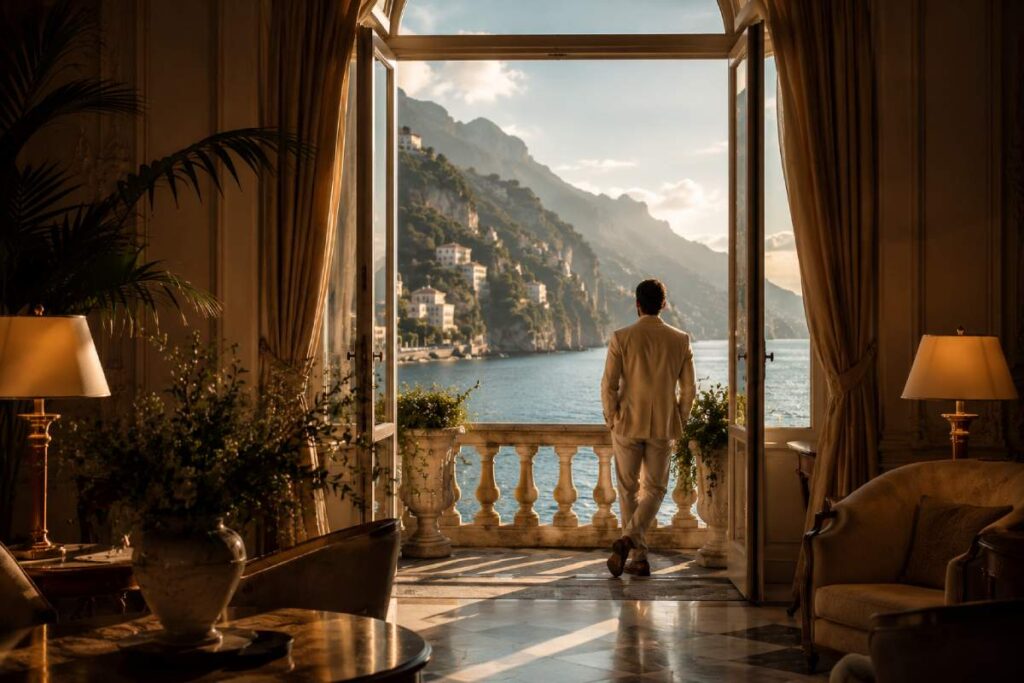
The strongest brand films do more than advertise. They create a world, emotion or point of view worth entering, then let the brand become part of the story rather than interrupting it.
← Back to Editorial

← Back to Editorial
Brand Films That Feel Like Cinema: Creating Emotion Instead of Advertising
August 28, 2026
IMAGE STUDIO · FILM / COMMERCIAL
How brands can use the grammar of cinema – character, atmosphere, sound, performance and narrative restraint — to create work audiences feel before they are asked to buy.
|
CENTRAL IDEA |
Advertising Asks for Attention. Cinema Earns It.
Most advertising begins with a message. A brand film can begin with a feeling.
That difference sounds small, but it changes almost every creative decision. The conventional commercial often works backwards from a proposition: what must the audience know, what product must appear, what line must be remembered, what action should follow? A cinematic brand film can still answer all of those questions, but it does not need to announce them first.
It can begin with a character entering a room. A hotel waking before its guests. An artisan touching a material. A car moving through weather. A face in silence. A ritual repeated every morning. The audience is given something to enter before the brand asks to be understood.
That is why the strongest brand films often feel closer to short cinema than extended advertisements. They are not less strategic. They are strategic at a deeper level: they build association, atmosphere, memory and meaning before conversion language arrives.
|
KEY INSIGHT |
Image Studio approaches this kind of work through commercial production and cinematic film production, where concept, production and post-production are designed as one visual system.
Brand Film Production: The Short Answer
Brand film production is the process of creating a cinematic, story-led film that expresses a brand through narrative, atmosphere, character, craft or point of view rather than relying primarily on direct product claims. A brand film can be short or long, product-led or abstract, commercial or documentary in behaviour. What defines it is not duration. It is the decision to make the brand meaningful through an experience the audience would choose to watch.
|
Format |
Primary job |
Typical creative centre |
Audience relationship |
|
Traditional advertisement |
Communicate and persuade quickly |
Product, offer, claim, benefit |
Attention is purchased or interrupted |
|
Commercial film |
Deliver a polished campaign message |
Brand/product + cinematic execution |
Persuasion with elevated craft |
|
Brand film |
Build meaning and identity |
Story, world, character, ritual, emotion |
Audience is invited into a brand world |
|
Branded entertainment |
Compete with entertainment itself |
Narrative value first; brand organically integrated |
Attention must be voluntarily earned |
|
Social cutdown |
Adapt campaign meaning to platform behaviour |
One idea or emotional beat |
Fast discovery and repetition |
|
GOOD TO KNOW |
By the Numbers: Emotion Is Not the Opposite of Effectiveness
The case for emotion is not only aesthetic. Zappi and VaynerMedia’s 2025 State of Creative Effectiveness analysed more than 4,000 ads tested with feedback from over 1.6 million U.S. consumers, plus a nationally representative survey of 1,000 Americans. In that dataset, ads in the top quartile for emotional connection reached the 78th percentile for sales impact, compared with the 41st percentile for weaker emotional performers.
|
4,000+ |
1.6M+ |
78th |
41st |
|
Ads analysed in the 2025 effectiveness study |
Consumer responses represented |
Sales-impact percentile for top-quartile emotional ads |
Sales-impact percentile for weaker emotional performers |
Those figures describe advertising effectiveness broadly, not brand films specifically. But they support a useful creative principle: emotion does not need to be treated as decoration added after the selling message. It can be part of how the message becomes commercially effective.
|
TRUST NOTE |
Cinema Is Not a Camera Setting
Cinematic is one of the most overused words in commercial production. It is often reduced to shallow depth of field, slow motion, anamorphic flares, film grain, widescreen framing or expensive cameras. Those choices can influence texture. None of them creates cinema by itself.
Cinema is the organisation of attention through time. It depends on what is withheld, when information arrives, whose point of view matters, how performance is directed, what sound continues across a cut, why the camera moves, when it refuses to move, and what the audience is allowed to feel before the film explains itself.
|
Surface “cinematic” |
Actual cinematic thinking |
|
Letterbox bars |
Composition with a reason |
|
Slow motion |
Control of duration and emphasis |
|
Film grain |
A coherent visual texture |
|
Gimbal movement |
Camera movement motivated by story or emotion |
|
Expensive lighting |
Light that establishes world, hierarchy and mood |
|
Dramatic music |
Sound and silence shaped around narrative |
|
Luxury location |
Production design that belongs to the brand idea |
|
FIELD NOTE |
1. Start With a Dramatic Truth, Not a Product Claim
A strong brand film usually begins with something more human than a message hierarchy. What is changing? What does the character want? What ritual defines the world? What tension does the audience recognise? What does the brand believe strongly enough to dramatise rather than explain?
This does not mean abandoning the brief. It means translating the brief into behaviour. “Craftsmanship” becomes a pair of hands repeating an exacting process. “Freedom” becomes a character making a choice. “Hospitality” becomes recognition before a guest asks. “Performance” becomes pressure, preparation and release. The concept becomes visible because someone is doing something, not because a title card says it.
2. Build a World the Brand Can Own
Great brand films often create a world before they create a sales argument. That world may be architectural, social, tactile, sonic or psychological. It can be a hotel at dawn, a workshop after closing, a city at night, a family table, a private fitting room or an invented cinematic reality.
World-building matters because brands compete not only on products but on associations. When location, casting, objects, wardrobe, light, sound and pace point toward the same idea, the brand becomes easier to recognise without constant logos or explanation.
This principle is especially visible in hospitality, where the strongest hotel storytelling turns rooms, rituals, people and destination into one coherent world rather than a sequence of property shots.
3. The Product Can Be Present Without Becoming the Plot
Sophisticated brand filmmaking is not anti-product. The product can be central. The problem begins when every scene exists only to prove a feature.
A product becomes more cinematic when it has a narrative function. A bag can become an object of ritual. A watch can structure time. A car can create distance or escape. A hotel key can mark arrival. A garment can change posture. A bottle can become part of hospitality. The object participates in the world instead of pausing the world so the camera can advertise it.
Prada’s 2025 Galleria campaign is a useful contemporary example. Directed by Yorgos Lanthimos and starring Scarlett Johansson, the official campaign describes the film as a “microcosm of a feature movie,” with the Galleria positioned as a totem within a surreal ritual world. The product is unmistakably central, yet the campaign does not behave like a conventional demonstration of bag features.
|
THE DETAIL |
4. Performance Is Brand Strategy
Casting is often treated as a production line item. In a brand film, it is part of positioning. The person on screen tells the audience what kind of world the brand belongs to before a word is spoken.
Performance matters just as much. Over-directed advertising behaviour – the perfect smile, the explanatory gesture, the conspicuous product hold – can make premium imagery feel less believable. A cinematic performance is usually more specific and less demonstrative. People listen. Hesitate. Ignore the camera. Touch objects for a reason. Move through space as though the world existed before the crew arrived.
|
FIELD NOTE |
5. Production Design Makes Strategy Physical
Brand values are abstract until the production makes them tangible. Production design turns words such as precision, warmth, rebellion, heritage, modernity or sensuality into environments, materials, colours, objects and spatial relationships.
This is why a location scout should not simply search for somewhere beautiful. The location must belong to the concept. A marble palace, brutalist house, rural workshop and fluorescent convenience store can all be cinematic. The relevant question is which one says something truthful about the brand.
|
Brand idea |
Production-design translation |
|
Heritage |
Patina, archival objects, natural materials, inherited spaces |
|
Precision |
Controlled geometry, repetition, clean surfaces, engineered light |
|
Hospitality |
Human traces, ritual objects, food, linens, thresholds, warmth |
|
Rebellion |
Unexpected scale, contrast, imperfect environments, disrupted formality |
|
Modern luxury |
Restraint, negative space, material quality, selective detail |
|
Craft |
Tools, hands, process, texture, evidence of making |
6. Light Should Describe the World, Not Advertise the Equipment
Commercial lighting often tries to make everything visible. Cinema is comfortable deciding what matters enough to be visible now.
A brand film can use softness, shadow, mixed colour temperature, practical lamps, hard sun, darkness or deliberately imperfect conditions when they support the world. The objective is not underexposure for mood or brightness for clarity. It is hierarchy: where should the eye go, and what should the light make the audience feel about that place, face or object?
7. Sound Is Half the Brand World
Many visually ambitious brand films become ordinary when heard without their licensed music track. Cinema rarely treats sound as a decorative layer. Footsteps, fabric, machinery, doors, breathing, traffic, room tone, birds, cutlery, water and silence can all establish physical reality before music begins.
Music can then do a more precise job. It can create counterpoint rather than simply instructing the audience to feel “premium.” In some films, reducing music and allowing real sound to lead can make the brand feel more confident.
|
KEY INSIGHT |
8. Editing Creates Meaning Between Images
A collection of beautiful shots is not automatically a film. Editing creates relationships: object to face, action to consequence, preparation to result, silence to impact, wide space to intimate detail.
The cut is where a brand film gains rhythm and argument. Fast does not mean modern. Slow does not mean luxurious. Pace should follow tension, performance, platform and the emotional promise of the piece.
|
FIELD NOTE |
9. Emotion Cannot Feel Engineered
There is a paradox at the centre of emotional advertising: the brand wants the audience to feel something, but the more visibly the film tries to manufacture that feeling, the less trustworthy it can become.
The solution is not to remove emotion. It is to earn it through specificity. A real detail is stronger than a generic tear. A character choice is stronger than inspirational copy. A quiet ending can be stronger than a crescendo. Emotion works when it appears to belong to the world of the film before it belongs to the marketing objective.
This aligns with recent branded-entertainment research. A 2025 Frontiers study examining award-winning Cannes Lions short films emphasised storytelling, organic integration of brand values, entertainment quality and the importance of placing content value ahead of overt product promotion.
10. Brand Film vs Branded Entertainment
The terms are often used interchangeably, but the distinction is useful. A brand film may still be clearly campaign-led. Branded entertainment sets a more demanding standard: the work must be interesting enough to compete with entertainment the audience could have chosen instead.
|
Question |
Brand film |
Branded entertainment |
|
Is the brand visible? |
Often |
Can be subtle or central |
|
Is there a campaign objective? |
Yes |
Yes, but entertainment value leads |
|
Can the story stand alone? |
Preferably |
Essential |
|
Typical length |
Flexible |
Often longer or episodic, but not necessarily |
|
Primary creative test |
Does it express the brand memorably? |
Would someone watch this without being forced? |
In a 2025 McKinsey interview, Oscar-winning producer Michael Sugar argued for brands becoming genuine partners in premium film and television rather than simply advertising around entertainment. His distinction is useful even for shorter films: the higher the entertainment value, the less the audience experiences the brand as an interruption.
11. The Hero Film Should Create a Content System
A cinematic brand film does not need to become isolated “hero content.” The production can be designed from the beginning to generate multiple expressions without weakening the main film.
|
Layer |
Role |
|
Hero brand film |
Complete emotional and strategic expression |
|
30–60 second cut |
Campaign storytelling for paid, web and social |
|
Vertical edits |
Platform-native discovery without rebuilding the idea from zero |
|
Character/process cuts |
Deeper focus on people, craft or product |
|
Stills / key frames |
Campaign consistency across website, press and social |
|
Behind the scenes |
Proof of process, people and creative authorship |
This is where brand film strategy connects naturally with social media production. The objective is not to reduce the hero film into random clips, but to let each platform reveal a different facet of the same brand world.
For the wider strategic context, see Why Luxury Brands Are Quietly Leaving Viral Content Behind, which explores why reach without identity is increasingly weak luxury strategy.
12. How to Brief a Brand Film That Can Actually Become Cinematic
The quality of the final film is often limited before the camera arrives. A useful brief gives the creative team strategic clarity without pre-solving every creative decision.
- What should the audience feel before they understand the message?
- What should they believe about the brand after the film ends?
- Who is the audience, and what do they already think about this category?
- What is the one brand truth the film must make visible?
- What must the product do inside the story?
- What is non-negotiable: talent, location, product detail, claim, logo, legal copy or CTA?
- Where will the film live: website, cinema, broadcast, paid social, organic social, event, retail, PR or multiple channels?
- Which secondary assets need to be created from the same production?
- What visual or behavioural brand codes must remain consistent?
- What would make the film feel too much like conventional advertising for this brand?
|
SAVE THIS |
13. What a Strong Treatment Should Explain
- The central idea in one clear sentence.
- Why the idea belongs to this brand rather than any competitor.
- The emotional progression from opening to ending.
- Character, casting and performance direction.
- Location and production-design logic.
- Cinematography: framing, movement, lens behaviour and light.
- Sound, music and the role of silence.
- Editing rhythm and narrative structure.
- How the product or service is integrated.
- How the hero film becomes campaign cutdowns without losing identity.
14. When a Brand Film Is the Wrong Format
Not every marketing problem needs cinema. If the audience needs a price, feature comparison, tutorial, urgent offer or product demonstration, a direct format may be more useful. The mistake is forcing cinematic abstraction onto a communication problem that demands clarity.
|
Need |
Often better format |
|
Explain a technical feature |
Product demo / explainer |
|
Drive immediate promotion |
Direct-response video ad |
|
Publish every week |
Scalable social content system |
|
Build trust through proof |
Testimonial / case study |
|
Launch a brand idea or repositioning |
Brand film |
|
Build cultural association or entertainment value |
Branded entertainment / documentary / narrative film |
Image Studio’s guide to video production styles for brands compares the wider format landscape when the right answer is not necessarily a brand film.
15. How to Measure a Brand Film Without Reducing It to Views
A cinematic film still needs accountability. The measurement model should match the job the film was created to do.
|
Objective |
Useful signals |
|
Brand awareness |
Qualified reach, completion, lift studies, search behaviour |
|
Brand meaning |
Message association, sentiment, qualitative response, recall |
|
Consideration |
Site visits, engaged sessions, product exploration, enquiries |
|
Campaign efficiency |
Asset reuse, paid performance, creative longevity, cost per usable deliverable |
|
Cultural relevance |
Earned media, organic sharing, creator/editorial pickup, conversation quality |
|
Conversion |
Leads, bookings, sales or attributed revenue where the journey allows |
|
GOOD TO KNOW |
16. Red Flags in “Cinematic” Brand Production
- The treatment is mostly reference images with no clear dramatic idea.
- The same concept could be presented to five competing brands without changing anything.
- The product is either awkwardly forced into every shot or almost absent from the brand logic.
- “Cinematic” is explained mainly through equipment, aspect ratio or film grain.
- There is no serious plan for sound beyond choosing a music track.
- Casting is based only on appearance rather than character and behaviour.
- The hero film is designed first and platform cutdowns are treated as an afterthought.
- The film relies on emotional manipulation that the brand has not earned.
- Every scene is beautiful but there is no progression, tension or ending.
- The production cannot explain what the audience should remember about the brand after the film.
17. Brand Film Production: Quick Reference
|
QUESTION |
CONCISE ANSWER |
|
WHAT IS A BRAND FILM? |
A story-led film that expresses brand identity through narrative, atmosphere, character, craft or point of view. |
|
WHAT MAKES IT CINEMATIC? |
Narrative intention, performance, world-building, sound, editing and motivated visual choices — not equipment alone. |
|
SHOULD THE PRODUCT APPEAR? |
When appropriate, yes. The strongest integration gives the product a natural function inside the world or story. |
|
HOW LONG SHOULD IT BE? |
As long as the idea needs and the distribution plan can support. Duration is a strategic choice, not a definition. |
|
DOES EMOTION HELP PERFORMANCE? |
Broad advertising research supports a strong relationship between emotional connection and commercial impact, but emotion must fit the brand and objective. |
|
WHAT SHOULD BE BRIEFED FIRST? |
Audience, objective, brand truth, desired feeling, distribution and non-negotiables. |
|
MAIN CREATIVE TEST |
Would the film still be worth watching if the logo appeared only at the end? |
18. Frequently Asked Questions
What is brand film production?
Brand film production is the development and creation of a story-led film designed to communicate brand identity, values or positioning through cinematic storytelling rather than relying only on direct advertising claims. It can include concept development, scripting, casting, locations, cinematography, sound, editing, colour grading and campaign adaptations.
What is the difference between a brand film and a commercial?
A commercial usually prioritises a specific message, product, offer or action within a constrained media format. A brand film typically gives more space to story, atmosphere, character and emotional association. The two can overlap, and a commercial can absolutely use brand-film thinking.
How long should a cinematic brand film be?
There is no universal ideal. A brand film may be 30 seconds, two minutes or considerably longer. The correct duration depends on the idea, audience, distribution channel, media plan and whether the film must function as advertising, owned content or entertainment.
Does a brand film need actors?
No. Characters can be customers, founders, employees, craftspeople, athletes, artists or even the product and environment themselves. The important question is whether the film has a point of view and progression.
Should a luxury brand film show the product clearly?
Usually yes when product recognition matters, but clarity does not require conventional pack-shot behaviour throughout. Product can be integrated through ritual, use, texture, movement, character or production design, then given explicit visibility at selected moments.
What makes a brand film feel like cinema?
Cinema comes from the coordination of story, character, performance, production design, cinematography, sound and editing. A beautiful camera image is one component; the cinematic feeling emerges from how the elements work together over time.
Can one brand-film shoot also create social media content?
Yes, and it is often more efficient to plan this during pre-production. Horizontal hero material, vertical scenes, process footage, still photography and shorter campaign edits can share a visual language when they are designed together rather than extracted randomly afterwards.
How do you measure the success of a brand film?
Measure according to the business and communication objective: awareness, recall, brand association, completion, qualified traffic, enquiries, sales, earned media, creative longevity or campaign efficiency. Views alone rarely explain whether the film strengthened the brand.
Is branded entertainment the same as a brand film?
Not exactly. Branded entertainment puts entertainment value at the centre and aims to earn voluntary attention in competition with other entertainment. A brand film can be more directly campaign-led while still using cinematic storytelling.
What should a brand send a production company before starting?
A strong starting brief includes the objective, audience, brand position, desired emotional response, key messages, product requirements, distribution channels, deliverables, timeline, brand guidelines and budget range. Creative references are useful when they explain intent rather than dictate imitation.
19. Creating Emotion Instead of Advertising
The point is not to make advertising ashamed of being advertising. Brands need clarity, visibility, persuasion and results.
The opportunity is to recognise that audiences are capable of feeling the machinery of persuasion. When every image explains its purpose too quickly, the work becomes efficient but forgettable. Cinema offers another possibility: let the audience observe, anticipate, identify, desire, wonder and occasionally misunderstand before the film resolves.
That space creates emotional participation. And once the audience has participated, the brand no longer needs to shout to be present.
The best brand films are not cinematic because they imitate movies. They are cinematic because they understand the same fundamental truth: people remember what they felt while the story was happening.
|
FINAL THOUGHT |
If you are developing a campaign, launch or brand story, explore Image Studio Commercial Production and Film Production, or contact Image Studio to discuss the concept, production and campaign delivery.