Lake Como rewards couples who plan the destination as one connected experience. This guide explores venue fit, guest movement, boats, weather, wedding-weekend design and the visual decisions that shape an iconic Italian celebration.
← Back to Editorial
← Back to Editorial
Inside Lake Como: Planning Italy’s Most Iconic Wedding Destination
August 5, 2026
IMAGE STUDIO DESTINATION GUIDE
A practical and visually informed guide to venues, guest movement, boats, seasons, wedding-weekend design and the production decisions that shape a Lake Como celebration.
1.Lake Como Is Experienced Through Movement
Lake Como rarely reveals itself all at once. It appears through a sequence of arrivals: a road curving above the water, a private gate opening onto a garden, a boat crossing toward a villa whose facade seems to rise directly from the lake. That gradual discovery is part of its power. It is also the first lesson in planning a wedding here: the destination is experienced through movement.
For international couples, Lake Como represents one of the most recognizable expressions of Italian luxury. Historic villas, formal gardens, mountain light and water create a setting that needs very little visual invention. Yet the lake is not a single compact resort. It is a long, branching geography of towns, roads, docks, hotels and private estates. A celebration can feel beautifully composed or unnecessarily fragmented depending on how those elements are connected.
The best Lake Como weddings are therefore not simply the ones with the most famous venue. They are the ones in which place, schedule, hospitality and storytelling support one another. This guide is for couples, planners and creative teams who want to understand the destination beyond its photographs and make decisions that protect both the guest experience and the final visual record.
| THE CENTRAL IDEA
Lake Como rewards couples who plan the destination as a connected system rather than a collection of beautiful locations. The venue, guest accommodation, boats, roads, ceremony orientation, weather plan and visual team must work together. When they do, the lake feels effortless. When they do not, its beauty can amplify every logistical weakness. |
2.Lake Como wedding planning at a glance
| Decision | Planning implication |
| Best suited to | Couples who value atmosphere, architecture, water, privacy and a carefully choreographed multi-day experience. |
| Most important first decision | Choose the geographic zone and guest base before adding events across the lake. |
| Typical complexity | High. Roads, docks, transfers, weather, venue access and supplier movement must be coordinated as one plan. |
| Strongest seasons | Late spring and early autumn often offer a compelling balance of light, hospitality operations and guest comfort; all dates require a rain plan. |
| Primary risk | Underestimating travel and transition time between hotels, boats, villas and late-night transport. |
| Visual advantage | Water, mountains, architecture and changing light create natural continuity across a wedding weekend. |
Lake Como is not one destination
The phrase “Lake Como wedding” can conceal a major planning reality: Como, Cernobbio, Torno, Tremezzina, Bellagio, Varenna and Menaggio do not function as one walkable resort. Each has a different relationship with roads, water transport, hotels and venue access. A location that looks close on a map may require a long transfer when the route follows the shoreline or crosses the lake.
The Como branch
Como, Cernobbio, Moltrasio, Blevio and Torno offer relatively direct access from Milan and Malpensa, together with established hotels and important villas. This area can be advantageous when many guests are arriving internationally or when events need a stronger connection to the city of Como. It can also experience heavy road traffic, particularly during peak periods and on event weekends.
Tremezzina and the western shore
The western shore around Lenno, Ossuccio, Tremezzo and nearby villages contains some of the lake’s most recognizable villa landscapes. It is visually rich and highly suited to celebrations built around gardens, private docks and water arrivals. The trade-off is that road movement can be slow, while accommodation may be distributed among several towns rather than concentrated in one hotel.
The central lake
Bellagio, Varenna and Menaggio create the classic central-lake experience. They are connected by public boats and ferries, but weddings cannot depend on ordinary passenger services as though they were private event transport. Timetables change seasonally, queues increase in busy periods, and weather or water conditions can affect operations. Private transfers must be planned with realistic boarding, docking and contingency time.
| IMAGE STUDIO PERSPECTIVE
At Lake Como, the route between places is often part of the visual story. A boat departure, a quiet dock, the first view of the villa and the movement of guests through gardens can become meaningful scenes. They only work when the production team knows the transport plan early enough to position crews without delaying the experience. |
3.Choose the venue for fit, not recognition
Lake Como contains globally recognized villas, historic hotels, private estates and more intimate properties. Fame can be useful as an initial filter, but it is not a planning method. The right venue is the one that supports the guest count, event sequence, privacy requirements, weather plan and production needs of the specific celebration.
A venue may photograph beautifully in perfect weather yet offer limited indoor capacity. Another may have strong reception spaces but difficult access for elderly guests. A property with a private dock can transform arrival and portrait possibilities, but only when docking rules, boat size and water conditions are understood. The visual promise should always be tested against the operational reality.
Before signing, couples should ask how the property functions across the full day: where each partner prepares, how suppliers enter, where guests wait before the ceremony, how dinner transitions indoors if necessary, where music can continue, and how everyone leaves safely after the final event. These questions are not less romantic than selecting the view. They are what protect it.
Venue decision framework
| Factor | Questions to ask | Why it matters | Visual consequence |
| Guest flow | Can arrivals, ceremony, aperitivo and dinner move without bottlenecks? | Transitions affect comfort and schedule reliability. | Crowded or rushed movement reduces opportunities for natural imagery. |
| Rain plan | Can the full guest count be hosted indoors with dignity? | A symbolic backup corner is not a complete contingency. | The visual language should remain coherent if events move inside. |
| Access | How do guests, suppliers and crews reach the property? | Narrow roads and dock limits change timing and vehicle plans. | Late crew arrival or restricted equipment movement limits coverage. |
| Sound and curfew | Where can music continue, and until when? | After-party expectations must match local and venue rules. | The emotional arc of the film changes if the celebration ends earlier. |
| Privacy | Is the property exclusive, and what areas are shared? | High-profile events may need controlled sightlines and access. | Private spaces allow more relaxed and authentic coverage. |
| Accommodation | How close can most guests stay? | Distributed hotels increase transfer complexity. | More transport can mean less time inside the celebration. |
4.Guest movement is the master timeline
On Lake Como, the wedding timeline cannot be separated from transport. A thirty-minute event transition may include gathering guests, walking to a dock, boarding, crossing, disembarking and moving through a property before the next moment begins. The travel itself may be beautiful, but it is still time.
The most reliable plans choose one principal guest base and minimise unnecessary crossings. Couples may still create a welcome dinner in one town and a wedding at another villa, but each additional location should earn its place. A second event is valuable when it changes the experience; it is less valuable when it simply creates another transfer.
Private boats can provide intimacy, control and a powerful sense of arrival. They can also create boarding delays, accessibility challenges and exposure to wind or rain. Road transport is often more predictable in difficult weather, but traffic can become significant. The best plans do not treat boats and cars as competing symbols of luxury. They use each for the role it performs best.
| PLANNING PRINCIPLE
Do not ask only, “How long is the boat ride?” Ask how long the entire movement takes from the moment guests leave one event until they are comfortably present at the next. Boarding, walking, waiting, luggage, elderly guests and production positioning all belong inside the answer. |
5.Season, weather and light
Late spring
Late spring can offer fresh gardens, long evenings and a softer sense of the season beginning. Temperatures and rain remain variable, so outdoor plans should have complete indoor alternatives rather than decorative backups.
Summer
Summer brings the longest days and the fullest hospitality season. It can also bring heat, intense midday light, traffic and crowded public transport. Guest shade, water, pacing and portrait timing become especially important.
Early autumn
Early autumn can preserve warm conditions while producing a calmer visual atmosphere. Daylight shortens more quickly, which makes the ceremony time and portrait window more consequential.
Shoulder and winter dates
Some hotels and venues extend their seasons, while others close or reduce services. Off-season celebrations can feel private and atmospheric, but availability must be verified across accommodation, boats, restaurants and suppliers before the date is treated as viable.
Lake light changes rapidly because mountains shape the horizon and different shores lose direct sun at different times. A generic sunset time does not describe what the terrace, garden or facade will actually experience. The creative team should assess orientation, shade, reflective water and the timing of each space rather than plan portraits from an app alone.
Rain should be treated as a design condition, not a disaster. Covered loggias, frescoed rooms, staircases, windows and candlelit interiors can produce a sophisticated visual language when the venue and schedule allow them to be used intentionally. The weakness is not rain itself. It is an improvised plan that compresses guests and suppliers into spaces never designed for the full celebration.
6.Design the wedding as a Lake Como weekend
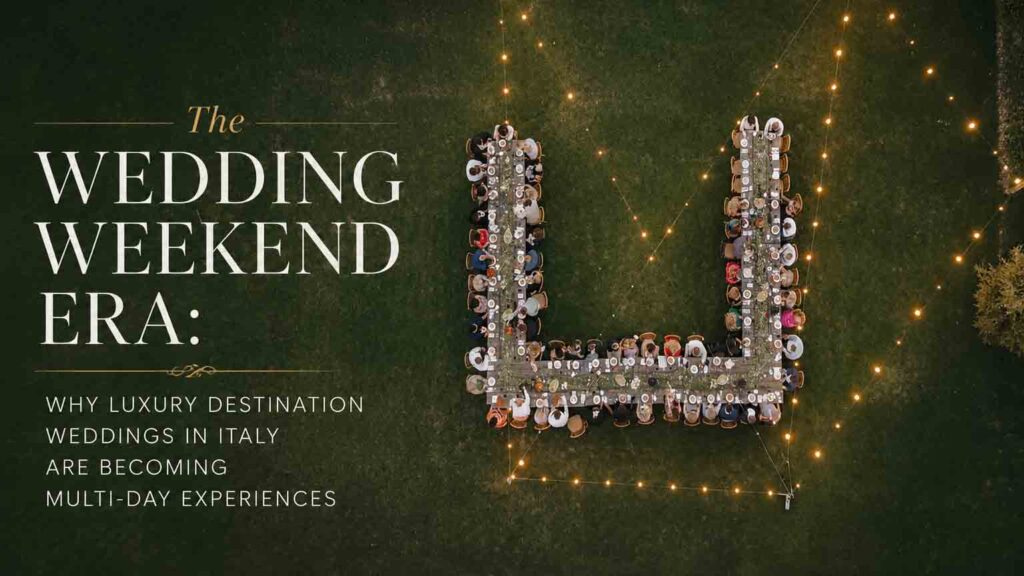
Lake Como is strongest when guests have time to understand it. A multi-day structure allows the destination to unfold gradually and reduces the pressure placed on a single wedding day. The welcome event can introduce the water and local atmosphere. The wedding can concentrate on ceremony and celebration. A farewell gathering can return the experience to conversation and connection.
This does not mean every event needs another major production. A smaller welcome aperitivo, boat gathering or relaxed dinner may create more value than a second formal reception. The objective is not to fill the itinerary. It is to give guests a rhythm that makes the journey feel worthwhile.
For couples considering a broader multi-day approach, Image Studio’s guide to luxury destination wedding weekends in Italy explains how welcome events, the wedding day and farewell gatherings can work as one complete story.
7.Plan photography, film and wedding content creation together
Lake Como produces many layers of visual memory: architecture, water, boats, fashion, family interactions, speeches, movement and the changing atmosphere of a multi-day celebration. Those layers are best protected when photography, filmmaking and wedding content creation are coordinated rather than treated as unrelated bookings.
The photographer needs time for refined portraits and unrepeatable documentary moments. The filmmaker needs movement, sound and continuity across the day. The wedding content creator focuses on immediate, vertical and behind-the-scenes material that can be delivered quickly. Each role has a different purpose, and none should compete for the same moment.
A shared production plan defines who leads during directed portraits, how ceremonies are covered without obstructing sightlines, where audio equipment can be placed, how boat movement is documented and which parts of the weekend require separate teams. This preparation is particularly important at villas with narrow terraces, compact docks or limited paths through gardens.
For couples building a modern visual team, see our guide to wedding content creation in Italy, which explains how rapid social-first content complements professional photography and cinematic film rather than replacing them.
8.A practical Lake Como planning sequence
| Stage | Priority | Lake Como-specific output |
| Before venue booking | Define guest count, privacy, region and accommodation strategy. | A shortlist based on geographic fit, not fame alone. |
| Venue review | Test weather plan, access, docks, sound limits and supplier routes. | A written operational map of the property. |
| Guest planning | Group accommodation and build transport around realistic door-to-door times. | One master movement schedule for the weekend. |
| Creative planning | Study light, ceremony orientation, portrait locations and visual transitions. | A shared plan for photography, film and content creation. |
| Final month | Confirm boats, cars, weather triggers, accessibility and supplier call times. | A decision tree for normal and contingency operations. |
| Wedding week | Reconfirm current timetables, traffic considerations and weather. | Final adjustments without rewriting the entire experience. |
9.Common Lake Como planning mistakes
Choosing a venue before choosing a guest strategy
The venue may be extraordinary, but the weekend becomes difficult if most guests cannot stay nearby or reach it comfortably.
Treating boats as decorative transport
A boat is part of the schedule. Capacity, luggage, footwear, weather, docking and boarding must all be considered.
Planning from map distance alone
The lake’s road shape and limited crossings mean physical proximity does not always equal quick travel.
Using a generic sunset time
Mountains and shore orientation change when direct light leaves a specific property.
Accepting an incomplete rain plan
A covered ceremony option is not enough if dinner, aperitivo, portraits and supplier operations cannot also move indoors.
Separating the visual teams
Uncoordinated photography, film and content creation can create duplicated direction, blocked views and unnecessary pressure on the couple.
Adding too many locations
A wedding weekend feels luxurious when it creates presence, not when guests are continually being transferred.
10.Explore the Lake Como wedding cluster
This guide should function as the planning hub for more specific Lake Como decisions. Relevant next resources include:
• Why Italy Remains the World’s Luxury Wedding Destination
• Top Lake Como Wedding Photographer Agencies
• Villa Balbiano Wedding Photographer Agencies
• Editorial Wedding Photography in Italy
• Luxury Wedding Films in Italy
• Wedding Content Creator Italy
11.Frequently asked questions
How far in advance should we plan a Lake Como wedding?
High-demand venues, hotels and creative teams are often selected well in advance, especially for peak-season weekends. The more complex the guest count, exclusivity requirements and multi-day programme, the earlier the geographic and accommodation strategy should be confirmed. Availability varies, so the useful answer is not a universal number but a sequence: secure the destination system first, then the individual details.
Which part of Lake Como is best for a wedding?
There is no single best area. The Como branch can simplify international access and hotel options; Tremezzina offers iconic villas and gardens; the central lake creates a powerful destination atmosphere. The best choice depends on guest accommodation, venue type, privacy, boat use and how many events will take place in different towns.
Are boats necessary for a Lake Como wedding?
No. Boats can create a memorable arrival and connect locations effectively, but they should be chosen for function as well as atmosphere. Some events work better with road transport, particularly in difficult weather or for guests with limited mobility. Many strong plans use a combination of private boats and vehicles.
What is the best month for a Lake Como wedding?
Late spring, summer and early autumn all offer distinct advantages. The right month depends on heat tolerance, daylight, garden character, hotel operations, rain planning and guest travel. Couples should evaluate a venue’s actual orientation and indoor plan rather than select a month only from general climate descriptions.
Should guests stay in one hotel?
A single hotel or a compact cluster of properties usually simplifies transfers and creates a stronger shared experience. It is not always possible for larger weddings, but the accommodation plan should avoid scattering guests across distant shores without a reliable transport system.
Do we need both a photographer, filmmaker and wedding content creator?
Not every couple needs all three, but they perform different roles. Photography creates a lasting still-image archive; filmmaking preserves movement, sound and narrative; wedding content creation provides immediate vertical and behind-the-scenes material. When all three are booked, they should work from one coordinated plan.
What should a Lake Como rain plan include?
It should include the ceremony, aperitivo, portraits, dinner, entertainment, guest circulation and supplier operations. The alternative layout should still feel intentional and should comfortably support the full guest count. Couples should also define who makes the weather decision and when it becomes final.
12.The lake rewards coherence
Lake Como does not need to be made spectacular. Its water, mountains, villas and gardens have already established the visual world. The task is to make the celebration belong inside that world without allowing logistics to break its rhythm.
That requires restraint as much as ambition. Fewer unnecessary transfers. A venue selected for how it functions, not only how it appears. A complete weather plan. A visual team involved early enough to understand light, movement and access. A weekend that gives guests time to experience the destination rather than continually travel through it.
When those decisions are made well, the result feels effortless. Guests remember the approach to the villa, the quiet of the water before the ceremony, the conversations that continued after dinner and the sense that every part of the celebration belonged to the same place.
That is the real promise of Lake Como. Not simply an iconic background, but a destination capable of shaping the entire wedding story.
Planning a Lake Como Wedding
A Lake Como celebration becomes most convincing when the venue, guest movement, light, transport and visual team are considered as one connected plan. If you are exploring a wedding on the lake, Image Studio can help you shape the photography, film and wedding content around the rhythm of the destination rather than treating them as separate services.
Explore Image Studio’s Lake Como wedding photography and filmmaking approach, or begin a conversation about your plans.